Shaughnessy garage doors don’t fit the standard catalogue. The streets here — First, Second, Third Shaughnessy — were laid out by the CPR on a curving grid that follows the land, and the homes sit on oversized lots with long private driveways. Many of those driveways end at detached coach houses built before 1940. The openings are wider and taller than anything you’ll find at a big-box store, often framed in original timber with carriage-style detailing that the heritage conservation area in First Shaughnessy requires you to match. You can’t just order a 16-by-7 and call it done.
Garage Door Repair Shaughnessy — Heritage Openings and Coach-House Geometry
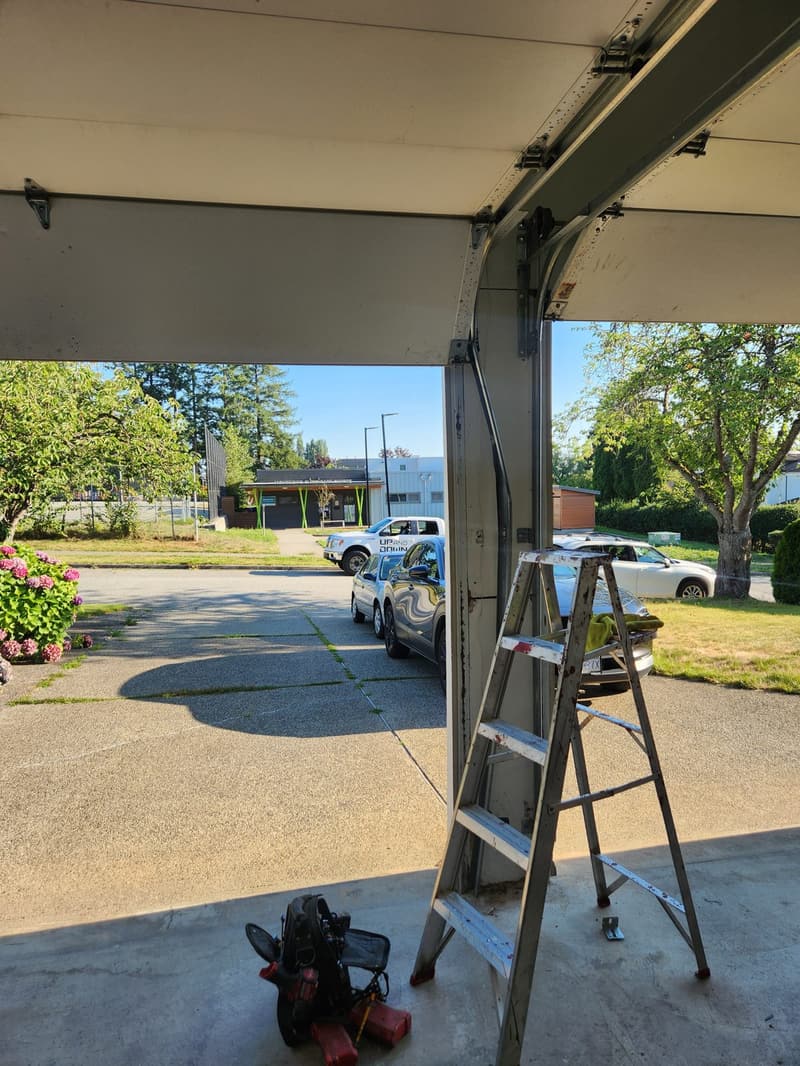
The coach houses on The Crescent and the side streets off Granville and Oak were built for carriages, then adapted for early automobiles. The headers are often solid timber, not doubled 2x12s, and the jambs can be irregular after eighty years of settling. We measure every opening three ways — width at top, middle, bottom; height left, centre, right — because a stock section will bind or gap. Custom carriage doors mean custom radius track, heavier gauge hinges, and springs calculated for the actual door weight, not a nominal size. If the original detailing has to stay visible from the street, we build the new door to replicate the panel layout, moulding profile, and hardware locations. The heritage board notices when you don’t.
Spring Calculations on Heavy Carriage Doors
A solid Douglas-fir carriage door twelve feet wide and eight feet tall weighs three hundred pounds before you add glass, insulation, or decorative hardware. Standard torsion springs rated for a hollow steel section will cycle maybe two thousand times on that weight — less than two years for a daily driver. We spec oil-tempered wire on a larger inside diameter, often a dual-spring assembly with a centre bearing plate anchored into the header. The cable drums match the door height so the cables stack clean. When we replace springs on these doors, we’re not swapping parts; we’re recalculating the whole counterbalance system. The price table below reflects the labour and hardware that job actually takes.
| Repair Type | Typical Range | Avg. Time |
|---|---|---|
| Torsion Spring Replacement (1 spring) | $189 – $289 | 45–60 min |
| Torsion Spring Replacement (2 springs) | $269 – $389 | 60–75 min |
| Cable Replacement (pair) | $149 – $229 | 45–60 min |
| Roller Replacement (full set) | $129 – $199 | 30–45 min |
| Off-Track Repair | $129 – $249 | 30–60 min |
| Opener Repair (labour + common parts) | $149 – $299 | 45–90 min |
| Opener Replacement (supply & install) | $349 – $599 | 60–90 min |
| Annual Tune-Up & Safety Inspection | $89 – $119 | 45 min |
Getting to You from Richmond
We run out of 12180 Horseshoe Way in Richmond — 20–35 minutes from our Richmond shop (about 18.7 km) via Knight Street Bridge and Granville or Oak, depending on traffic. The route puts us on the flank arterials that border Shaughnessy, so we’re not cutting through school zones or playground streets. If you’re on The Crescent or one of the interior curves off 33rd or 41st, we know the turning radius the truck needs at the end of a long private drive. We’ll park on the street if the driveway’s tight and walk the tools in. No surprise fees for access.
Heritage Conservation Area Constraints
First Shaughnessy’s heritage conservation area means any change visible from the street — door face, hardware, operator rail, even the colour — can trigger a review. We’ve worked with the city’s heritage planners enough to know what passes without a hearing: replicate the existing panel pattern, match the moulding profile, keep the original hinge and handle locations, use a low-profile opener rail that sits behind the top section. If the coach house is a protected building, we document the existing condition before we touch it. That documentation saves weeks if the board asks questions. We don’t guess; we ask the planner first.
Track and Hardware for Non-Standard Radii
Stock radius track assumes a standard lift and a twelve-inch radius. Coach houses often need low-headroom track with a six-inch radius, or high-lift track that runs the horizontal back into the loft space. The flag brackets have to lag into old-growth timber, not modern framing — we pre-drill and use structural screws, not lag bolts that split the grain. Hinges are heavy-gauge, numbered for each panel position so the door tracks true. Rollers are eleven-ball nylon on a seven-sixteenths stem, not the ten-ball hardware-store version. Every piece is rated for the door’s actual weight and cycle count.
Opener Selection on Tall, Heavy Doors
A half-horsepower chain-drive opener will stall on a three-hundred-pound carriage door at the first cold snap. We spec belt-drive units with DC motors, soft start and stop, and a torque curve that handles the breakaway force. The rail has to be solid steel, not the perforated angle that flexes on a twelve-foot door. Battery backup matters here — power goes out on the big lots when a single tree takes the line. We mount the control panel inside the coach house, not on the exterior jamb where heritage rules might flag it. Safety eyes go at six inches, not the standard four, because the threshold often steps up.
Annual Maintenance on Heritage Hardware
Original hardware — strap hinges, lift handles, slide bolts — wasn’t built for modern cycle counts. The annual tune-up we do here includes lubricating every pivot point with synthetic grease, checking the cable drum alignment, testing the spring balance at three points in the travel, and tightening every lag screw into the timber header. We inspect the weather seal on the bottom section; the original threshold often settles uneven, so we trim the astragal to match the gap. If the heritage hardware is seized, we free it and adjust rather than replace, unless the piece is cracked. That’s the $89–$119 visit. It catches the failures before they happen on a Monday morning.
Frequently Asked Questions
Can you match the original carriage-door panels and hardware on a heritage coach house?
Yes. We measure the existing panel layout, moulding profile, and hardware locations, then build the new sections to replicate them. The heritage board in First Shaughnessy typically accepts this without a hearing when the visual match is documented.
Do you handle the heritage permit process if the door face changes?
We prepare the existing-condition photos, drawings, and material specs the city asks for. Most coach-house door replacements in the conservation area are accepted as maintenance when the appearance is unchanged. If a review is required, we supply the documentation your planner needs.
What spring life should I expect on a heavy custom carriage door?
With properly sized oil-tempered dual springs, twenty-five thousand cycles — roughly fifteen to twenty years at three cycles a day. Undersized springs on a three-hundred-pound door fail in two to three years. We calculate the spring for the actual weighed door, not the nominal size.