

What fails most on Vancouver garages and why
Lane-access garages are the defining constraint in Vancouver. A narrow rear lane, a 7-foot-wide opening cut in the 1920s, and an opener hung on header brackets that were never designed for the load — that is the typical job site from Dunbar to Renfrew-Collingwood. The door itself is often a 1950s wood section or a 1980s steel sandwich panel that has outlived its hardware twice over.
Salt air off the inlet accelerates spring corrosion. The wet season swells wooden frames and jams tracks. A torsion spring rated for 10,000 cycles reaches its limit in five to seven years on a two-car household where each driver opens the door four times a day. Extension springs on older single-car doors fail sooner because the geometry pulls them past their safe stretch on a low headroom track.
We see the same failure modes repeatedly: cracked nylon rollers that bind in cold weather, cables that fray against worn drum grooves, photo-eyes knocked out of alignment by a garbage bin, and openers that reverse because the force limit was never recalibrated after the door was rebalanced.
Springs — what breaks and what replaces it
Torsion springs on a standard-lift residential door in Vancouver usually sit on a 1-inch solid shaft with a single spring for doors up to 10 feet wide, or a pair for wider openings. The wire size, inside diameter, and relaxed length must match the door weight within 5 percent. Guessing by eye is how you get a spring that relaxes in two years or one that overpowers the opener and strips the drive gear.
Extension springs on pre-war single-car garages in Kitsilano and Point Grey run alongside horizontal tracks with a pulley at each end. The safety cable through the center of each spring is not optional — it contains the spring when it snaps. Without it, the broken coil becomes a projectile inside a garage that is often only 18 feet deep.
We use oil-tempered wire, color-coded to DASMA standards, and we wind to the manufacturer’s specified turn count. A 7-foot door with a 200-pound weight typically takes a .225-inch wire, 34-inch relaxed length, 10,000-cycle spring. The same door with a high-lift track for storage above the opener needs a different inside diameter and more turns. We calculate it on site with a calibrated scale, not a chart.
Cables, drums, and the lane-effect wear pattern
Cables fail at the bottom bracket where the loop wraps around the pin, and at the drum where the groove wears a flat spot. On lane-access garages, the approach angle often forces the door to bind on one side during the last foot of travel. That side takes extra tension every cycle. The cable stretches, the drum groove wears uneven, and the door starts to cock in the opening.
We replace cables in pairs. Mixing a new cable with a three-year-old one puts different stretch characteristics on each side. Drums get replaced when the groove depth exceeds 0.015 inch or when the set-screw flats are rounded. On older doors with 400-series drums, we upgrade to 525-series if the shaft diameter allows — wider groove, longer cable life.
Openers — chain, belt, and the retrofit problem
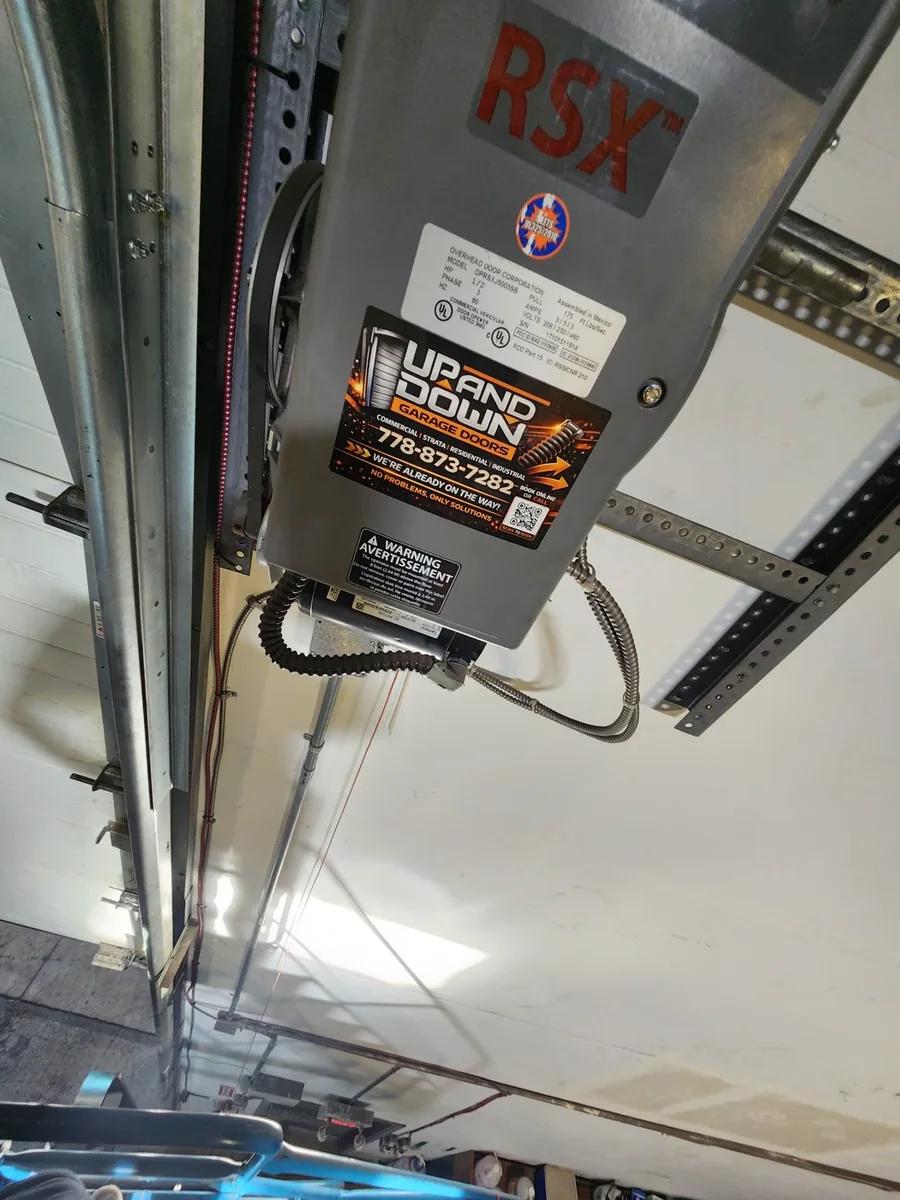
A 1920s garage in Dunbar or Kerrisdale typically has a 6-foot-6 header and 4 inches of headroom. A standard drawbar opener needs 12 inches. The fix is a jackshaft opener mounted beside the torsion tube, or a side-mount residential unit with a low-headroom rail. Both cost more than a ceiling-mount unit. Both install in half the time because they do not require reinforcing the ceiling joists.
Chain-drive openers last 12 to 15 years in this climate. Belt-drive units run quieter — important when the bedroom is above the garage — but the belt stretches in humid summers and needs a tension adjustment at the two-year mark. Screw-drive openers collect grit in the rail and bind by year three. We do not install them.
Smartphone connectivity is standard on current models. The feature that matters is battery backup. A power outage during a winter storm leaves a 200-pound door locked in place without it. The backup battery is a 12-volt 5Ah sealed lead-acid cell. It lasts two to three years. We replace it during the annual tune-up.
Rollers, hinges, and track — the quiet door
Nylon rollers with sealed ball bearings roll on 10-ball or 13-ball races. Steel rollers on a residential door are a noise complaint waiting to happen. Thirteen-ball nylon rollers on a 14-gauge hinge last 15,000 cycles in Vancouver’s wet-dry cycling. The hinge gauge matters: 14-gauge on the top two hinges, 13-gauge on the intermediates, 11-gauge on the bottom bracket where the cable tension pulls hardest.
Track alignment is the most overlooked adjustment. Horizontal tracks must run level within 1/16 inch over 12 feet. Vertical tracks must be plumb. The flag bracket — where vertical meets horizontal — carries the full door weight in the transition. A loose lag bolt there moves the track 1/8 inch under load. That is enough to pop a roller out of the groove.
We check track brackets on every service call. A 3/8-inch lag into a 2×4 header holds 250 pounds in shear. A 3/8-inch lag into old-growth fir holds 400. Into a rotted 2×4, it holds zero. We probe the wood with an awl before we trust the bracket.
Weather seals — bottom, sides, and top
The bottom astragal on a steel door is a U-shaped vinyl retainer with a T-insert. On a wood door it is a nail-on rubber sweep. Both harden after three Vancouver winters. The side and top seals — PVC stop molding with a flexible vinyl flap — shrink and pull away from the door face. A 1/4-inch gap at the top corner admits enough driven rain to wet the opener motor.
We install dual-durometer seals: rigid PVC base, flexible TPE flap. The flap stays pliable to -30°C. The bottom insert is a hollow-bulb design that compresses 50 percent without taking a set. On uneven concrete floors we add a threshold seal — aluminum channel with a vinyl bulb — that the door compresses against. It stops the wind tunnel effect when the lane funnels a southeast gust down the alley.
What you can check safely before you call
Disconnect the opener. Pull the red emergency release handle. Lift the door manually. It should move smoothly, stay at waist height when you let go, and require no more than 15 pounds of force to raise or lower. If it flies up or crashes down, the spring is wrong for the weight. If it binds or catches, a roller or track is the problem.
Look at the cables. No frayed strands, no kinks, no rust at the bottom bracket. Check the rollers. Spin each one with your finger. It should turn freely for two full rotations. A roller that stops in half a turn is seized.
Shine a flashlight at the photo-eyes. Both LEDs should be solid, not blinking. Wave a broom handle through the beam while the door is closing. It must reverse instantly. If it does not, the eyes are misaligned or the logic board has failed.
Do not remove the bottom bracket. Do not unwind a torsion spring. Do not disconnect a cable while the spring is wound. The stored energy in a wound torsion spring on a 16-foot door exceeds 300 foot-pounds. It will take fingers off at the knuckle. We have seen it. You do not want to be the next case.
What a service call involves
We arrive with a calibrated spring scale, a torque wrench, a full assortment of oil-tempered springs, cables, rollers, hinges, drums, bearings, and two opener models in the truck. The first 20 minutes are diagnosis: weigh the door, measure the spring, inspect every moving part, test the opener force limits and safety reversal.
You get a verbal summary and a written quote before any part is replaced. Springs, cables, and rollers are priced per piece. Opener replacement is a flat rate that includes the unit, rail, hardware, programming, and battery backup. Track realignment is time-and-materials if the wood is sound; if brackets need new lumber, we quote the carpentry separately.
Most single-spring torsion jobs finish in 90 minutes. Two-spring conversions take two hours. Opener swap with low-headroom rail takes three. We clean the track, lubricate bearings and rollers with PTFE spray, tighten every lag and set-screw, and run the door through 10 full cycles before we leave.
What drives cost — general trade factors
Door weight is the first variable. A 16-foot insulated steel door weighs 280 pounds. The same opening in a 1920s wood door weighs 350. Heavier door means larger wire, longer spring, higher material cost. Spring cycle rating is the second. A 25,000-cycle spring costs 40 percent more than a 10,000-cycle unit but lasts two and a half times longer on a busy household.
Opener type is the third. Jackshaft units cost more than ceiling-mount chain drives. Low-headroom rail adds material. Smart module is included on current models but the first year of cloud service is sometimes a separate subscription.
Access is the fourth. A lane-access garage with a parked car blocking the approach adds 30 minutes of shuttling tools. A garage packed to the ceiling with storage adds an hour of clearing space to reach the torsion tube. We do not charge for the walk-in, but we do charge for the time the technician spends moving your boxes.
Maintenance that prevents the local failure modes
Twice a year — March and October — wipe the track clean with a rag. Do not use grease. Grease collects grit and becomes grinding paste. Spray PTFE lubricant on roller bearings, hinge pins, torsion shaft bearings, and the spring coils themselves. A light coat on the spring reduces the metal-on-metal chirp and slows corrosion.
Check the bottom seal in October. If the vinyl is cracked or the retainer is bent, replace it before the November rains. Test the photo-eyes monthly. Clean the lenses with a microfiber cloth. A film of road dust from the lane cuts the beam strength by 40 percent.
Tighten the opener chain or belt once a year. A sagging chain jumps the sprocket teeth under load. A loose belt slips on the drive pulley. Both sound like a grinding noise that the homeowner describes as “the opener is dying.” It is usually a 90-second adjustment.
Neighbourhood by neighbourhood — what changes
Dunbar — Pre-war character homes on 33-foot lots. Detached garages at the rear lane, single-car openings, 6-foot-6 headers. Most doors are 1970s wood sections retrofitted with chain-drive openers on standard rails that hit the header. Jackshaft conversion is the clean fix.
Kerrisdale — Similar stock to Dunbar but wider lots allow some double-car garages. The 1920s homes often have original fir frames that are sound. The 1950s infill has narrower lanes and tighter approaches. Cable wear on the driver’s side is the tell.
Marpole — Mix of 1940s wartime housing and 1980s duplexes. The wartime homes have 7-foot doors on low-headroom track. The duplexes share a driveway but have separate garages — each door sees half the cycles but the same salt air. Springs fail on calendar time, not cycle count.
Kitsilano — Dense, pre-1940 housing. Lane garages dominate. Many openings are 6-foot-8 or 7-foot even — non-standard heights that require custom-cut sections or a frame-out. Retrofit openers are almost universal. Photo-eyes get knocked by recycling bins weekly.
Mount Pleasant — 1910s Craftsman bungalows and 1960s Vancouver Specials. The Specials have integral front garages with 16-foot double doors. Those doors run standard-lift track with room for a ceiling-mount opener. Torsion springs on the double doors are usually a pair of .250-inch wire, 37-inch length.
Renfrew-Collingwood — Post-war bungalows and 1970s split-levels. Wider lanes, more headroom. Standard 7-foot-6 or 8-foot openings. Failures are straightforward wear — springs at cycle life, rollers at 12 years, openers at 14.
Killarney — 1960s-70s development on a grid. Detached garages, standard 8-foot headers, 16-foot double doors common. The only oddity: some original builders used extension springs on double doors to save header space. We convert to torsion on the first major repair.
Point Grey — Large pre-war homes, some with carriage houses converted to garages. Openings range from 7-foot single to 18-foot custom double. High-lift track is common to clear storage lofts. Springs need extra turns and a larger inside diameter. Drums are often 525-series from the factory.
Getting to Vancouver from our shop
From Horseshoe Way we run north up No. 5 Road or Highway 99 and cross on the Oak Street Bridge for Marpole, Kerrisdale, Dunbar and the west side. The bridge deck carries four lanes and a separated bike path; morning peak adds ten minutes but the route is direct. When the job is toward Mount Pleasant, Renfrew-Collingwood or Killarney we take the Knight Street Bridge instead. The Knight crosses the North Arm at a lower elevation — fog sits on the deck later in the season — and the approach funnels through Marine Drive traffic. Point Grey and Kitsilano sit between the two bridges; we choose Oak or Knight depending on which lane the job sits off.
Frequently asked questions about garage doors in Vancouver
Who repairs garage doors in Vancouver for lane-access garages? We do. Lane-access garages with low headers and tight approaches are the most common job site we see in the city. Jackshaft and low-headroom openers are standard inventory on our trucks.
What causes garage door springs to break in Vancouver’s climate? Salt air accelerates surface corrosion on the wire. Wet-dry cycling works micro-cracks into the oil temper. A 10,000-cycle spring reaches its limit in five to seven years on a typical two-car household. We install 25,000-cycle springs as our baseline.
Can you install an opener on a 1920s garage with a 6-foot-6 header in Kitsilano? Yes. A standard drawbar opener needs 12 inches of headroom. We install a jackshaft opener beside the torsion tube or a side-mount residential unit with a low-headroom rail. Both fit in 4 inches.
How much does a garage door spring replacement cost in Vancouver? We do not publish prices. Cost depends on door weight, spring cycle rating, single versus double spring, and whether the drums and cables need replacement at the same time. We quote verbally on site after weighing the door.
Do you replace weather seals on wood garage doors in Point Grey? Yes. We install nail-on rubber sweeps for the bottom and dual-durometer PVC stop molding for the sides and top. The flexible TPE flap stays pliable through Vancouver winters.
What maintenance should I do before the rainy season in Vancouver? Clean the tracks with a rag — no grease. Spray PTFE lubricant on roller bearings, hinge pins, shaft bearings, and spring coils. Check the bottom seal for cracks. Clean the photo-eye lenses. Test the reversal with a broom handle.
Will my garage door work during a power outage in Vancouver? Only if the opener has a battery backup. The backup is a 12-volt 5Ah sealed lead-acid cell that lasts two to three years. We replace it during the annual tune-up. Without it, a 200-pound door is locked in place.