

What breaks first on a Coquitlam garage door
Coquitlam is really two cities stacked vertically. The older neighbourhoods along the Barnet Highway corridor — Maillardville and Austin Heights — have houses built in an era when a single-car garage was enough and a torsion spring was expected to last twenty years. Up on Burke Mountain and Westwood Plateau, the houses are new enough that the builder-installed opener is still under warranty and the conversation is about upgrades, not repairs.
The failure mode changes with the elevation. Down low, you get tired hardware. Up high, you get cold.
Maillardville’s narrow openings
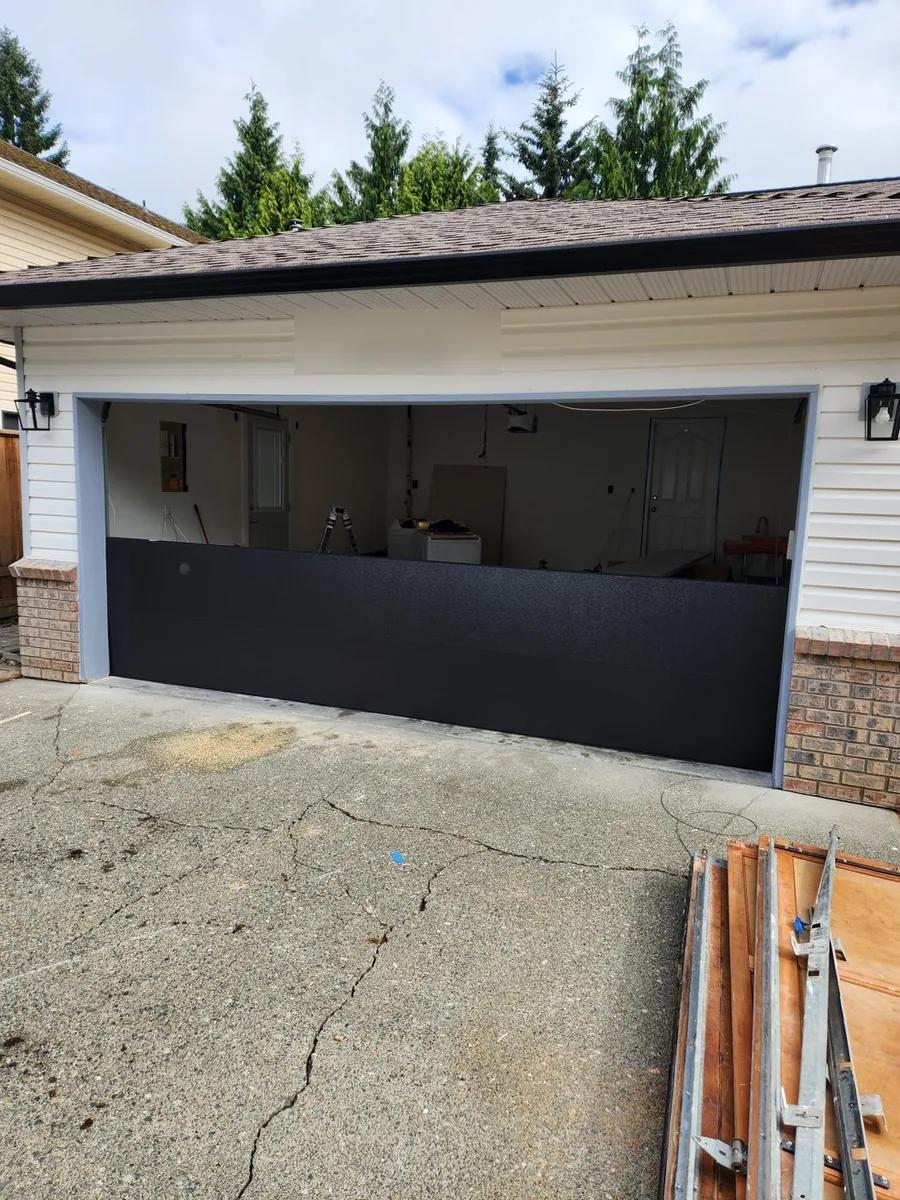
Maillardville was founded in 1909 by French-Canadian mill workers. The houses from that period — and through the 1940s — were built with garage openings that do not match modern standard sizes. A replacement door for a Maillardville house almost always requires custom fabrication. Off-the-shelf 8-by-7 or 9-by-7 doors will not fit without framing modifications.
If you own one of these older homes and the door is original or a retrofit from the 1970s, the tracks are likely undersized and the springs are matched to a lighter door than anything sold today. Replacing just the door panel without re-springing the system will give you a door that either slams down or struggles to lift. The correct approach is a full replacement — springs, cables, track, and opener — sized to the actual opening.
Austin Heights: the 40-year hardware wall
Austin Heights was built mostly in the 1970s and 80s. Those houses are now 40 to 50 years old, which is exactly the service life of a residential torsion spring system under normal use. If your house in Austin Heights still has its original garage door hardware, you are running on borrowed time.
The springs are the first thing to go. A torsion spring is rated for a specific number of cycles — typically 10,000 to 15,000 for a standard residential spring. At two to four cycles per day, that is seven to fifteen years. If your springs are original to a 1980s house, they have been cycled well past their design life. They will snap eventually. When they do, the cable unwinds, the door drops, and whatever is under it gets damaged.
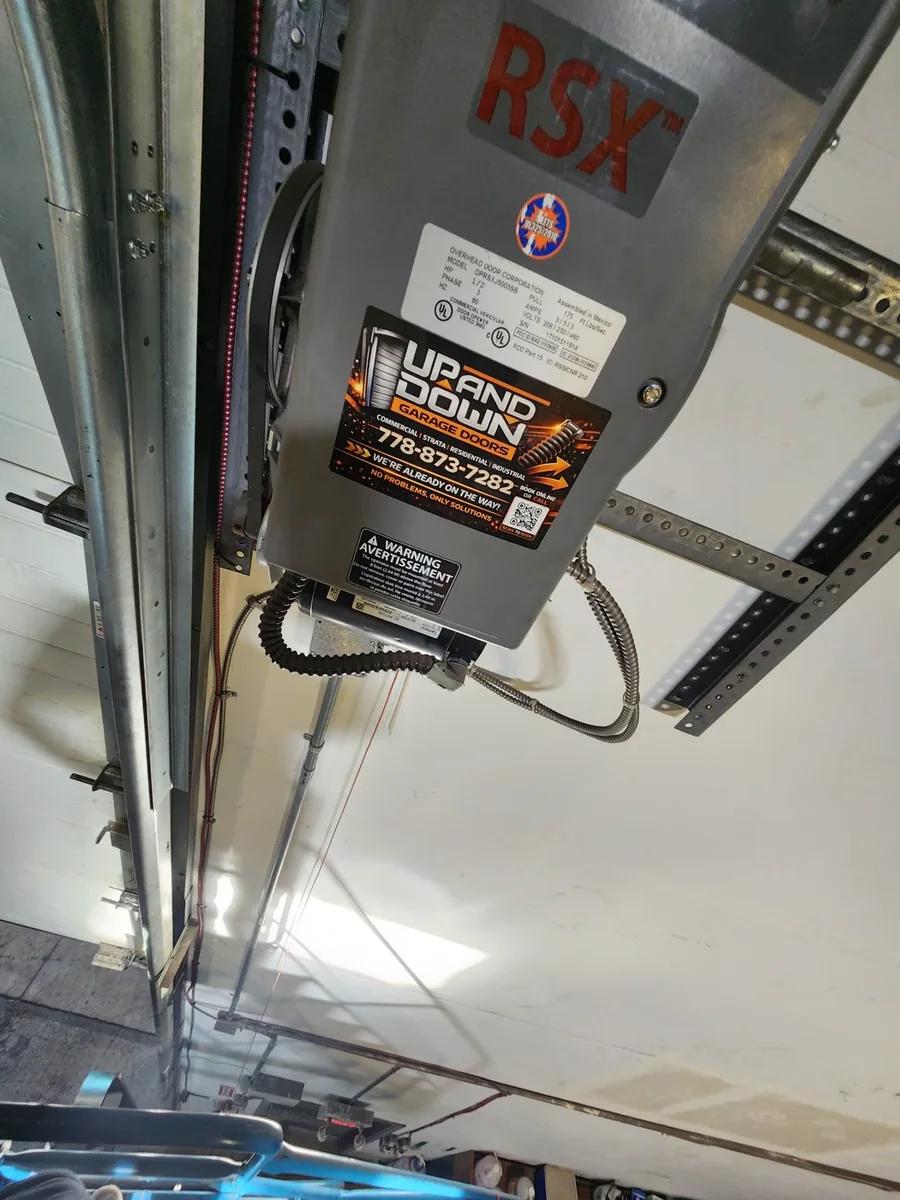
The openers from that era are also a problem. Chain-drive openers from the 1980s and 90s lack the safety features required by modern code — photo eyes, auto-reverse, entrapment protection. If you still have one, replace it. Not because it broke. Because it is unsafe.
Burke Mountain: warranty and upgrade
Burke Mountain is Coquitlam’s newest neighbourhood, built mostly after 2008. The houses are larger, the garages are double or triple, and the household income is the highest in the city. The doors and openers are still under the builder’s warranty.
This creates a different kind of service call. The door is not worn out. It was never adjusted properly in the first place. Builder-installed doors are often set up for speed, not accuracy — the spring tension is close but not exact, the track brackets are snugged but not torqued, the opener limits are set to make the door close, not to make it close right. A door that reverses two inches off the floor, or one that bangs when it reaches the stop, is usually a limit-and-force adjustment issue, not a parts failure.
The other common Burke Mountain call is the homeowner who wants to upgrade before the builder-grade opener fails. A belt-drive opener is quieter than the chain-drive unit that came with the house. A wall-mount opener frees up ceiling space. A lift master with battery backup keeps working when the power goes out — and on Burke Mountain, power outages from wind or snow are more common than in the valley.
Westwood Plateau: cold and steep
Westwood Plateau sits high enough that it holds snow longer than any other part of Coquitlam. That matters for garage doors because cold changes the behaviour of every component.
Grease stiffens. Nylon rollers become brittle and crack. Steel cables lose flexibility and are more likely to fray where they ride over the bottom bracket. The torsion spring’s steel gets harder and more likely to snap on a cold morning, especially if it was already near the end of its cycle life.
The other Westwood Plateau issue is the driveway. Many of these houses have steep, long driveways that slope down to the garage. Water runs under the door seal, freezes on the concrete, and lifts the bottom seal or bows the bottom panel. A rubber bottom seal rated for -40°F is the right choice here, not the standard vinyl seal that goes stiff at freezing.
Eagle Ridge: the middle ground
Eagle Ridge sits between the older valley floor and the new developments above. The housing stock is mixed — some 1990s builds, some early 2000s, some recent infill. The garage door problems here are the standard suburban mix: opener failure from age and use, weather seal deterioration, track misalignment from the settling that happens in the first decade after construction.
What Eagle Ridge does have is a lot of townhouse and duplex configurations with shared garage walls. That means sound transmission matters. A chain-drive opener in a townhouse vibrates through the shared wall. A belt-drive or wall-mount opener is quieter and keeps the neighbours from hearing every open and close.
Getting to Coquitlam from our shop
We run out of our shop via Highway 91 to Highway 1 east. From there, the route splits. If the job is in Maillardville or Austin Heights, we take the Mariner Way exit and cut across. For Burke Mountain or Westwood Plateau, we stay on Highway 1 to the Como Lake Avenue exit and climb from there.
The climb to Burke Mountain and Westwood Plateau adds time to the drive, especially in winter when the upper roads can be icy or snow-covered. That is geography, not a complaint. We schedule those jobs accordingly.
What a torsion spring replacement actually involves
A torsion spring replacement is not a parts swap. It is a re-engineering of the door’s balance. The old spring has a specific wire size, inside diameter, and length that matched the door’s weight when it was installed. If the door has been repainted, had insulation added, or had a different panel installed, the weight has changed and the spring needs to be recalculated.
The technician measures the door’s weight with a spring scale, calculates the correct spring rate, and installs a spring matched to the actual door, not to what the door was when it left the factory. Then the spring is wound to the correct number of quarter-turns — not a guess, not “tight enough to lift it,” but the exact number of turns that balances the door at the halfway point so it stays put when you let go.
This is not a DIY job. A torsion spring under load stores enough energy to break an arm or take off fingers. The tools used to wind it — winding bars — are simple steel rods, but if one slips out of the cone, the spring unwinds instantly. Leave this to someone who does it daily.
Cable repair: why one side breaks before the other
A garage door cable breaks because the spring on that side lost tension first, or because the cable was rubbing against a bracket, or because the bottom bracket shifted and the cable came off the drum. The most common cause is uneven spring wear — one spring fatigues slightly faster than the other, the door starts to lift crooked, and the cable on the tight side takes more load until it snaps.
When a cable breaks, both cables should be replaced. Replacing one leaves the other with the same age and wear pattern, and it will snap within a year. The springs should be checked at the same time, because the broken cable was a symptom of a spring problem, not the problem itself.
Opener failure: what actually goes wrong
Residential garage door openers fail in predictable ways. The logic board burns out from a power surge. The gears strip from wear — nylon gears in particular, which are designed to be the sacrificial part so the motor does not burn up. The safety sensors get knocked out of alignment by a bump from a car or a broom, and the door refuses to close.
Most opener problems are not motor failure. The motor is a simple AC or DC unit that either runs or does not. If the motor runs but the door does not move, the gears are stripped. If the motor does not run at all, check the power supply and the logic board. If the opener runs but the door reverses immediately, the force setting is too low or the sensors are misaligned.
A good technician can diagnose this in under two minutes. The fix is usually a gear kit, a logic board replacement, or a sensor realignment. Full opener replacement is needed when the motor bearings are seized, the circuit board is unrepairable, or the unit is old enough that replacement parts are no longer made.
Rollers and tracks: the noisy door
A door that rattles, shakes, or sounds like it is going to jump the track has a roller or track problem. Nylon rollers wear faster than steel rollers but are quieter. In a cold garage on Westwood Plateau, nylon rollers crack and fail sooner than they would in a heated shop. Steel rollers last longer but transmit more vibration through the track to the brackets and the framing.
Track problems are usually alignment issues. A track that is bent, twisted, or not parallel to the door panel will bind as the door moves. The fix is to loosen the track brackets, align the track to the door’s path, and retighten. If the track is actually damaged — crushed or bent out of shape — it needs to be replaced, not adjusted.
Weather seals: the one thing you can fix yourself
The bottom weather seal on a garage door is a simple replaceable part. It slides into a channel on the bottom panel. If it is cracked, torn, or flattened, pull it out and slide a new one in. The same goes for the side and top seals, which are held in place with nails or screws.
This is the one garage door repair that is genuinely a DIY job. No tension, no risk, no special tools. The only trick is getting the right seal profile. There are about a dozen different shapes — bulb, T-channel, beaded, and so on. Take a photo of the old seal or cut a short piece to bring to the supplier.
What a service call looks like
When we arrive at a Coquitlam house, the first thing we do is test the door manually. We disconnect the opener and lift the door by hand to feel the balance. If it is heavy, the springs are weak or broken. If it binds, the track is misaligned or the rollers are worn. If it drops, the spring tension is wrong.
Then we cycle the door on the opener and watch the travel. We check the reverse sensitivity — the door should reverse within two seconds of hitting a one-and-a-half-inch block on the floor. We check the photo eyes for alignment and cleanliness. We look at the cables for fraying, the springs for gaps or rust, the track brackets for loose bolts, and the rollers for wear.
We tell you what is failing, what will fail next, and what can wait. Then we give you the price and let you decide.
Maintenance that actually matters
Most garage door maintenance advice is too vague to be useful. Here is what actually matters for a Coquitlam door:
- Lubricate the springs and bearings once a year, in late fall, with a silicone-based spray. Do not use WD-40 — it is a solvent, not a lubricant, and it will wash the grease out of the bearings.
- Check the cables for fraying every time you change the oil in your car. If you see broken strands, call for a replacement before they snap.
- Test the auto-reverse monthly. Put a piece of wood on the floor under the door and close it. If it does not reverse, adjust the force setting or replace the opener.
- Clean the photo eyes with a dry cloth. Spider webs and dust are the most common cause of a door that refuses to close.
- Tighten the track brackets. They loosen over time from vibration, and a loose bracket allows the track to shift.
Frequently asked questions about garage door repair in Coquitlam
How much does garage door repair cost in Coquitlam?
The cost depends entirely on what is broken and what door you have. A limit-and-force adjustment on a Burke Mountain builder-installed opener is a quick call. A full torsion spring replacement on a Maillardville custom door takes longer and costs more. We quote the price before any work starts, and the quote is the price.
Who repairs garage doors in Coquitlam on weekends?
We do. Weekends are when most homeowners have time to deal with a broken door, so we schedule service calls seven days a week. The same technicians, the same rates, no weekend upcharge.
How long does a garage door spring last in Coquitlam?
A torsion spring lasts 10,000 to 15,000 cycles. At two cycles per day, that is about seven to ten years. At four cycles per day, it is three to five years. The springs on a Westwood Plateau door may fail sooner in cold weather because the steel becomes more brittle at low temperatures.
Can a garage door be repaired in Coquitlam in winter?
Yes. Cold weather makes the work harder — the metal is colder, the grease is stiffer, and the technician is working in a cold garage — but the repair itself is the same. The one thing that changes is that we schedule more time for jobs on Burke Mountain and Westwood Plateau in winter because of the drive and the conditions.
What is the most common garage door problem in Coquitlam?
The most common call is a door that will not close. The cause is almost always misaligned photo eyes, a blocked sensor, or a limit setting that drifted. The second most common call is a broken spring, which is seasonal — more springs break in cold weather than in warm weather.
Do I need to replace both springs if one breaks?
Yes. Always. Springs are sold in matched pairs. If one broke, the other is the same age and has the same number of cycles on it. It will break within months. Replacing both at once costs less than two separate service calls.
How do I know if my garage door opener is safe?
Test the auto-reverse. Place a one-and-a-half-inch block of wood on the floor under the centre of the door. Close the door. If it does not reverse within two seconds of hitting the block, the opener is unsafe and needs adjustment or replacement. If your opener was made before 1993, it likely does not have photo eyes at all and should be replaced.
Next step
If your Coquitlam garage door is acting up, call us. We will ask what it is doing, what neighbourhood you are in, and what kind of door you have. Then we will schedule a time to come look at it.
Also worth a look: new garage door installs in Coquitlam.