

What fails most on Delta garage doors and why
The wind off the Strait of Georgia hits Ladner, Tsawwassen and Beach Grove straight on. West-facing doors take driven rain and salt-laden air every winter. Bottom seals rot in two seasons. Hinge points and bearing plates rust faster than they do inland. Rollers seize from grit that blows in off the dyke roads. In North Delta and Sunshine Hills, the problem is age — 1970s and 80s subdivisions where the original torsion springs are on their second or third cycle life, and the openers were installed when “chain drive” was the only option. Sunshine Hills adds slope: doors on sloped driveways see uneven cable wear because the track alignment shifts as the house settles.
Getting to Delta from our shop
Straight down Highway 99 through the George Massey Tunnel for Ladner, Tsawwassen and Beach Grove — one of the shortest runs we make, since the tunnel is just south of our shop. North Delta and Sunshine Hills are easier via Highway 91, cutting across the Annacis Island interchange. The tunnel route is predictable outside rush hour; the 91 route avoids the tunnel entirely but adds a few kilometres. Either way, we know which neighbourhoods sit where, so the right parts are on the truck before we leave.
Torsion spring replacement on Delta doors
A standard two-car door in Ladner or Tsawwassen runs 16 feet wide and weighs 180–220 pounds with insulation. The original springs on most 1980s builds were 10,000-cycle units. At four cycles a day — two cars leaving, two returning — that is seven years. Most are past 20. When one spring snaps, the door will not move. The opener trolley clicks but the door stays put. We replace both springs as a matched pair, upgraded to 25,000-cycle wire, and reset the cable drums so the lift is even. On older single-car doors in North Delta, the spring cone often seizes to the shaft. That adds time but not complexity — we bring the puller.
Cable repair and why it fails faster near the water
Salt air accelerates corrosion inside the cable strands where you cannot see it. A cable that looks intact on the outside can have a frayed core. The first sign is usually a door that hangs crooked — one side lower than the other — or a loud snap followed by a door that will not open at all. On Beach Grove and Tsawwassen homes with low clearance above the header, we see more cables rubbing the jamb bracket because the track was mounted tight to save headroom. We run stainless aircraft cable on salt-exposed doors. It costs more upfront and lasts three times longer.
Opener repair and replacement — chain, belt, and jackshaft
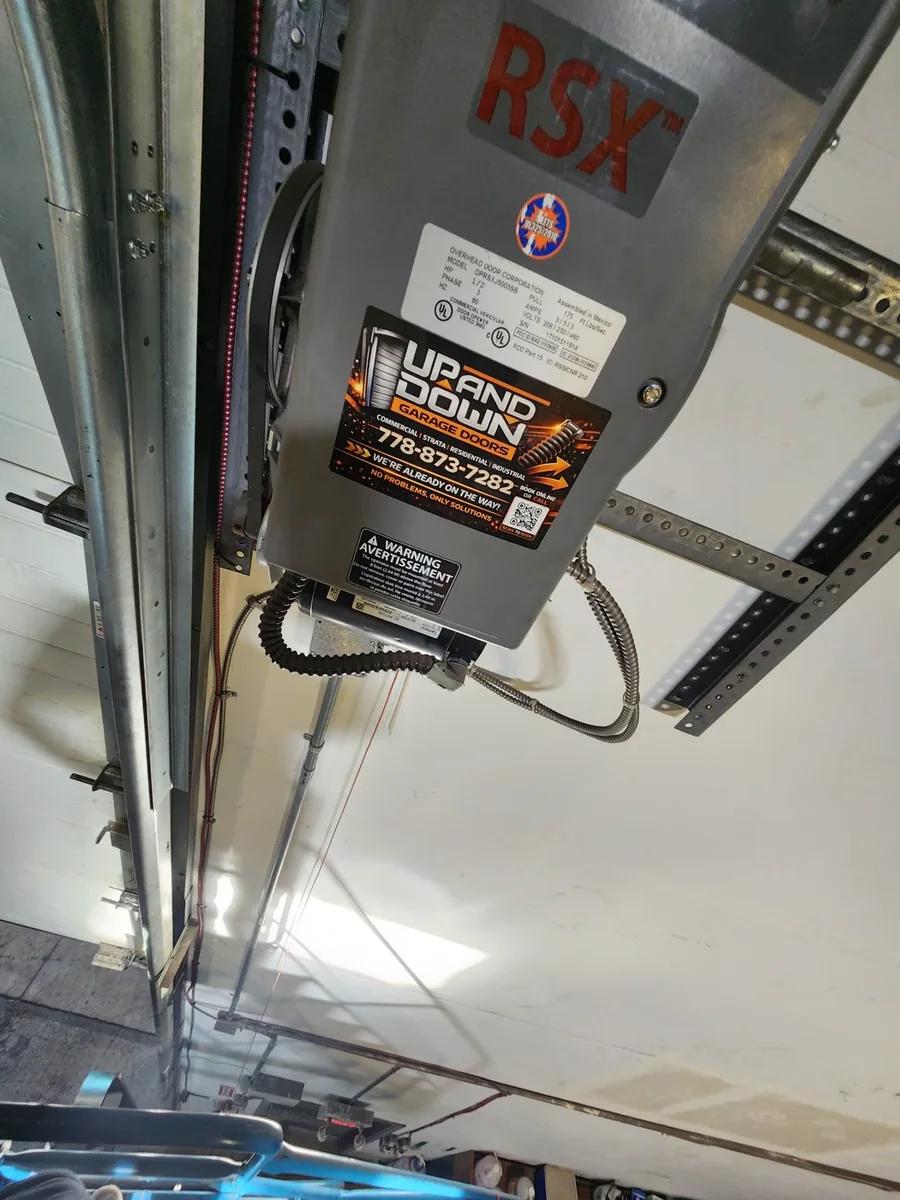
Chain-drive openers from the 1990s and 2000s are still common in Sunshine Hills and North Delta. They last 15–20 years if the chain is lubricated annually. Most are not. The chain stretches, jumps the sprocket, and the door reverses halfway up. Belt drives are quieter and we install them on bedrooms-over-garage layouts in Ladner ranches. Jackshaft openers mount beside the torsion shaft and free up ceiling space — useful in older Ladner village garages where the header is low and a rail-mounted opener would hit the door top section. We carry LiftMaster and Genie parts for same-visit repair on most models.
Roller and hinge wear on dyke-road grit
Nylon rollers with unsealed bearings pick up fine sand from River Road and Ladner Trunk Road. The bearings grind, the roller flats, and the door shudders in the track. Steel rollers last longer but transmit more vibration to the opener. We swap to sealed-bearing nylon — 13-ball or 11-ball depending on door weight — and replace the top and bottom hinges at the same time. The bottom hinge carries the full door weight at the floor; its bearing fails first. On heavier insulated doors in Tsawwassen, we use 14-gauge hinges instead of the standard 18-gauge.
Track alignment and binding on settled slabs
Sunshine Hills sits on glacial till that shifts. A slab that drops an inch on one side tilts the vertical track. The door binds, the opener senses resistance, and the safety reversal triggers. Homeowners often adjust the force knob higher — that masks the symptom and risks a cracked section. We loosen the track lag bolts, shim the verticals plumb, and re-anchor. If the slab has cracked, we note it. The fix holds until the ground moves again. In Ladner village, some garages were built on pier blocks. Those move seasonally. We set the tracks with a slight intentional clearance so the door still runs when the floor shifts.
Weather seals — bottom, perimeter, and threshold
The bottom astragal on a west-facing Tsawwassen door takes the brunt of every storm. UV and salt turn rubber brittle in 18 months. We install dual-durometer seals: a firm spine that holds the channel, a soft lip that conforms to an uneven floor. Perimeter vinyl stops drafts at the jambs and header. On Beach Grove homes where the driveway slopes toward the garage, we add an aluminum threshold with a vinyl insert — it stops water that runs down the drive from pushing under the bottom seal. No seal stops standing water. If the grade drains toward the door, the fix is grading or a trench drain, not a better gasket.
Sensor alignment and photo-eye trouble
Sunlight hitting the receiving eye at low winter angles — common on south-facing garages in North Delta — causes intermittent reversal. The door starts down, hits the invisible beam, and goes back up. We shield the receiver with a 3D-printed hood or relocate the eyes six inches lower. Dirt, spider webs, and condensation on the lens do the same thing. A quick wipe with a microfiber cloth solves half the “my door won’t close” calls we get. If the opener logic board has failed, the LED on the motor unit flashes a code. We read it, quote the board, and replace it if the opener is under 12 years old. Older than that, a full unit replacement makes more sense.
What a service call looks like
We show up, listen to the symptom, and cycle the door once. Disconnect the opener. Lift the door manually — it should move smoothly and stay at waist height. If it crashes down or flies up, the spring balance is off. We check cables, rollers, hinges, track, bearings, opener gear, logic board, sensors, and seals. We show you what we found, explain the options, and give a price before any work starts. Most repairs — springs, cables, rollers, sensors — are done in one visit. Opener logic boards and custom springs occasionally need a parts order. We do not upsell. If the door is 25 years old and the sections are delaminating, we say so. A new door is sometimes the honest answer.
Maintenance that actually prevents the local failure modes
Twice a year: wipe the photo eyes. Spray silicone on the roller bearings, hinge pins, and torsion springs — not WD-40, not grease. Check the bottom seal for cracks. Operate the door manually with the opener disconnected; it should feel light and balanced. Once a year: tighten the lag bolts on the track and the opener rail. In Ladner, Tsawwassen, and Beach Grove, rinse the bottom three feet of the door and tracks with fresh water after a windstorm — it washes the salt off before it corrodes the hardware. That five-minute habit adds years to springs, cables, and rollers.
Neighbourhood specifics — where the work differs
Ladner — Village core homes are pre-1970, many with single-car doors on low headers. Custom spring sizing is common. Detached garages on lanes mean we bring a longer hose for the compressor.
Tsawwassen — Broad lots, wide doors, heavy insulation. Wind load is the design factor. We spec 25,000-cycle springs and 14-gauge hinges as standard. West-facing doors get stainless cable and dual-durometer seals by default.
North Delta — 1970s–80s subdivisions, standard two-car doors. High volume of straightforward spring and opener swaps. Sunshine Hills adds slope-related track binding.
Sunshine Hills — Split-levels on sloped lots. Uneven cable wear and track binding are the signature issues. Jackshaft openers are popular here because ceiling space is tight.
Beach Grove — Low-lying, water-adjacent. Salt corrosion drives every failure mode. Stainless hardware, sealed rollers, and threshold seals are not upsells — they are the correct spec.
Frequently asked questions
Who repairs garage doors in Delta, BC? We cover all of Delta — Ladner, Tsawwassen, North Delta, Sunshine Hills, and Beach Grove — from one shop. The same techs who answer the phone show up at your door.
What causes a garage door to stop halfway in Delta? Usually a broken torsion spring, a seized roller, or a track that has shifted on a settled slab. In Tsawwassen and Beach Grove, salt-corroded cables are a common cause.
How long do garage door springs last in Ladner? Standard 10,000-cycle springs last about seven years at four cycles a day. We install 25,000-cycle springs as our baseline — roughly 17 years at the same use.
Can I replace just one garage door spring? You can, but the unbroken spring has the same fatigue. It will fail soon after. We replace both as a matched pair so the door lifts evenly and you do not pay for a second visit.
Why does my garage door reverse before hitting the floor in North Delta? Photo eyes misaligned by vibration, sunlight hitting the receiver at low angle, or dirt on the lens. Wipe the lenses first. If it persists, the eyes need shielding or relocation.
Do you repair garage door openers or only replace them? We repair. Gear kits, logic boards, limit switches, belt and chain assemblies — most are in stock. If the opener is over 12 years old and the board fails, replacement is usually the better value.
What maintenance should I do before winter in Beach Grove? Rinse the bottom tracks and door face with fresh water to remove salt. Lubricate rollers, hinges, and springs with silicone. Check the bottom seal for cracks. Tighten track lags.