Up and Down Garage Doors fixes broken garage door springs across Vancouver’s west side — Kerrisdale, Dunbar, Kitsilano, Point Grey, Shaughnessy, Arbutus Ridge, MacKenzie Heights, South Granville — with same-day service when you call before noon. We carry the right torsion and extension springs for the heavy wood doors and older hardware common in these neighbourhoods, and we show up with the tools to finish the job in one visit.
Broken Spring Repair Vancouver
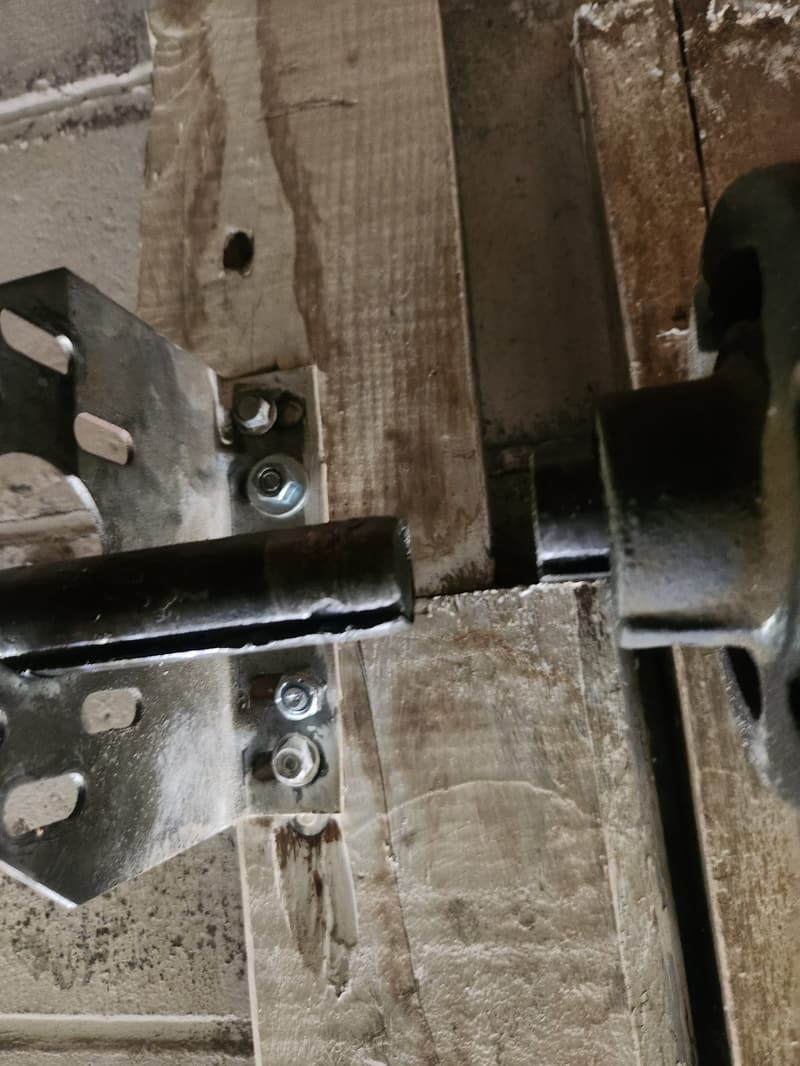
The bang is unmistakable. Sounds like a gunshot or a 2×4 snapping under load. You’re in the kitchen, maybe putting groceries away, and the garage lets off a crack that rattles the windows. By the time you get out there, the door is stuck — either jammed halfway up or crashed down hard enough to bend the bottom panel.
Sometimes there’s no bang at all. The door just gets heavy. The opener strains, the motor whines, and the door moves six inches before the safety reversal kicks in. You try the wall button again. Same thing. That’s a spring that’s stretched past its yield point or a torsion spring that’s lost enough tension that the counterbalance is gone.
We get calls from Shaughnessy where the homeowner heard the snap at 6 a.m. and couldn’t get the car out for work. Calls from Kitsilano where the door came down on a bike rack. Calls from Dunbar where the opener arm bent because the spring failed and the motor kept pushing. The symptom varies. The root cause is the same: the spring that does the actual lifting is gone.
Torsion versus extension springs on west-side homes
Most doors built after the late 1980s use torsion springs — a steel coil mounted on a shaft above the door opening. The shaft runs through the centre of the spring. Cable drums sit at each end. When the door goes up, the cables wind onto the drums and the spring unwinds, storing energy. When the door comes down, the spring winds back up. It’s a clean system. Fewer moving parts. Better cycle life.
Older doors — and there are a lot of them in Kerrisdale, Point Grey, and the south slopes of Dunbar — often still run extension springs. Two springs, one on each side, running parallel to the horizontal tracks. They stretch as the door closes. Safety cables should run through the centre of each spring to catch the coils if one snaps. Half the time those safety cables are missing or rotted through.
We see both setups on the same street. A 1950s character home in Arbutus Ridge might have the original extension-spring hardware on a solid fir door that weighs 350 pounds. Three doors down, a 1990s renovation swapped in a steel sectional with torsion springs. The hardware under the hood tells you the era.
Torsion springs are rated in cycles. Standard is 10,000 cycles — one cycle is open and close. At four cycles a day that works out to under seven years; most families cycle the door less often, so real-world life often runs longer. High-cycle springs rated for 25,000 or 50,000 cycles cost more upfront but make sense if you plan to stay. We stock both. The wire gauge, inside diameter, and length have to match the door weight and drum size exactly. Guessing gets you a door that’s too heavy or one that flies up and slams the header.
Extension springs are rated by colour code and length. White, green, yellow, blue, red — each colour corresponds to a weight range. The problem is the colour fades. Coastal damp turns the paint chalky in three years. We’ve seen blue springs that were actually green, installed by someone who read the faded tag wrong. The door never balanced right. The opener burned out in eighteen months.
Why springs fail on the west side
Cycle life is the textbook answer. Steel fatigues. Each open-close cycle flexes the wire. Micro-cracks form. Eventually one grows fast and the coil snaps. But cycle life assumes ideal conditions. The west side doesn’t give you ideal conditions.
Coastal damp is the silent killer. Salt air off the inlet, morning fog that sits in the lane garages until noon, rain that blows sideways under the weatherstripping. The springs live in that environment. Bare oil-tempered wire rusts. Zinc-coated wire lasts longer but the coating wears at the contact points where the coils touch. Once rust pits form, the stress concentration multiplies. A spring rated for 10,000 cycles might snap at 4,000.
We’ve pulled torsion springs from a garage in MacKenzie Heights where the coils were rusted solid, seized against each other. The homeowner said the door had been “a little noisy” for two years. Noise is the spring grinding against itself. That’s metal loss you can’t see until the spring is off the shaft.
Wrong-gauge springs from a bad prior install are the other major cause. We see this on retrofit jobs where a heavier door went on old hardware. A 16-foot double door in a 1970s build in South Granville got replaced with an insulated steel sectional. The new door weighed 80 pounds more. The installer reused the old springs. They lasted eleven months. The homeowner paid twice.
Improper winding is a third cause, mostly on torsion springs. The spring has to be wound to a specific number of turns — usually 7.5 to 8.5 turns for a seven-foot door. Undershoot and the door is heavy. Overshoot and the spring is overstressed from day one. We’ve seen springs wound with a pipe wrench and a prayer. The set screws on the winding cone strip, the spring unwinds violently, and the shaft spins like a propeller. That’s how techs get hurt. That’s how header brackets get ripped off the wall.
The specific mechanics and parts we deal with
When we show up for a spring job, we’re not just swapping a coil. We’re evaluating the whole counterbalance system.
Torsion spring assembly: The spring itself — oil-tempered wire, either bare or galvanized. The winding cones, one stationary and one winding. The centre bearing plate that holds the stationary cone. The shaft — solid or keyed, 1-inch or 1-1/4-inch depending on door width. Cable drums at each end, either standard lift or high-lift depending on track radius. The end bearing plates. The centre support bracket if the span exceeds twelve feet. Set screws on the cones and drums — we use hardened cup-point screws, not the soft hardware-store stuff that strips.
Extension spring assembly: The pair of springs. The pulley forks (stationary pulleys at the rear track hangers, movable pulleys on the spring ends). The lift cables — 7×19 aircraft cable, 1/8-inch or 5/32-inch depending on door weight. Safety cables running through the spring centre. The S-hooks or clip hooks at the spring ends. The track hangers and rear track brackets. The front cable attachment at the bottom fixture.
Cable drums matter more than people think. A worn drum groove lets the cable walk off the flange. The door goes crooked. The rollers bind in the track. The opener gear strips. We replace drums as a pair whenever we do torsion springs. The cost is small compared to a callback.
Track alignment gets checked on every spring job. If the horizontal tracks aren’t level, or the vertical tracks aren’t plumb, the door binds. Binding loads the springs unevenly. One side takes more cycles. That side fails first. We’ve seen brand-new springs snap in six months because the track was bent from a car bumper tap three years ago and nobody fixed it.
Opener types change the math. Chain-drive openers tolerate a slightly heavy door better than belt-drive. Jackshaft openers mounted beside the torsion shaft need precise spring balance — they have no mechanical advantage. If the spring is off by ten pounds, the motor faults. We’ve replaced springs on LiftMaster 8500W jackshaft units in Point Grey where the homeowner didn’t realize the opener required a tighter balance window than the old chain-drive it replaced.
Gauge and material choices: We use oil-tempered ASTM A229 wire for standard springs. Galvanized wire for damp environments — lanes that never see sun, garages below grade, anything within three blocks of the water in Kitsilano or West Vancouver. The galvanizing adds cost but buys two to three extra years in this climate. For high-cycle springs we specify shot-peened wire. The surface compression layer delays crack initiation. It’s not marketing — shot-peened wire genuinely resists crack initiation longer than standard-drawn wire in a damp climate.
Why we never recommend DIY spring work
This isn’t a liability disclaimer. It’s physics.
A torsion spring on a 16-foot door stores the energy of a sledgehammer swing — concentrated in a steel coil under 200-plus foot-pounds of torque. The winding bars are the only thing between that energy and your face. The bars have to be the right diameter (1/2-inch), the right length (18-inch minimum), and made of solid steel. Not rebar. Not a screwdriver. Not a piece of pipe you found in the garage.
The winding cone has four holes. You engage one. You wind a quarter turn. You engage the next. You wind. You do this 30 to 34 times for a standard door. One slip — the bar jumps out of the hole — and the spring unwinds in a fraction of a second. The bar becomes a projectile. The shaft spins. The cable drums become flails. We’ve seen the aftermath. Broken wrists. Shattered eye sockets. A tech in Alberta lost three fingers when a worn set screw let go on the final turn.
Extension springs are no safer. A stretched extension spring stores energy linearly. If the safety cable is missing or the S-hook straightens, the spring becomes a whip. The coils shoot across the garage at 200 feet per second. We’ve pulled spring coils out of drywall, windshields, and a refrigerator in a Kerrisdale garage where the homeowner tried to “just stretch it a bit” with a come-along.
The hardware store sells springs. They don’t sell the experience to know when the centre bearing plate is cracked, when the shaft is scored, when the cable drum is egg-shaped, when the track hanger is pulling out of the rafter. They don’t sell the winding bars. They don’t carry liability insurance for when it goes wrong.
We’ve fixed three DIY attempts this year on the west side alone. One in Dunbar where the homeowner bought the wrong wire gauge — the door flew up and bent the top panel against the header. One in Arbutus Ridge where the winding bar slipped and put a hole in the drywall ceiling. One in Shaughnessy where the extension spring safety cables were omitted and the snap took out the taillight of a parked Audi. The repair bill was triple what a pro visit would have cost.
A call we took in Kerrisdale last winter
Mid-January. Rain blowing sideways off the inlet. The homeowner called at 7:40 a.m. — car trapped, needed to leave for a 9 a.m. flight out of YVR. The door was a 1980s wood sectional, 16 feet wide, insulated retrofit panels added ten years ago. Original torsion hardware. One spring snapped. The other was stretched but intact.
We were in the neighbourhood — two blocks away on a cable replacement. Got there in twenty minutes. The broken spring was a standard 10,000-cycle coil, wire gauge .225, inside diameter 2 inches, length 32 inches. The mate measured the same but the coils were gapped — a sign it was overstressed. The centre bearing plate had a hairline crack at the bolt hole. The shaft had a score mark from a previous drum set screw that walked.
We replaced both springs with 25,000-cycle galvanized units. Swapped the centre bearing plate. Dressed the shaft score with emery cloth so the new drums would seat clean. Replaced both cable drums — the old ones had worn grooves. Re-tensioned the cables. Checked track alignment — the left horizontal track was 3/8 inch low at the rear hanger. Shimmied the hanger bracket. Lubed rollers, hinges, bearings. Tested balance. Door lifted with two fingers.
The opener was a Chamberlain belt-drive from 2012. Force limits needed adjustment after the spring change — heavier springs mean the opener thinks it’s hitting an obstruction. We dialled it in. Safety reversal tested. Photo-eyes cleaned. Homeowner made the flight. Total time on site: ninety minutes. That’s a normal spring job when the hardware is accessible and the parts are on the truck.
DIY versus calling a pro for spring replacement
We’ve covered the safety side. There’s also the competence side.
A pro job includes: verifying the door weight, calculating the correct spring specs, inspecting every component in the load path, replacing worn parts before they fail, setting the opener force limits, testing the safety reversal, and warrantying the work. We warranty springs for three years on parts. Labour is ninety days. If a spring we installed snaps in year two, we come back and swap it. No charge.
A DIY job includes: measuring the old spring (hopefully correctly), ordering online (hoping the specs match), waiting for delivery, renting or buying winding bars, figuring out the winding count, hoping the centre bracket holds, hoping the shaft isn’t bent, hoping the cables don’t fray on the old drums, guessing the opener adjustment, and having zero recourse if it goes wrong.
The cost difference on a standard torsion spring job — two springs, drums, bearing plate, cables, labour — is roughly $350 to $550 in parts if you buy retail. Our installed price ranges $380 to $620 depending on door weight and spring cycle rating. You’re paying $30 to $70 more for someone who’s done it 400 times, carries the right parts, and stands behind it.
On extension springs the gap narrows. Parts are cheaper. But the fiddly factor is higher — pulley forks, safety cables, S-hooks, track hangers. We’ve spent two hours untangling a DIY extension spring mess where the homeowner crossed the cables. The service call to fix it cost more than the original pro quote would have been.
If you’re a millwright or an elevator tech with a fully equipped shop and a spare afternoon, you might come out ahead. For everyone else, the math doesn’t work.
West-side housing stock specifics that change the job
Pre-war character homes in Kerrisdale, Shaughnessy, and Point Grey often have lane garages with narrow original openings — eight feet wide, seven feet high. The doors are solid fir or cedar, heavy as hell. The hardware is extension springs on wood jambs that have swollen and shrunk for eighty years. The track hangers lag into old-growth Douglas fir rafters that are hard as concrete. Drilling new holes means pre-drilling. The springs are often custom lengths because the horizontal tracks run tight under shallow roof pitches.
1960s and 70s single garages in Dunbar, Arbutus Ridge, and MacKenzie Heights typically have 9-foot or 10-foot wide openings. The doors are often original steel pan sections — thin, uninsulated, light. But the hardware is tired. The torsion shafts are 1-inch solid bar that’s twisted. The cable drums are cast pot metal that cracks. The centre bearing plates are stamped steel that bends. We replace a lot of shafts on these jobs because the keyway is worn and the new drums won’t stay timed.
Strata and character-home retrofit constraints show up in South Granville and Kitsilano. A laneway house gets a new garage door but the strata bylaw requires the exterior look to match the original carriage-house aesthetic. That means faux hinges, faux handles, and a door that weighs 400 pounds because of the overlay panels. The torsion springs have to be upsized. The shaft has to be 1-1/4-inch. The opener has to be a jackshaft because there’s no ceiling clearance for a rail. We’ve done four of these in the last eighteen months. Each one needed custom spring specs calculated from the actual door weight, not the manufacturer’s chart.
Coastal damp affecting hardware is the constant. Garage floors in West Vancouver and the west side slopes are often below grade. Water seeps through the slab. The bottom brackets rust first. Then the cable drums. Then the spring wire where it contacts the shaft. We specify galvanized or powder-coated hardware for any garage within five blocks of the water. It’s not upselling. It’s the difference between a spring that lasts eight years and one that lasts three.
How fast can you get to Kerrisdale, Dunbar, or Kitsilano?
We’re based in Richmond. The Knight Street Bridge to 41st Avenue takes twenty minutes in normal traffic. The Oak Street Bridge to 41st takes twenty-five. From there it’s five minutes to Kerrisdale, ten to Dunbar, fifteen to Kitsilano or Point Grey. If you call before 11 a.m. and we have the springs on the truck — which we usually do for standard residential doors — we’re at your garage that afternoon. After 11 a.m. it’s next morning first slot. We don’t overbook. We tell you the truth on the phone.
What’s involved in a spring replacement service call?
We show up. We disconnect the opener. We secure the door in the down position with vice grips on the track. We unwind the broken torsion spring (or remove the extension springs). We inspect the shaft, drums, bearings, cables, tracks, hinges, rollers, bottom brackets, and centre bracket. We replace the springs as a pair — always. We replace cables if they show any fraying. We replace drums if the grooves are worn. We replace the centre bearing plate if it’s cracked. We wind the new springs to the calculated turns. We re-engage the opener. We adjust force and travel limits. We test safety reversal. We lubricate all moving parts. We clean up. You pay. We leave. Most jobs are ninety minutes to two hours.
Do you offer same-day spring repair on the west side?
Yes. Call before 11 a.m. and we aim for the same afternoon. The catch: we need the right springs on the truck. Standard residential torsion springs — .207, .218, .225, .234, .243, .250 wire gauges, 1-3/4 or 2-inch inside diameter, lengths 24 to 36 inches — we stock all of them. High-cycle galvanized in the same specs — stocked. Extension springs in standard lengths and colour codes — stocked. Non-standard shafts, odd drum sizes, commercial doors, counterweight systems — those we order. We’ll tell you on the phone which bucket you fall in.
What does spring replacement cost in Vancouver BC?
Installed, torsion springs on a standard residential door: $380 to $620. That’s both springs, drums, cables if needed, bearing plate if needed, labour, and warranty. Heavier doors (insulated 16-footers, custom wood overlays) push the top end. High-cycle 25,000-cycle springs add $80 to $120 over standard. Galvanized wire adds $40 to $60.
Extension spring jobs: $320 to $500 installed. Includes both springs, safety cables, pulley forks if worn, cables if worn, labour, warranty.
We don’t quote over the phone without seeing the door. Anyone who gives you a firm price sight unseen is guessing. We give ranges. The final number lands in the range.
Can I replace just the broken spring and save money?
You can. We won’t do it. The unbroken spring has the same cycles, the same rust exposure, the same metal fatigue. It will fail — usually within six months. Then you pay for a second service call, a second spring, and the labour again. Replacing as a pair costs 40% more upfront and saves 100% of the second visit. The math is obvious.
My garage is in a strata building on the west side — does that change anything?
Sometimes. Strata bylaws may restrict noise hours, contractor parking, or require a certificate of insurance naming the strata corporation. We’re licensed and insured and can provide a certificate of insurance naming the strata corporation. We’ve worked in buildings where the garage is tandem, the opener is on a shared circuit, or the door is a fire-rated assembly. Fire-rated doors need springs that match the UL listing. We know the drill. Mention it when you call and we’ll bring the paperwork.
Up and Down Garage Doors — 778-873-7282. We serve Vancouver’s west side: Kerrisdale, Dunbar, Kitsilano, Point Grey, Shaughnessy, Arbutus Ridge, MacKenzie Heights, South Granville. Same-day spring repair when you call before noon.
General garage door repair Vancouver | Broken spring repair details | Emergency garage door repair | Cable replacement | Preventive maintenance