Up and Down Garage Doors evaluates steel skin dents on residential garage doors across Metro Vancouver, determining repair feasibility based on gauge thickness, structural location, and corrosion risk — distinguishing cosmetic fixes from safety-critical section replacements.
Garage Door Dent Repair Options — What Determines If a Dent Is Fixable
How Steel Gauge Affects Repair Potential
Residential garage doors in Metro Vancouver typically use 24-gauge (0.024 in / 0.61 mm) or 25-gauge (0.021 in / 0.53 mm) hot-dipped galvanized steel skins over polyurethane or polystyrene cores. Thinner 26-gauge (0.018 in / 0.46 mm) skins appear on builder-grade models. The gauge number runs inverse to thickness — lower gauge means thicker steel. A 24-gauge skin withstands shallow dent pulling with stud welders or glue-pull tabs; 26-gauge often stretches irreversibly, leaving visible oil-canning after repair attempts.
Dent Depth and Profile Geometry
Shallow dish dents under 3 mm deep with gradual transitions respond to paintless dent repair (PDR) techniques using specialized rods and leverage bars through the section’s stiles. Sharp creases — especially those crossing the horizontal rib (the “break line” stamped for rigidity) — create work-hardened zones that resist metal memory restoration. Dents exceeding 6 mm depth or spanning multiple ribs typically require section replacement because the steel’s yield point has been exceeded.
Location Relative to Structural Elements
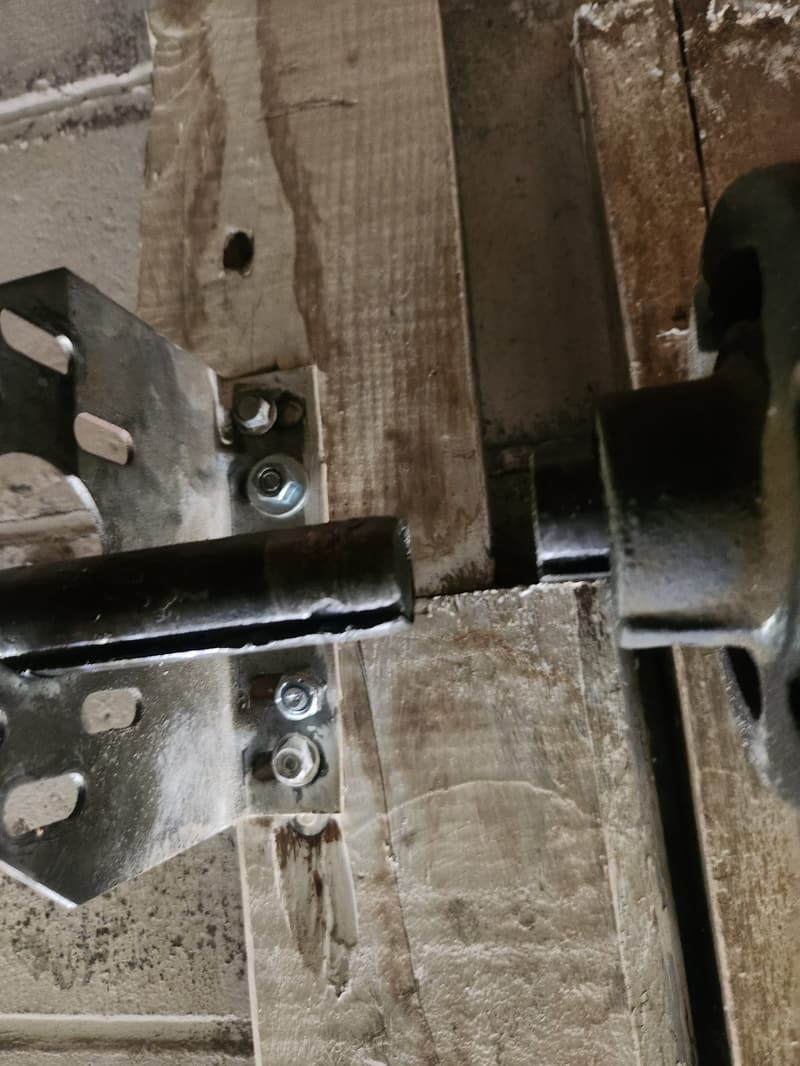
Dents confined to the flat panel face between stiles are candidates for repair. Damage affecting the hinge reinforcement plates (typically 14-gauge / 1.9 mm galvanized brackets), bottom bracket anchors, or the top section’s operator bracket mounting zone compromises the door’s structural integrity. A dent within 50 mm of any hardware attachment point should be assessed for hidden cracking in the heat-affected zone of the spot welds.
When Section Replacement Is the Only Safe Option
Corrosion Initiation in Coastal BC Climate
Metro Vancouver’s marine air carries chloride deposits that settle in micro-cracks from impact damage. Even factory-applied polyester topcoats (typically 15-20 microns dry film thickness) develop microscopic pinholes at dent perimeters. Within 12-18 months, white rust appears at the fracture lines, progressing to red rust that undercuts the galvanized layer (Z275 / G90 coating weight standard). Once corrosion penetrates to the core, the section loses torsional stiffness — critical for 16 ft wide double doors where each section contributes to the overall box beam behavior.
Insulation Core Damage
Polyurethane-injected cores (R-value 12-18 depending on density) bond to both steel skins. A sharp impact that cracks the inner skin delaminates the foam, creating a thermal bridge and reducing panel rigidity. Polystyrene slab cores (R-value 6-9) can fracture silently. Tapping the dent perimeter with a plastic-handled screwdriver reveals hollow sounds indicating core separation — a condition no surface repair resolves.
Cycle Life Implications
Standard residential torsion springs are rated for 10,000 cycles (one open/close = one cycle). A compromised section alters load distribution across the hinge line, increasing peak stress on adjacent sections by an estimated 15-25% per DASMA 102 engineering guidelines. This accelerates fatigue at the next hinge point, potentially cascading into multi-section failure before the spring cycle rating is reached.
Repair Methods Used in the Trade
Paintless Dent Repair (PDR) for Garage Doors
Technicians access the dent backside through the section’s end stiles or by temporarily removing the bottom weather seal retainer. Using 4-6 mm diameter rods with varied tip profiles (ball, flat, hook), they massage the metal from the center outward. Glue-pull tabs (hot-melt adhesive rated to 90°C) work on exterior-only access but risk paint lifting on aged factory finishes. PDR suits dents up to 50 mm diameter on 24/25-gauge skins without creasing.
Stud Welder and Dent Puller Systems
Capacitor-discharge stud welders fuse 2-3 mm copper-coated pins to the dent crown. A slide hammer or pneumatic puller draws the metal upward. The pins are then twisted off and the nubs ground flush. This method risks burn-through on 26-gauge steel and leaves micro-indentations requiring body filler — unacceptable on visible exterior faces without full repaint.
Body Filler and Repaint Considerations
Two-part polyester filler (e.g., 3M 05887 or equivalent) builds low spots after metal work. However, garage door sections flex 2-3 mm per cycle at the center span. Rigid filler eventually cracks at the repair edges. Flexible epoxy-based fillers (e.g., SEM 39753) accommodate movement better but require 24-hour cure before catalyzed urethane topcoat application. Color matching on weathered doors — especially the common “sandstone” or “almond” baked enamels — rarely achieves invisible results without blending adjacent panels.
Metro Vancouver Housing Stock Context
Common Door Profiles in the Region
Richmond, Delta, and South Vancouver ranchers (1960s-1980s) often retain original 24-gauge flush or short-panel doors (21 in / 533 mm section height). North Shore and West Vancouver custom homes favor 25-gauge carriage-house styles with composite overlay boards. Surrey, Langley, and Coquitlam newer subdivisions (2000s-present) typically specify 25-gauge long-panel (41 in / 1041 mm section height) insulated doors from major North American manufacturers. Section dimensions are standardized: 18, 21, or 24 in heights × 8, 9, 10, 12, 14, 16, 18 ft widths.
Weather Exposure Patterns
South-facing doors in Ladner, Tsawwassen, and White Rock receive 2,000+ annual sun hours, accelerating chalking of polyester coatings. North-facing and shaded installations in Coquitlam, Port Moody, and UBC areas retain moisture longer, promoting corrosion at unrepaired dent sites. Wind-driven rain events (60-80 km/h gusts common November-March) force water into micro-cracks at dent perimeters, accelerating the corrosion cycle described above.
Cost Considerations
PDR on a single accessible dent typically costs less than section replacement but varies with access difficulty and finish requirements. Full section replacement includes the panel (priced by gauge, insulation type, width, and finish), hardware transfer labor, spring re-tensioning, and safety system verification. A site assessment determines whether repair preserves structural margins or merely delays inevitable replacement.
Frequently Asked Questions
Can I repair a dent myself with a suction cup or heat gun?
Consumer suction cups lack the holding force to overcome work-hardened steel memory. Heat guns risk burning through the galvanized layer, destroying corrosion protection and voiding any remaining manufacturer warranty. Both methods frequently worsen the appearance.
How do I know if the inner skin is cracked?
Shine a bright flashlight at a low angle across the dent interior at night. Hairline fractures reflect light distinctly. Alternatively, gently press the dent center while watching the opposite side — any oil-canning movement indicates inner skin separation from the core.
Will insurance cover dent repair or replacement?
Comprehensive auto policies cover vehicle-impact damage to garage doors subject to your deductible. Document the damage with dated photos before any repair attempt. We provide itemized estimates for insurance submission.
Does repairing a dent affect the door’s R-value?
Proper PDR on an intact core maintains original thermal performance. Any repair involving drilling, filler, or core penetration creates thermal bridges. Section replacement restores the rated R-value.
How long does a section replacement take?
Single-section replacement on a standard residential door typically requires 2-3 hours including spring rebalancing, safety sensor realignment, and cycle testing. Multi-section or custom-color matches may require ordering lead time.
What if the dent is on the bottom section?
Bottom sections house the bottom bracket (anchor for lifting cables) and astragal seal retainer. Damage here risks cable detachment or water intrusion. We evaluate bottom section dents more conservatively — replacement is often the prudent choice.
Need a professional dent assessment?
Call 778-873-7282 for on-site evaluation across Metro Vancouver
Up and Down Garage Doors — Richmond BC
Panel replacement service details | Richmond garage door repair | Get a quote online | Contact us