Up and Down Garage Doors services real wood garage doors across Metro Vancouver BC with trade-level expertise on moisture cycling, refinishing schedules, and torsion spring specifications matched to door weight.
Wood Garage Door Maintenance Guide
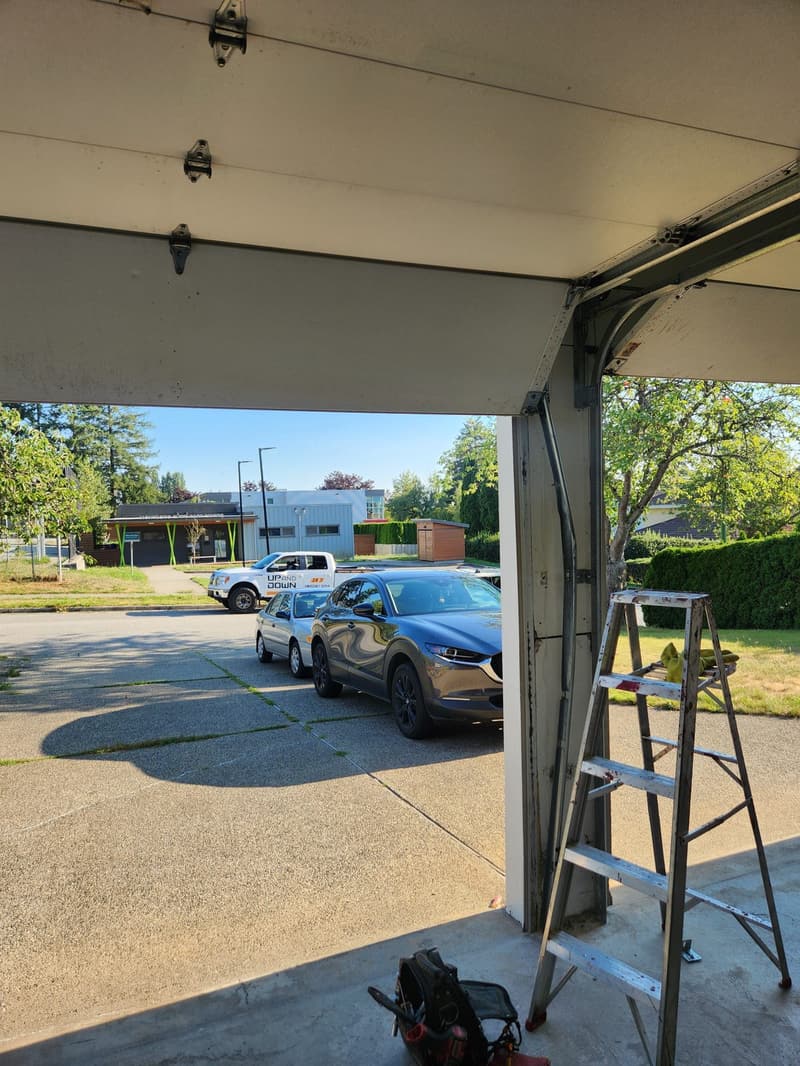
Metro Vancouver’s marine climate delivers 150+ days annually above 80% relative humidity. Wood doors absorb and release moisture seasonally — swelling 2–3 mm across panel width in wet winters, shrinking in dry summer heat. This cyclic movement stresses glue lines in stiles and rails, loosens mortise-and-tenon joints, and cracks finish films. Douglas fir and western red cedar doors common in Shaughnessy, Kerrisdale, and North Vancouver neighborhoods show raised grain within 18 months of installation if factory finish isn’t maintained. End-grain exposure at panel bottom rails wicks water upward 150 mm during prolonged rain events, accelerating rot at stile-to-rail connections.
What Wood Species Are Common in Metro Vancouver Installations?
Douglas fir (coastal grade) and western red cedar dominate pre-2000 installations. Post-2000 custom doors use kiln-dried vertical-grain Douglas fir, sapele, or African mahogany. Factory pre-finished doors typically receive two coats of penetrating oil or three coats of marine-grade spar urethane (2.5–3.0 mils dry film). Unfinished doors require immediate field finishing — raw wood exposed to November rain reaches 28% moisture content within 72 hours, exceeding fiber saturation point.
Refinishing Intervals Based on Exposure
How Often Should Wood Doors Be Refinished in BC?
South- and west-facing doors in Richmond, Delta, and Tsawwassen need recoating every 18–24 months. North-facing or shaded doors in Coquitlam, Port Moody, and UBC areas extend to 36–48 months. Penetrating oil finishes (Penofin, Cabot) require annual maintenance coats on high-exposure elevations. Film-forming spar urethanes (Interlux, Epifanes) last longer but fail catastrophically — peeling to bare wood — requiring full strip and re-coat. Inspect finish each October: water beading indicates intact film; darkening or graying means UV breakdown has begun.
What Prep Work Is Required Before Refinishing?
Remove hardware. Clean with TSP substitute (phosphate-free) at 1/2 cup per gallon warm water. Rinse thoroughly — residual alkali prevents adhesion. Sand with 80-grit to remove failed finish, 120-grit to feather edges, 180-grit final pass. Vacuum, then wipe with mineral spirits. Apply finish only when wood moisture content reads 12–15% on pin-type meter. Two coats minimum, 24 hours between coats, 72 hours before re-hanging hardware.
Weight vs. Steel: Spring Sizing Specifications
How Much Heavier Are Wood Doors Than Steel?
A 16’×7′ solid wood door weighs 280–350 lbs depending on species and panel thickness (1-3/8″ to 1-3/4″). Equivalent 24-gauge steel insulated door: 130–160 lbs. The 150–200 lb differential demands larger torsion springs. Standard 0.2253″ wire diameter × 2″ ID × 32″ length springs (IPPT 28.6) on steel doors are insufficient. Wood doors typically require 0.2437″ or 0.2625″ wire diameter springs on 2″ ID cones, 36–42″ length, delivering 35–45 IPPT. Dual-spring assemblies (two springs on one shaft) are standard for doors over 300 lbs — each spring carries half the IPPT load.
What Cycle Rating Do Wood Door Springs Need?
Residential standard: 10,000 cycles (approx. 7–10 years at 4 cycles/day). High-cycle upgrade: 25,000-cycle springs (0.2625″ wire, 48″ length) reduce replacement frequency. For 350 lb doors in high-use households (8+ cycles/day), 50,000-cycle springs (0.283″ wire, 60″ length) are specified. Spring wire diameter, inside diameter, and relaxed length must be measured before ordering — color codes vary by manufacturer. DASMA color code: 0.2437″ = yellow, 0.2625″ = white, 0.283″ = red.
Hardware Wear Patterns Specific to Wood Doors
Why Do Hinges and Rollers Wear Faster on Wood Doors?
Added weight increases hinge pin shear load. 14-gauge hinges (standard on steel) deform under 300+ lb doors — 11-gauge or 13-gauge heavy-duty hinges required. Nylon 11-ball rollers (standard) flatten at contact patch under sustained load; 13-ball precision-bearing rollers (DASMA Grade 3) distribute load across larger raceway. Track radius: 12″ standard radius binds on heavy doors — 15″ or 20″ high-lift radius reduces roller side-loading. Strut reinforcement (21-gauge U-channel) on top two sections prevents section bowing under wind load and self-weight.
What Opener Specifications Match Wood Door Weight?
Chain-drive openers rated 1/2 HP (LiftMaster 8165, Chamberlain B550) struggle with 300+ lb doors — excessive motor current, premature gear wear. Belt-drive 3/4 HP (LiftMaster 8550, 8500W) or jackshaft 3/4 HP (LiftMaster 8500) deliver consistent torque. DC motor with soft-start/soft-stop reduces shock loading on torsion springs and hardware. Force adjustment must be set per DASMA 102: door reverses at 15 lbs resistance on down travel, 10 lbs on up travel. Photo-eye alignment critical — wood door deflection under weight can misalign sensors by 3–5 mm seasonally.
FAQ
Can I Convert My Wood Door to a Lighter Material Without Changing Springs?
No. Spring IPPT must match door weight within ±5%. Replacing a 320 lb wood door with a 150 lb steel door on existing springs causes violent overbalance — door flies open, cables slacken, risk of spring unwinding. Springs must be resized or replaced during any material conversion.
How Do I Measure My Existing Spring Wire Diameter?
Use a micrometer or caliper on 10 active coils, divide by 10. Measure relaxed length (unwound) and inside diameter. Count total coils. Provide all four numbers to supplier — color codes are not universal across manufacturers.
What Causes Wood Door Sections to Bow Between Stiles?
Inadequate strut reinforcement combined with moisture gradient: exterior face dries faster than interior face, creating differential shrinkage. Install 21-gauge struts on top three sections; ensure interior finish coat equals exterior coat thickness to balance vapor transmission.
Why Does My Opener Click But Not Move a Heavy Wood Door?
Undersized motor stalls at breakaway torque. Check motor RPM under load — below 2800 RPM indicates insufficient torque. Upgrade to 3/4 HP DC belt-drive or jackshaft opener. Verify trolley engagement and chain/belt tension per manufacturer spec.
Can I Refinish Just the Bottom Panel That’s Rotting?
Partial refinishing creates moisture differential — finished panels repel water, unfinished panel absorbs it, accelerating rot at joint lines. Full-door refinishing maintains uniform vapor permeability. Replace rotted bottom rail with pressure-treated Douglas fir or composite before refinishing.
What Lubrication Schedule Applies to Wood Door Hardware?
Silicone-based spray on roller bearings, hinge pins, and torsion spring coils every 6 months. Avoid petroleum grease — attracts grit, accelerates nylon roller wear. Wipe excess from track faces; lubricant on tracks causes roller slippage, not rolling.
Need wood door spring sizing or refinishing assessment?
Up and Down Garage Doors — Metro Vancouver BC
Home | Panel Replacement | Spring Repair | LiftMaster 8500W Jackshaft Opener | Contact