Up and Down Garage Doors diagnoses why residential garage doors stick fully open across Metro Vancouver — broken torsion springs, opener carriage disconnects, snapped lift cables — and guides homeowners through safe manual lowering using the emergency release cord before professional repair.
Garage Door Stuck Open Causes
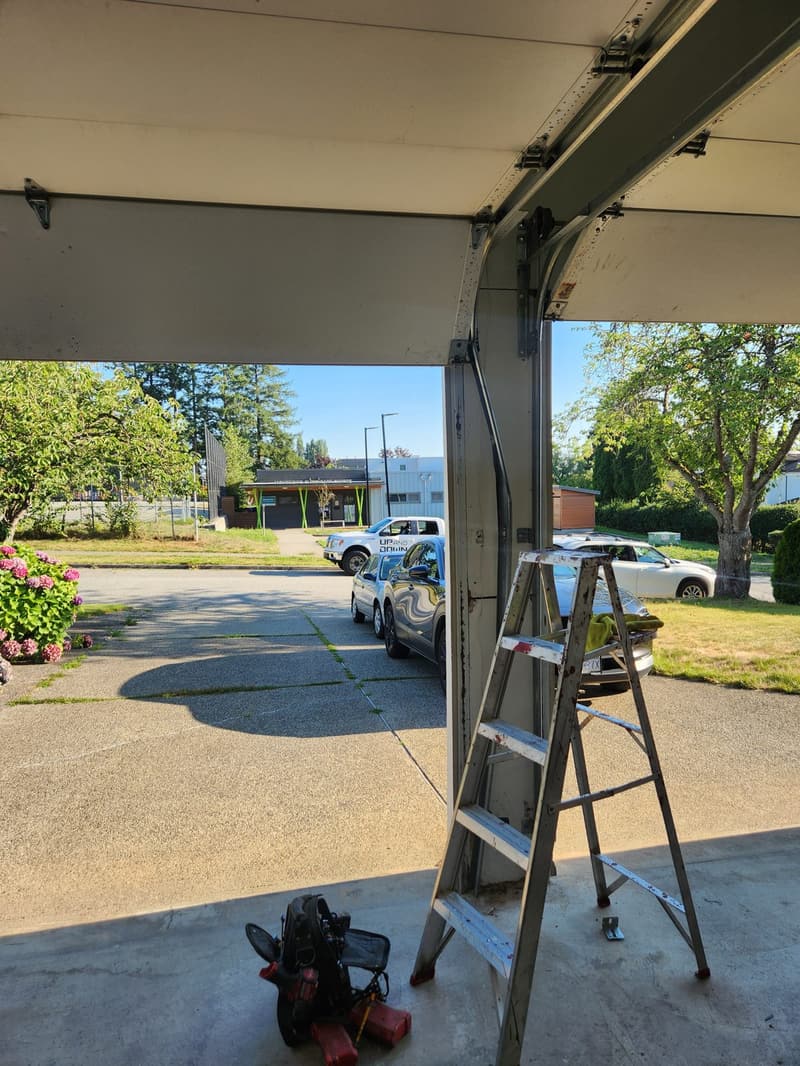
Standard residential torsion springs in Metro Vancouver homes are wound on a 1-inch (25.4 mm) diameter steel shaft with a stationary cone on one end and a winding cone on the other. Common wire diameters are 0.207 in (5.26 mm), 0.218 in (5.54 mm), 0.225 in (5.72 mm), 0.234 in (5.94 mm), and 0.243 in (6.17 mm) — corresponding to gauge numbers 6, 5.5, 5, 4.5, and 4 respectively. A typical 7 ft (2134 mm) high door uses springs with 30–36 active coils. Cycle ratings range from 10,000 cycles (standard) to 25,000–50,000 cycles (high-cycle upgrades). When a spring fractures, the stored torque releases instantly — the door loses all counterbalance and the opener’s drive system cannot hold the 150–250 lb (68–113 kg) door weight. The door slams down or jams in the open position depending on whether the break occurs on the wound or unwound side.
Opener Carriage Disconnect — How the Emergency Release Works
LiftMaster/Chamberlain belt-drive and chain-drive openers (models 8500W, 84504R, 84505R, 85870, 87802, 4690L, 6690L, 6580L, 2420L, 2220L, 98022, 98032, 8365W-267, 87504-267, 84602) use a trolley carriage that engages the opener rail via a locking lever. The red emergency release cord hangs from the carriage — pulling it down and back (toward the motor head) disengages the carriage from the drive sprocket or belt pulley. On jackshaft openers (8500W, 85870), the release lever is on the motor housing side. Once disconnected, the door moves freely on its track rollers — but with zero counterbalance if the spring is broken. Never pull the release while the door is moving under opener power.
Safe Manual Lowering Procedure for a Door Stuck Open
- Disconnect opener power at the ceiling outlet or breaker.
- Verify the door is fully open and the tracks are clear of debris.
- Pull the red emergency release cord straight down, then back toward the motor head until you hear/feel the carriage click into the disconnected position.
- Stand to the side of the door — never directly under it. Grip the bottom section lifting handles or the vertical stile near the bottom roller bracket.
- Lower the door slowly, controlling the weight with your legs, not your back. A 16×7 ft non-insulated steel door weighs ~150 lb; insulated ~200 lb; wood or glass can exceed 250 lb.
- If the door binds or one side drops faster, stop immediately — a cable may be off the drum or a roller out of track.
- Once fully closed, secure the door with a C-clamp or locking pliers on the track above a roller to prevent unintended opening.
- Do not re-engage the opener until a technician has inspected springs, cables, drums, and bearing plates.
Metro Vancouver Housing Stock & Wear Patterns
Richmond, Delta, Ladner, and Tsawwassen homes built 1970s–1990s typically have 16×7 ft or 16×8 ft single-panel or four-section steel doors on 2-inch (50.8 mm) track with 10-ball nylon rollers. Coastal humidity accelerates spring corrosion — uncoated oil-tempered wire loses 15–20% fatigue life within 5 years. North Vancouver, West Vancouver, and UBC-area homes often feature heavier insulated or wood composite doors (200–300+ lb) requiring 0.234 in or 0.243 in wire springs. Burnaby, Coquitlam, Port Coquitlam, and Maple Ridge see mixed housing stock — older 8×7 ft single-car doors with 0.207 in wire springs alongside newer 18×8 ft double doors needing dual-spring assemblies. Surrey, Langley, White Rock, and South Vancouver new builds increasingly specify 25,000-cycle springs standard. Temperature swings from 5°C to 30°C cause daily expansion/contraction cycles that accelerate coil fatigue.
Cable & Drum Specifications That Matter
Standard lift cables are 7×19 galvanized aircraft cable, 1/8 in (3.18 mm) diameter, rated 1,700 lb minimum breaking strength. Drums are stamped with part numbers indicating cable wrap capacity — e.g., 400-8 (4 in diameter, 8 wraps) for 7 ft doors, 400-12 for 8 ft doors. High-lift and vertical-lift tracks use larger drums (5.25 in, 6.375 in) with different groove pitch. A frayed cable at the bottom bracket or drum groove indicates imminent failure — replace both cables as a set. Never reuse old cables on new springs.
FAQ
Why won’t my garage door close after the opener clicks but doesn’t move?
The opener motor runs but the carriage is disconnected, the drive gear is stripped, or the trolley carriage bolt has sheared. Check the red release cord — if it’s pulled down, the carriage is disengaged. Re-engage by pulling the cord forward (toward the door) until the carriage clicks onto the drive sprocket.
Can I manually lower the door if only one torsion spring is broken?
Yes, but the door will be severely unbalanced — the broken side drops freely while the intact spring holds the other side. Lower extremely slowly with two people, one on each side. The door may twist in the tracks. Secure with C-clamps immediately once closed.
How do I know if my lift cables need replacement?
Inspect the bottom 12 inches at the bracket and the drum wraps. Look for broken wires (individual strands poking out), kinks, rust pitting, or flattened sections. Cables stretch over time — if the door sits uneven when closed, cables may be unequal length. Replace in pairs.
What’s the difference between standard and high-cycle torsion springs?
Standard springs use oil-tempered wire rated 10,000 cycles (one open/close = one cycle). High-cycle springs use larger wire diameter (e.g., 0.243 in vs 0.207 in) with more active coils, rated 25,000–50,000 cycles. They cost more upfront but last 2–5× longer — ideal for Metro Vancouver homes with 4+ daily cycles.
My door is stuck halfway — is that the same problem?
Different failure mode. A door stuck halfway usually indicates a roller off track, broken hinge, bent track section, or opener force limit set too low. See our garage door stuck halfway guide for that specific diagnosis.
Should I lubricate the springs before calling for repair?
No. Lubricating a broken or fatigued spring masks noise but doesn’t restore strength. It can also make winding cones slip during professional replacement. Leave springs dry — technicians apply proper lubricant after installation.
Door stuck open? Don’t risk injury — call Up and Down Garage Doors.
Serving Richmond, Vancouver, Burnaby, Surrey, Delta, Coquitlam, Langley, North Vancouver, West Vancouver, White Rock, Maple Ridge, Port Coquitlam, New Westminster, Ladner, Tsawwassen, UBC, Kitsilano, Shaughnessy, South Vancouver, West End.
Related resources: Richmond garage door repair | Spring repair details | Opener replacement pricing | Get a quote online | Contact us