Up and Down Garage Doors helps Metro Vancouver homeowners diagnose opener force and travel limit issues — misadjusted settings cause reversed doors, incomplete travel, and safety sensor faults on LiftMaster, Chamberlain, and legacy chain-drive units across Richmond, Burnaby, and Vancouver.
Opener Force Travel Settings — What the Force Setting Actually Controls
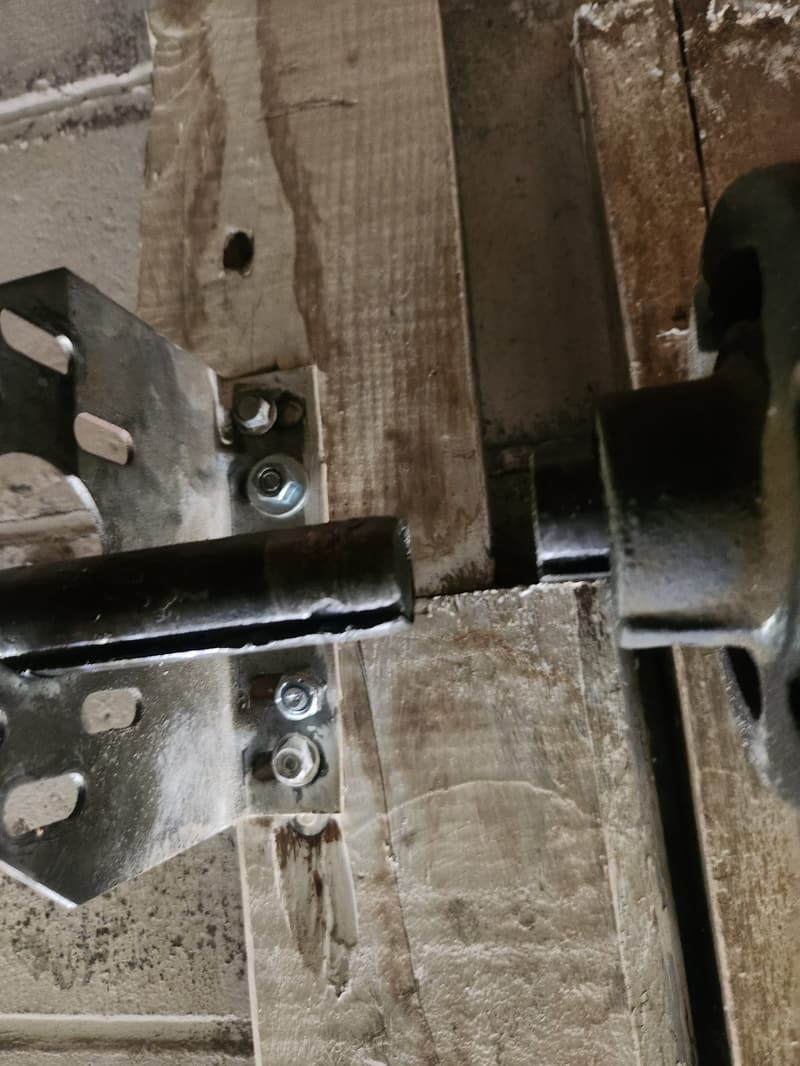
The force adjustment (often labeled “up force” and “down force” on LiftMaster Logic 5.0 and Security+ 2.0 boards) regulates the motor current threshold before the opener interprets resistance as an obstruction. On a typical residential 1/2 HP AC motor (LiftMaster 8500W, 85870, 84504R), the control board monitors RPM drop via the internal optical encoder — when current draw exceeds the programmed percentage of rated torque, the door reverses. Factory defaults assume a properly balanced 7 ft sectional door with 10,000-cycle torsion springs (0.225 in. wire diameter, 1.75 in. ID) on 14-gauge horizontal track. If springs have relaxed or cables have stretched, the door feels heavier and trips the force limit prematurely.
What the Travel Limits Actually Control
Travel limits tell the opener where “fully open” and “fully closed” positions are. On screw-drive models (LiftMaster 2420L, 2220L) and chain-drive units (8365W-267, 6580L), limits are set by physical cams on the limit shaft or by electronic position counters tied to the motor encoder. A 7 ft door requires roughly 14–16 full rotations of the trolley carriage on a 32-pitch chain; the limit switch must trigger within ±½ in. of the floor seal. If the down limit is set too long, the bottom section compresses the weather seal and the opener continues pushing — this loads the top roller brackets (typically 13-gauge steel, 2 in. hinge points) beyond design and can bend the top section. If set too short, the door stops 2–3 in. above the floor, leaving a gap that admits wind-driven rain common in Richmond’s winter storms.
Symptoms of Excessive Force Setting
- Door reverses 6–12 in. off the floor with no visible obstruction
- Opener hums but trolley doesn’t move — motor overload thermal cutout trips after 8–10 seconds
- Safety sensors show solid LEDs but door still reverses (force trip, not photo-eye)
- Top section bows upward at center when closing — indicates down force masking a binding roller or track misalignment
Symptoms of Insufficient Force Setting
- Door stops mid-travel on cold mornings — 10W-30 synthetic grease on screw drive (LiftMaster 2420L) stiffens below 5 °C, increasing drag
- Door opens 3 ft then reverses — up force too low for door weight after spring relaxation
- Chain/sprocket skips teeth on 41A5021 chain (1/2 in. pitch, 1/8 in. roller diameter) when motor torque spikes
Symptoms of Misadjusted Travel Limits
- Down limit long: door hits floor, motor runs 1–2 seconds more, top section bows, opener rail flexes upward at header bracket
- Down limit short: 1–3 in. gap at floor, rubber bottom seal (ASTM D2000 M2AA807) never compresses
- Up limit short: door stops 6–12 in. below header, trolley hits up-limit cam early — common after replacing a 7 ft door with an 8 ft door without re-setting limits
- Up limit long: trolley crashes into opener chassis, shearing the plastic limit cam (part 41A5034 on Security+ 2.0)
Safe Reversal Test — 2×4 Method (UL 325 Compliance)
Place a 2×4 SPF lumber flat on the floor centered under the door. Close the door using the wall console. The door must reverse within 2 seconds of contacting the wood. If it does not reverse, or reverses before contact, the down force is misadjusted. Do not test with hands, feet, or cinder blocks — the 2×4 simulates a 40 lb child per UL 325. After any force or limit adjustment, repeat the test three times. On LiftMaster 8500W (jackshaft) and 85870, the force profile is stored in non-volatile memory; power cycling does not reset it.
Metro Vancouver Conditions That Shift Settings
Coastal humidity cycles swell unsealed Douglas fir door panels (common in 1970s Richmond ranches) by 3–5 mm each winter, increasing drag on nylon rollers (11-ball, 3/8 in. stem). Salt air from Boundary Bay corrodes extension spring pulleys (1/2 in. bore, 3.25 in. OD) on older single-car doors in Tsawwassen and Ladner, adding friction that mimics a force setting problem. Temperature swings from -5 °C to 25 °C in a single week (typical November in Burnaby) change steel torsion spring rate by ~8%, altering the force the opener “feels.” We see this pattern on LiftMaster 84602 and 87802 installations across the region.
When to Adjust vs. When to Repair
Adjust force/travel limits only after confirming: springs balance the door (door stays at half-open when released), rollers spin freely, track is plumb within 1/8 in. per 7 ft, and cables are seated in cable drums (4 in. or 5.25 in. diameter, 1/8 in. cable groove). If the door fails any of these, adjusting the opener masks a mechanical fault and voids the LiftMaster warranty. On belt-drive units (84505R, 87504-267), belt tension must be 1/2 in. deflection at mid-span — loose belt mimics low force symptoms.
FAQ
How do I know if my force setting is too high or too low?
Too high: door reverses without hitting anything, or top section bows. Too low: door stalls mid-travel, especially in cold weather. Test with a 2×4 on the floor — the door must reverse on contact within 2 seconds.
Can I adjust travel limits myself on a LiftMaster 8500W jackshaft opener?
The 8500W uses electronic limits set via the menu button on the side of the motor unit. Press and hold “Learn” until the LED flashes, then use the up/down arrows to set positions. If the door has an 8 ft height, the factory 7 ft limit will stop short — re-set after any door height change.
Why does my door close fine in summer but reverse in winter?
Cold thickens grease on screw drives and stiffens bottom seals. Metal contracts, changing track alignment slightly. Springs lose ~8% torque per 20 °C drop. These combine to increase perceived load, tripping the factory force setting. A seasonal force adjustment (typically +10–15% down force) compensates.
What happens if the down limit is set too long?
The door compresses the bottom seal fully, then the opener keeps pushing. The top section bows, roller brackets (13-gauge) bend, and the opener rail can pull away from the header bracket. This damages the door structure, not just the opener.
Does adjusting the force setting fix a broken spring?
No. A broken torsion spring (typically 0.225 in. wire, 10,000-cycle rated) makes the door weigh 150–200 lb more. Increasing force to compensate overloads the motor, strips the nylon drive gear (part 41A2817 on chain drives), and creates a safety hazard. Replace the spring first.
How often should force and travel limits be checked?
After any spring replacement, cable replacement, door panel replacement, or seasonal change if the door behaves differently. We include limit verification in every opener service call across Metro Vancouver.
Need opener force or travel limits diagnosed and set correctly?
Call 778-873-7282 — Up and Down Garage Doors serves Richmond, Burnaby, Vancouver, and all Metro Vancouver.
Related service pages: LiftMaster 8500W jackshaft opener repair, LiftMaster 84504R/84505R belt-drive service, Richmond garage door repair, opener replacement pricing for Vancouver, get an instant quote online.