Up and Down Garage Doors explains the red emergency release trolley disconnect mechanism, proper re-engagement procedures, and critical safety warnings for residential garage door openers across Metro Vancouver BC.
Emergency Release Cord Guide — How the Trolley Disconnect Mechanism Works
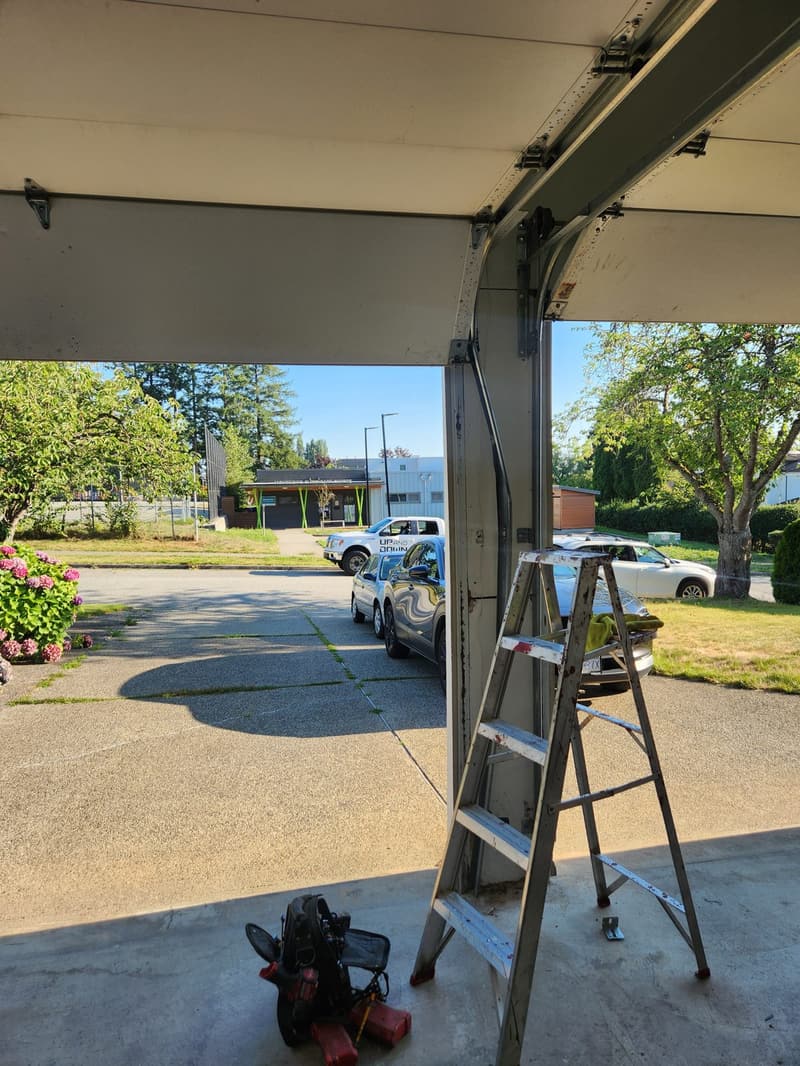
The red emergency release cord attaches to a spring-loaded trolley disconnect lever on the opener rail. When pulled downward, the lever rotates a cam that separates the trolley from the drive chain or belt, allowing manual door operation. Most residential LiftMaster and Chamberlain openers use a 1/8-inch diameter (11-gauge) galvanized steel aircraft cable with a 7×19 strand construction, rated for approximately 1,700 lbs minimum breaking strength. The trolley carriage typically travels on a 1-1/2 inch wide T-rail with nylon or Delrin wear pads. Cycle ratings for the disconnect mechanism itself are not separately published by manufacturers; the opener assembly carries a 10,000 to 20,000 cycle rating depending on model series.
When NOT to Pull the Red Cord
Door in the Fully Open Position
Pulling the release with the door fully open is the most dangerous scenario. The door’s full weight — typically 150 to 300 lbs for insulated steel sectional doors common in Richmond, Burnaby, and Surrey — transfers instantly to the torsion spring counterbalance system. Without the opener’s rail and trolley providing lateral stability, the door can shift sideways, jump the horizontal track, or fall if a spring is broken or improperly tensioned. Metro Vancouver’s damp climate accelerates spring corrosion; a weakened spring can snap under sudden load transfer.
Door Partially Open with Broken Spring
If one torsion spring has failed (common on 10,000-cycle springs after 7-10 years in coastal BC humidity), the door is already unbalanced. Disconnecting the opener removes the only thing preventing the heavy side from dropping. We regularly see this on 16×7 and 16×8 doors in older Vancouver Specials and 1980s Surrey builds where original springs were never upgraded to high-cycle (25,000-50,000 cycle) units.
Cable Off Drum or Frayed
If a lift cable has jumped the drum or shows broken strands — frequent after 15+ years in North Vancouver and West Vancouver homes with salty air exposure — the door hangs crooked. Pulling the release lets the heavier side drop uncontrolled.
Opener Running or Mid-Cycle
Never pull the cord while the motor is running. The trolley moves at 7-8 inches per second; the disconnect lever can snap back violently, damaging the cam mechanism or injuring fingers.
Re-Engaging the Trolley Correctly
- Ensure door is fully closed and power to opener is off (unplug or flip breaker).
- Pull the red cord straight down until you hear/feel a distinct click — the trolley reconnects to the chain/belt sprocket.
- Manually lift the door 6-12 inches; the trolley should catch and move with the door.
- Restore power and test with wall button. The opener should complete a full cycle without the trolley slipping.
On LiftMaster 8500W and 85870 jackshaft openers, the release handle is on the motor head, not the rail. Re-engagement requires rotating the handle 90 degrees until it locks. On 84504R/84505R and 87802 models with battery backup, the trolley may not re-engage if the battery is depleted — charge or replace the 12V 4.5Ah SLA battery first.
Metro Vancouver Housing Stock Considerations
Vancouver Specials (1965-1985) and 1980s Surrey/Delta rancher garages often have 7-foot high doors with 12-inch radius track — the trolley sits closer to the header, making the release cord shorter and harder to reach. Newer Richmond and Coquitlam townhomes (post-2000) frequently use 8-foot high doors with 15-inch radius track and LiftMaster 8365W-267 or 84602 belt-drive openers; the cord hangs lower but the heavier insulated doors (R-16 polyurethane, 200+ lbs) make accidental release more consequential. UBC and West End high-rise parkades use commercial sectional doors with LiftMaster 98022 or 98032 operators — the release mechanism is a lever on the motor head, not a hanging cord.
Component Specifications Reference
- Release cable: 1/8″ dia., 11-gauge, 7×19 galvanized aircraft cable, ~1,700 lbs MBS
- T-rail width: 1-1/2″ standard residential
- Trolley wear pads: Nylon 6/6 or Delrin (acetal), replaceable
- Opener cycle rating: 10,000 cycles (chain-drive 2220L, 2420L) to 20,000+ cycles (belt-drive 8500W, 87802)
- Torsion spring standard: 10,000 cycles, .207″/.218″/.225″ wire dia. common
- High-cycle spring upgrade: 25,000-50,000 cycles, .243″/.250″/.262″ wire dia.
- Lift cable: 1/8″ or 3/32″ 7×19 galvanized, 1,700 lbs / 920 lbs MBS respectively
FAQ
Why won’t my trolley re-engage after pulling the red cord?
The trolley cam may be misaligned with the chain/belt sprocket. Close the door fully, ensure power is off, pull the cord straight down firmly until you hear a click, then manually lift the door 6-12 inches to seat the trolley. On battery-backup models, a dead 12V SLA battery can prevent the logic board from recognizing re-engagement.
Can I replace just the red handle and cord?
Yes. The cord is standard 1/8-inch 7×19 galvanized aircraft cable. Cut to length, crimp a new thimble and handle, and route through the trolley lever. Do not substitute paracord, rope, or coated cable — they stretch or fray differently and can jam the lever.
Is it safe to pull the release if the door is halfway open?
Only if springs are intact and properly tensioned, cables are seated on drums, and the door moves smoothly by hand. Test balance first: lift manually to waist height and release — it should stay put. If it drifts up or down, springs need adjustment; do not use the release.
Does pulling the emergency release void my opener warranty?
No. The release is a designed safety feature. However, damage caused by pulling it under load (door falling, trolley cam breaking) is considered misuse, not a warranty defect.
Why is my release cord stuck or hard to pull?
Corrosion on the trolley lever pivot, a kinked cable inside the rail, or a bent cam. Common on 15+ year old chain-drive units in damp North Shore garages. Spray the pivot with PTFE lubricant; if the cable is kinked, replace the full cable assembly.
What if the door falls after I pull the cord?
Clear the area immediately. Do not try to catch it. Call 778-873-7282 for emergency service — a fallen door usually means broken springs, cables off drums, or both, requiring professional repair before the opener can be safely reconnected.
Need professional garage door service in Metro Vancouver BC?
Call 778-873-7282 for emergency release issues, spring replacement, or opener repair.
Explore related services: Richmond garage door repair, LiftMaster 8500W jackshaft opener, high-cycle torsion spring upgrades, door stuck halfway troubleshooting, schedule a service call.