Up and Down Garage Doors supplies and installs precision-matched rollers — nylon 13-ball, steel 10-ball, 2-inch and 3-inch stem — tuned to the damp coastal cycles that wear hardware faster in Richmond, Vancouver, Burnaby, and Surrey.
Garage Door Roller Types Guide
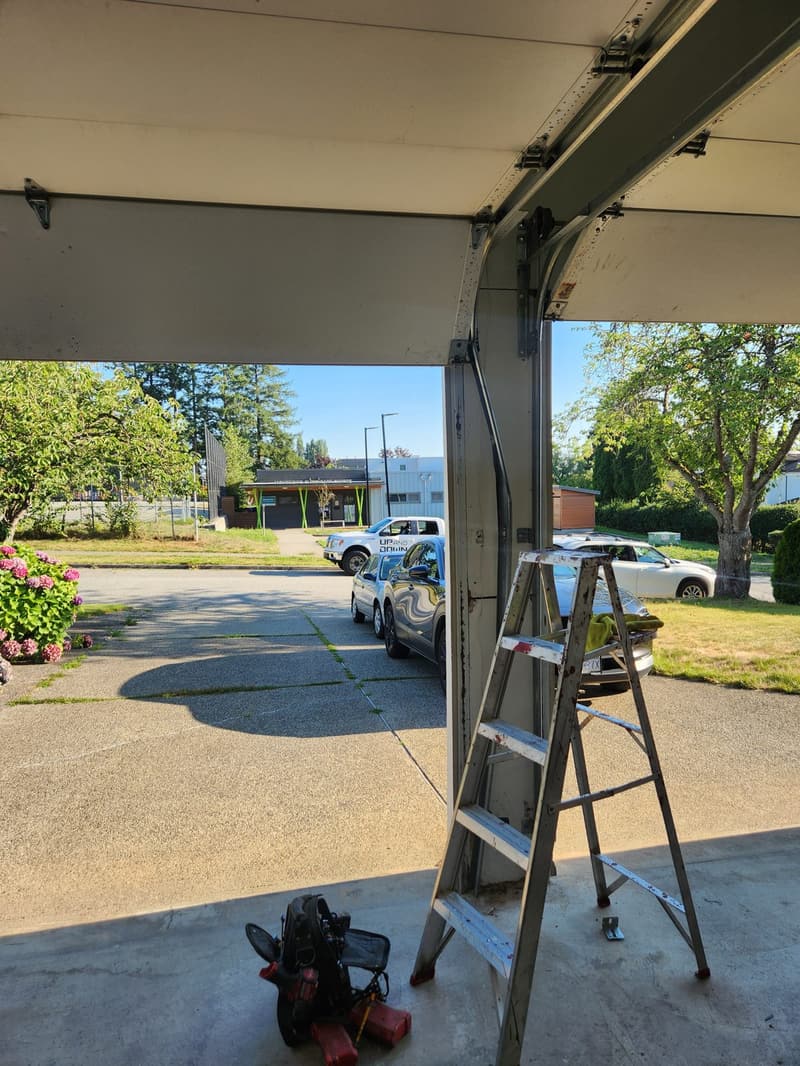
Metro Vancouver’s marine layer delivers salt-laden humidity that accelerates corrosion on unsealed bearing races and uncoated stems. Doors on 1970s split-levels in Richmond’s Steveston area and 1990s builds in Surrey’s Fleetwood often run 7 ft tall on 2-inch track with 11-ball nylon rollers that seize after 8,000–10,000 cycles. Newer 8 ft doors in Burnaby’s Brentwood towers and Vancouver’s Kitsilano infill projects spec 3-inch track with 13-ball sealed bearings rated 25,000+ cycles. Matching roller diameter, stem length, and bearing seal to the actual track gauge and door weight prevents premature flat-spotting and shaft wobble.
Nylon vs Steel: Material Trade-offs
How does nylon reduce noise compared to steel?
Nylon 6/6 tires (Shore D 78–82) absorb high-frequency vibration from 0.015 in track joint gaps, cutting perceived noise 6–8 dB versus steel-on-steel. The polymer tire also eliminates metal-to-metal galling when condensation freezes in January — common on uninsulated garages in Delta and Ladner.
When do steel rollers outlast nylon?
Steel rollers with hardened races (RC 58–62) and 0.125 in wire-diameter retainers survive 50,000+ cycles on heavy commercial doors (250+ lb) where nylon tires chunk under point loads. For residential doors under 180 lb, 13-ball nylon typically reaches 25,000 cycles before tire deformation exceeds 0.020 in runout.
Bearing Count: 10-Ball vs 13-Ball
What does the extra ball bearing change?
13-ball races distribute load across 30% more contact points, reducing Hertzian stress per ball from ~1,800 psi to ~1,350 psi on a 150 lb door. This extends bearing life from roughly 15,000 to 25,000 cycles in salt-air exposure. 10-ball units remain standard on builder-grade 7 ft doors with 2-inch track; 13-ball is the minimum upgrade for 8 ft doors on 3-inch track.
Stem Length: 2 Inch vs 3 Inch
Which stem length matches my track?
2-inch stems (actual 1.97 in) fit standard residential 2-inch track (0.075 in gauge). 3-inch stems (actual 2.97 in) are required for 3-inch commercial track (0.105 in gauge) found on newer high-lift conversions in Vancouver’s Shaughnessy laneway homes. Installing a 2-inch stem in 3-inch track creates 0.5 in lateral play — causing hinge bracket fatigue within 2,000 cycles.
Diameter & Gauge Specifications
What are the standard roller diameters and wire gauges?
Residential rollers: 1.75 in OD (11-ball nylon), 2.0 in OD (13-ball nylon), 2.0 in OD (10-ball steel). Stem wire: 0.225 in (11-gauge) for 2-inch track; 0.306 in (9-gauge) for 3-inch track. Bearing race wire: 0.125 in (11-gauge) on 10-ball; 0.105 in (12-gauge) on 13-ball sealed units.
Cycle Ratings & Replacement Intervals
How many cycles should a roller last in Metro Vancouver conditions?
Coastal humidity cuts published cycle ratings by 30–40%. A 25,000-cycle rated 13-ball nylon roller typically shows 0.015 in radial play at 15,000 cycles here. We recommend inspection at 10,000 cycles (approx. 7 years at 4 cycles/day) and proactive replacement at 15,000 cycles to avoid track damage from wobbling rollers.
FAQ
Can I mix nylon and steel rollers on the same door?
No. Mixed materials create uneven rolling resistance — nylon compresses 0.003–0.005 in under load while steel does not — causing the door to drift sideways and bind in the track within 500 cycles.
Do sealed bearings require lubrication?
Factory-sealed 13-ball bearings are lubed for life with NLGI #2 synthetic grease. Adding spray lube attracts grit that migrates past seals. Wipe stems only; never spray into bearing caps.
What stem length do I need for a high-lift conversion?
High-lift tracks use 3-inch commercial track (0.105 in gauge). You need 3-inch stems (2.97 in actual) with 9-gauge wire. Standard 2-inch stems will not engage the track throat fully.
How do I identify my current roller spec without removing it?
Count bearing balls through the side slot: 10 or 13. Measure stem exposed below the hinge bracket: ~2 in = 2-inch stem; ~3 in = 3-inch stem. Roller OD visible at track throat: 1.75 in or 2.0 in.
Will upgrading rollers alone fix a noisy door?
Only if noise originates from roller bearings. Hinge squeal, spring chirp, and opener chain rattle require separate fixes. We diagnose source before quoting roller replacement.
What happens if I run worn rollers too long?
Flat-spotted rollers hammer track joints, peening the track radius. This creates a 0.030–0.060 in ridge that destroys new rollers in under 1,000 cycles. Track replacement costs 3–4× roller replacement.
Need rollers matched to your door weight and track? Call 778-873-7282 for a free assessment.
778-873-7282 — Up and Down Garage Doors, Richmond BC
Home | Richmond Repair | Grinding Noise Diagnosis | Instant Quote | Contact Us