Up and Down Garage Doors warns Metro Vancouver homeowners that residential torsion springs store 300–500 ft-lb of energy — enough to shatter bone — and require calibrated winding bars, not improvised tools, for any adjustment or replacement.
Garage Door Spring Safety Warning — How Much Energy Is Actually Stored
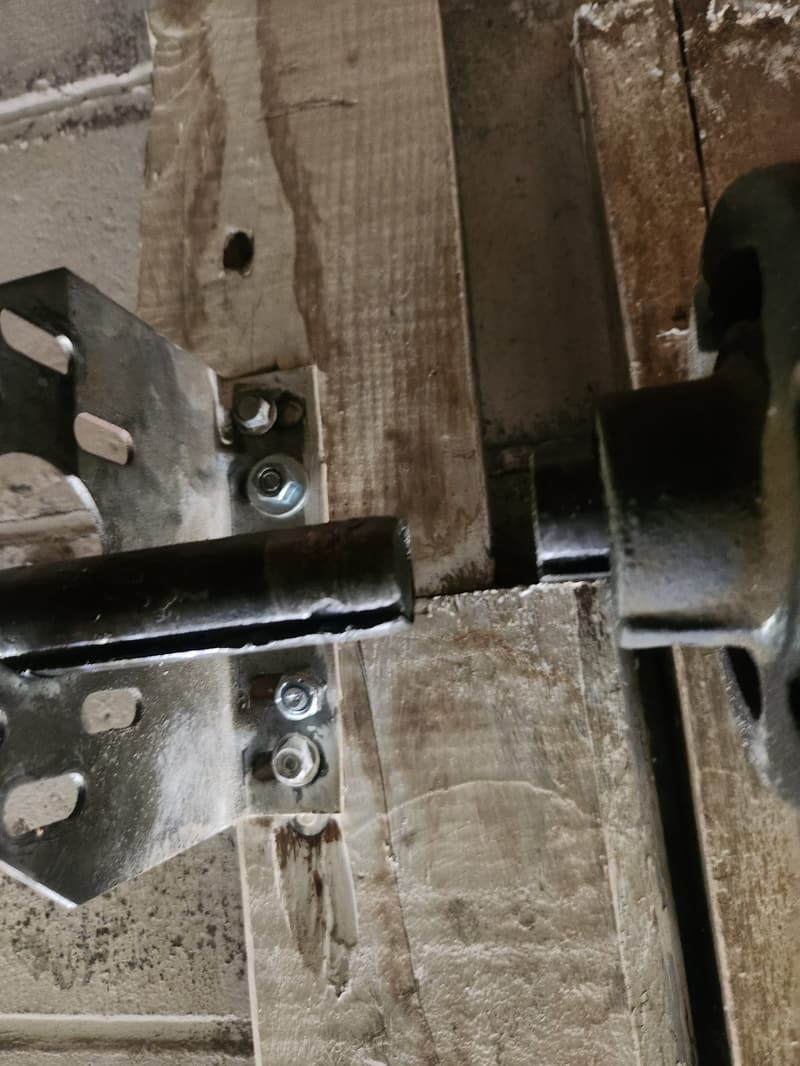
A typical 7 ft high residential door in Richmond, Burnaby, or Surrey uses a pair of 207 × 2 in or 225 × 2 in oil-tempered springs (wire diameter .207 in or .225 in, inside diameter 1.75 in or 2 in). At full wind — usually 7.5 to 8.25 turns on a 7 ft door — each spring holds roughly 150–250 ft-lb. Combined, the counterbalance system stores 300–500 ft-lb. That energy releases in milliseconds if a cone slips, a bar bends, or a setter loses grip.
Why Winding Bar Discipline Is Non-Negotiable
What is the correct winding bar specification?
Trade-standard winding bars are 18 in long, 1/2 in diameter cold-rolled steel with a 90° bend at one end. The 1/2 in diameter matches the winding cone holes on virtually all residential cones (DASMA 102). Shorter bars reduce leverage, increasing required force and slip risk. Improvised screwdrivers, rebar, or 3/8 in rod lack the torsional rigidity and will deform under load, causing uncontrolled release.
How many turns and how do you count them?
On a 7 ft door with 207 × 2 springs, the standard is 7.5 full turns (30 quarter-turns). On an 8 ft door with 225 × 2 springs, it’s typically 8.25 turns (33 quarter-turns). Technicians count quarter-turns aloud and mark the shaft with paint pen after each full turn. Losing count by even one turn changes spring torque by ~13%, leading to door drift, opener strain, or sudden unbalance.
Real Injury Modes Seen in the Trade
What happens when a cone slips?
The winding cone can shear its set screws or the key can shear off the shaft. The bar becomes a projectile rotating at the spring’s angular velocity — effectively a 18 in lever flailing at 100+ rpm. Technicians have recorded broken forearms, facial lacerations, and shattered safety glasses from cone slip events. The spring itself can uncoil violently, whipping the shaft and cables.
What about cable drum failure during winding?
If a cable drum set screw is loose or the cable is frayed, the drum can spin freely when the spring is wound. The sudden release unloads the spring into the shaft assembly. The cable whips outward — a 1/8 in aircraft cable at tension can cut to bone. Always verify cable seating in the drum groove and drum set screw torque (typically 15–20 ft-lb on 3/8 in set screws) before applying any winding turns.
Component Specifications You’ll Encounter
Residential torsion hardware in Metro Vancouver follows DASMA 102 dimensions:
– Wire diameters: .192 in, .207 in, .218 in, .225 in, .234 in, .243 in, .250 in, .262 in, .273 in, .283 in, .295 in, .3065 in, .3195 in, .331 in, .34375 in, .3625 in, .375 in, .39375 in, .40625 in, .421875 in, .4375 in
– Inside diameters: 1.75 in (most common), 2 in, 2.625 in, 3.75 in (commercial)
– Lengths: 20 in to 36 in typical for 7–8 ft doors
– Cycle ratings: 10,000 cycles standard; 25,000–50,000 cycles high-cycle (longer wire, larger ID)
– Cones: 1.75 in ID uses 1/2 in winding holes; 2 in ID uses 1/2 in or 5/8 in depending on manufacturer
– Shafts: 1 in OD hollow steel (16 ga wall) for residential; 1.25 in for heavier doors
Why Metro Vancouver Housing Stock Matters
Richmond and Delta rancher-style homes (1960s–1980s) often have 16 ft wide double doors on 207 × 2 springs — borderline for cycle life in damp coastal air. Condensation in unheated garages accelerates surface corrosion on non-galvanized wire, reducing fatigue life by 30–40%. North Shore and West Vancouver homes with 8–10 ft high doors frequently use 225 × 2 or 234 × 2 springs on 1.25 in shafts. The higher door weight (often 250–350 lb) pushes stored energy toward the upper end of the range.
FAQ
Can I replace just one spring if the other looks fine?
No. Springs fatigue symmetrically. Replacing only one creates torque imbalance — the new spring carries disproportionate load, fails prematurely, and the door runs crooked. Always replace as a matched pair.
How do I know my spring wire size without calipers?
Measure 10 coils of the relaxed spring with a tape measure, divide by 10. Example: 10 coils = 2.07 in → .207 in wire. Or count 20 coils and divide by 20. This is the trade method when calipers aren’t available.
What does “high-cycle” spring actually mean?
High-cycle springs use larger wire diameter and/or larger inside diameter to reduce stress per cycle. A 25,000-cycle spring might be .243 in wire on a 2 in ID versus standard .207 in on 1.75 in ID. They cost more upfront but last 2–3× longer in Metro Vancouver’s damp climate.
Why do springs break in cold snaps?
Oil-tempered wire becomes more brittle below 0°C. A pre-existing micro-crack from corrosion or fatigue propagates rapidly on the first cold-morning cycle. We see a spike in broken-spring calls every January in Burnaby, Coquitlam, and Surrey.
Can I use extension springs instead of torsion?
Extension springs (side-mounted) store similar energy but lack the containment of a shaft. A broken extension spring becomes a free projectile unless safety cables are installed — and many older installations lack them. Torsion is safer when properly maintained.
What should I do if I hear a loud bang from the garage?
Do not operate the door. A bang usually means a spring has fractured. The door may be stuck, crooked, or the opener may be damaged from the shock load. Call 778-873-7282 — we carry standard 207 × 2, 225 × 2, and high-cycle inventory for same-day replacement across Metro Vancouver.
Do not attempt torsion spring work.
Call 778-873-7282 for safe, professional service in Richmond, Vancouver, Burnaby, Surrey, Delta, and the North Shore.
Up and Down Garage Doors | Richmond Garage Door Repair | Vancouver Broken Spring Repair | Torsion Spring Replacement Details | Contact Us