Up and Down Garage Doors performs high-lift garage door conversions across Metro Vancouver BC, replacing standard-radius track with high-lift drums, vertical track extensions, and recalculated torsion springs to clear ceiling-mounted car lifts in Richmond, Vancouver, Burnaby, and Surrey homes.
High Lift Garage Door Conversion
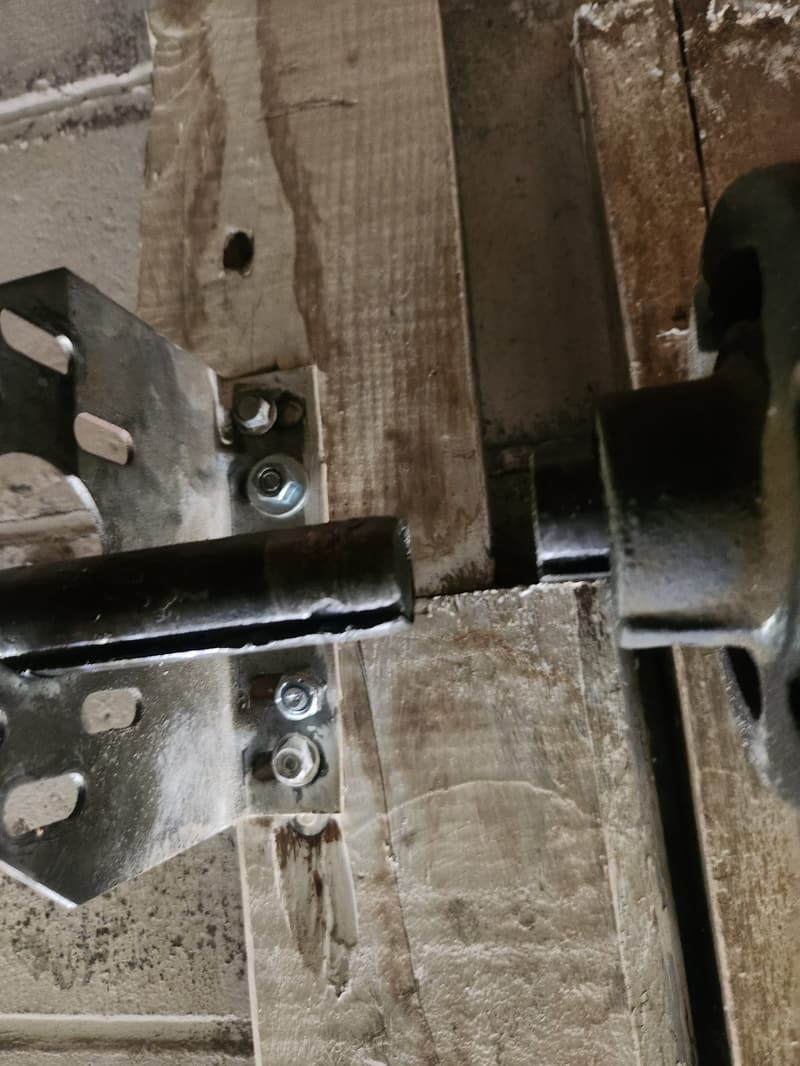
Metro Vancouver’s housing stock includes thousands of 1970s–1990s split-level and rancher homes with 7’6″ to 8′ ceiling heights. In Richmond and Delta, newer custom builds often specify 9′ or 10′ ceilings to accommodate four-post car lifts. A standard 12″ radius track with 4″ cable drums consumes 14″–16″ of headroom above the door opening. When a homeowner installs a BendPak or Dannmar four-post lift, the lift’s crossbeam sits 72″–78″ above the floor, leaving insufficient clearance for the door’s horizontal track. High-lift conversion moves the horizontal track closer to the ceiling, reclaiming 24″–48″ of vertical clearance.
Drum Specifications: Standard vs. High-Lift
What drum diameter and cable groove changes are required?
Standard residential doors use 4″ diameter cable drums (e.g., D400-144) with a 0.531″ cable groove pitch for 7’–8′ high doors. High-lift conversions require drums with larger effective diameters — typically 5.25″ (D525-144) or 6.375″ (D637-144) — to increase cable take-up per revolution. The groove pitch widens to 0.625″ or 0.750″ to match the longer cable travel. Drum part numbers follow the DASMA convention: first digits indicate drum diameter in inches, suffix indicates cable groove count (144 = 1/4″ cable, 4 grooves). Using a 5.25″ drum on a door originally spec’d for 4″ increases lift per turn by roughly 31%, reducing required spring turns.
Track Geometry: Radius, Vertical Rise, and Horizontal Run
How does track radius change with high-lift?
Standard 12″ radius track (part series 2TRK-12R) transitions from vertical to horizontal over a 12″ arc. High-lift conversions often use 15″ radius (2TRK-15R) or custom 18″ radius track to reduce the angle at which the door enters the horizontal run, lowering roller stress. The vertical track extends upward by the high-lift amount — typically 24″ to 48″ — using 2″ galvanized 13-gauge vertical track (2TRK-VERT-13GA) with 3″ on-center hinge plate spacing. Horizontal track remains 2″ 13-gauge but mounts to ceiling-mounted angle iron (L3x3x1/4) lag-bolted to joists on 24″ centers. In Vancouver’s older homes with 16″ OC joists, additional blocking is required.
Spring Recalculation: Wire Diameter, IPPT, and Cycle Rating
How are torsion springs recalculated for high-lift?
High-lift increases the moment arm on the torsion shaft. The spring’s inch-pounds per turn (IPPT) must be recalculated using the formula: IPPT = (Door Weight × Drum Radius) / (Number of Springs × Turns). For a 250 lb door on a 5.25″ drum (2.625″ radius) with two springs, target IPPT per spring is ~328 IPPT. Common wire diameters: 0.225″ (225 wire) yields ~285 IPPT on a 2.0″ ID × 32″ spring; 0.234″ (234 wire) yields ~340 IPPT. Cycle rating drops as stress increases — a 25,000-cycle spring at standard lift may fall to 15,000–18,000 cycles at high-lift unless wire diameter increases. DASMA 102-2021 tables guide selection. We stock 0.225″, 0.234″, 0.243″, and 0.250″ wire in 1.75″ and 2.0″ ID for same-day recalculation.
Opener Compatibility: Jackshaft vs. T-Rail
Which openers work with high-lift track?
T-rail openers (chain/belt drive) require a straight horizontal run; high-lift’s extended vertical section often exceeds the opener’s maximum door height spec (typically 7′ or 8′). LiftMaster 8500W and 85870 jackshaft openers mount beside the torsion shaft and accommodate any high-lift height because they drive the shaft directly. For T-rail models (LiftMaster 84504R, 84602, 87802), a high-lift adapter kit (part 41A5635) extends the trolley travel, but total door height cannot exceed 10′ without custom rail. We verify opener compatibility before quoting conversion. See our LiftMaster 8500W installation and LiftMaster 87802 installation pages for model-specific specs.
Hardware Wear Patterns in Coastal BC Climate
How does Metro Vancouver weather affect high-lift components?
Richmond, Delta, and North Vancouver see 1,500–2,000 mm annual rainfall with high chloride deposition from marine air. Standard 13-gauge track develops white rust at cut ends within 18 months. We specify G90 galvanized track (0.9 oz/ft² zinc) and recommend powder-coated black track (2TRK-PC) for high-lift installations within 2 km of salt water. Cable drums: cast aluminum (DASMA-rated) resists corrosion better than stamped steel. Torsion springs: oil-tempered wire with zinc-phosphate coating (per ASTM A229) lasts 2–3× longer than bare wire in this climate. Rollers: 13-ball nylon rollers with sealed bearings (part 2ROL-NYL-13B) outlast 10-ball steel rollers by ~40% in damp conditions. We include these upgrades in every high-lift quote for coastal municipalities.
FAQ
What is the minimum ceiling height for a high-lift conversion with a car lift?
You need at least 9’6″ finished ceiling height to fit a four-post car lift (72″–78″ lift height) plus high-lift door track (12″–16″ horizontal track depth) plus 6″–8″ opener clearance. At 9′ ceilings, a low-profile lift and 15″ radius track may work; we measure on site.
Can I keep my existing torsion springs?
Rarely. High-lift changes the drum radius and required turns. Existing springs are usually wrong IPPT and wrong cycle life. We recalculate and supply new springs matched to the new drum and door weight.
How long does a high-lift conversion take?
One day for most residential doors: remove horizontal track, extend vertical track, install new drums and springs, re-hang door, adjust opener. Two days if structural blocking or jackshaft opener install is needed.
Does high-lift affect door balance or opener force settings?
Yes. The door’s center of gravity shifts. We re-balance to 8–12 lbs lift force at mid-travel and reprogram opener force limits. Jackshaft openers auto-learn; T-rail models need manual force adjustment.
What maintenance does high-lift track need?
Lubricate rollers and hinges every 6 months with PTFE spray. Inspect cable drums for groove wear annually — high-lift cables see more wrap cycles per open/close. Check vertical track lag bolts for loosening from vibration.
Can you convert a door that already has a jackshaft opener?
Yes. The jackshaft stays mounted; we swap drums, springs, and track. The opener’s torque sensor recalibrates on first cycle. No opener replacement needed unless the shaft diameter changes (rare).
Ready to clear space for your car lift?
Call 778-873-7282
Up and Down Garage Doors — Richmond BC, serving all Metro Vancouver
Related services: Richmond garage door repair | Panel replacement | Instant quote | Contact us