Up and Down Garage Doors helps Metro Vancouver homeowners choose between insulated and uninsulated garage doors by analyzing attached-garage thermal performance, condensation risk in coastal humidity, and operational noise — backed by real component specs and Lower Mainland installation experience.
Insulated vs Uninsulated Garage Doors
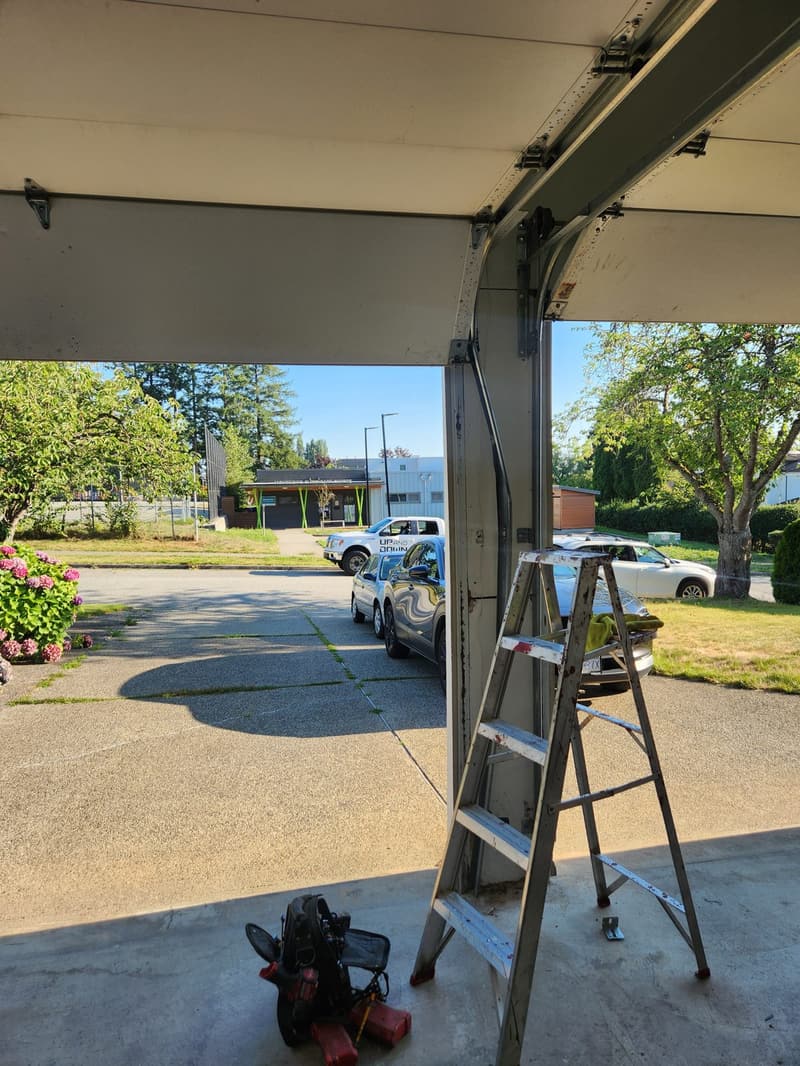
Metro Vancouver’s climate creates specific demands that make the insulated vs uninsulated decision more consequential than in drier regions. The Lower Mainland averages 160+ rainy days annually with winter temperatures hovering between 0–8°C and relative humidity often exceeding 80%. An attached garage shares a wall — and often a ceiling — with conditioned living space. That thermal boundary determines whether your furnace heats the garage or your living room.
Uninsulated 24-gauge steel sections (typical 0.024″ thickness) offer roughly R-0.5 to R-1.0 thermal resistance. Insulated sections with 1-3/8″ polyurethane foam cores reach R-12 to R-18; 2″ polyurethane reaches R-16 to R-22. Polystyrene (styrene) panels typically deliver R-6 to R-10 depending on density and thickness. The difference shows up on hydro bills for homes in Richmond, Burnaby, Surrey, and North Vancouver where attached garages are standard in post-1980s housing stock.
Attached-Garage Energy Logic
How Heat Moves Through the Garage Wall
In a typical Metro Vancouver split-level or rancher with an attached garage, the common wall is 2×4 or 2×6 framing with R-12 to R-20 batt insulation. The garage door becomes the weak link. A 16′ x 7′ uninsulated door has ~112 sq ft of R-1 surface. At a 20°C delta (20°C inside, 0°C outside), that door loses roughly 2,240 BTU/hr. An R-16 insulated door cuts that to ~140 BTU/hr. The furnace runs less; the room above the garage stays warmer.
BC Energy Step Code Implications
BC Energy Step Code Step 3 (now baseline for many Lower Mainland municipalities) requires effective whole-building airtightness and thermal performance. While garage doors aren’t directly tested in blower-door results, an uninsulated door undermines the envelope. Builders in Coquitlam, New Westminster, and Delta increasingly spec R-16+ doors to avoid callbacks on cold rooms above garages.
Condensation Control in Coastal Humidity
Dew Point Dynamics on Steel Sections
Uninsulated steel panels drop to near-outdoor temperature overnight. When humid interior garage air (from vehicles, laundry, or house migration) contacts that cold steel, condensation forms. At 80% RH and 5°C panel temperature, dew point is ~1.5°C — easily reached on clear nights with radiative cooling. The result: water pooling on concrete, rust on bottom brackets, cable drums, and torsion springs.
How Insulated Cores Shift the Dew Point
Polyurethane-insulated panels keep the interior steel face within 2–3°C of garage air temperature. That moves the dew point outside the assembly. For Richmond and Delta homes near the Fraser River where humidity runs higher, this prevents the cyclic wetting/drying that accelerates corrosion on 0.250″ (1/4″) torsion spring wire and 7×19 galvanized aircraft cable (typically 1/8″ or 3/32″ diameter).
Vapor Barrier Continuity
Quality insulated doors use tongue-and-groove section joints with vinyl bulb seals. The interior steel skin acts as a Class II vapor retarder (perm rating ~0.5). Uninsulated doors rely solely on perimeter weatherstrip — often vinyl U-seal on the bottom, PVC stop molding on jambs — which leaks at corners and shrinks in UV exposure.
Quietness: Decibel Reduction Mechanics
Panel Vibration and Sound Transmission
Uninsulated 24-gauge panels act like drumheads. A 16′ wide section has a fundamental resonance around 80–120 Hz. Opener motor vibration (typically 1/2 HP AC or 3/4 HP DC) couples into the panel. Insulated doors damp this via constrained-layer damping: steel-foam-steel sandwich raises mass and adds viscoelastic loss. STC improvement is typically 8–12 dB — perceptible as “half as loud” to human hearing.
Roller and Hinge Noise
Noise also comes from 11-ball nylon rollers (standard) vs 13-ball precision-bearing rollers (upgrade). Hinge gauge matters: 14-gauge hinges on residential doors flex less than 16-gauge. Insulated doors often ship with heavier hardware — 14-gauge end hinges, 13-gauge center hinges — because the panel weight demands it. A 16′ x 7′ insulated door weighs 180–220 lbs vs 90–120 lbs uninsulated. That weight changes spring specs.
Hardware Specs That Change With Door Weight
Torsion Spring Sizing
Spring wire diameter, inside diameter, and length are calculated from door weight, height, drum diameter, and cycle rating. Standard residential: 25,000-cycle springs. High-cycle: 50,000 or 100,000 cycles using larger wire (e.g., 0.262″ vs 0.250″) and longer length. An insulated 16′ x 7′ door typically needs a pair of 0.250″ x 1.75″ ID x 32″ springs (IPPT ~28). Uninsulated same size might use 0.225″ x 1.75″ ID x 28″ (IPPT ~22). Wrong spring = premature failure or unsafe balance.
Cable and Drum Matching
Lift cables: 7×19 galvanized, 1/8″ diameter for doors up to ~250 lbs. Drums: 4″ or 5.25″ cable diameter depending on door height. High-lift or vertical-lift tracks (common in Vancouver specials with cathedral ceilings) use different drum geometry. Cable length must match drum wraps — typically 7–8 wraps on a 7′ door.
Opener Rail and Trolley Load
Chain-drive openers (e.g., LiftMaster 8500W wall-mount) handle heavier doors better than belt-drive on standard trolley rails. The 8500W’s 24V DC motor delivers 800 N·s impulse — sufficient for 250+ lb doors. Belt-drive units on 7′ rails may need reinforcement brackets for insulated doors over 200 lbs.
Cost Considerations Without Invented Numbers
Insulated doors cost more upfront due to foam injection, dual steel skins, and heavier hardware. The price gap narrows when factoring reduced heating cycles, longer spring/cable life from stable temperatures, and resale appeal in BC’s energy-aware market. Uninsulated doors remain viable for detached garages, shade structures, or budget-driven replacements where thermal boundary isn’t a factor.
Frequently Asked Questions
What R-value do I need for an attached garage in Metro Vancouver?
R-16 (2″ polyurethane) is the practical minimum for attached garages in the Lower Mainland. R-12 (1-3/8″ polyurethane) works if the common wall is well-insulated and the garage isn’t heated. R-6 to R-10 polystyrene suits semi-attached or partially conditioned spaces.
Will an insulated door stop condensation on my garage floor?
It stops condensation on the door panels themselves. Floor condensation comes from humid air hitting cold concrete — a separate issue solved by ventilation (exhaust fan or cracked window) and/or a vapor barrier under slab in new builds.
Can I insulate my existing uninsulated door?
Retrofit kits (polystyrene sheets with reflective facing) add R-4 to R-6 but add weight without upgrading springs, cables, or hinges. This creates balance and safety risks. Full door replacement with factory-insulated sections and matched hardware is the correct approach.
Do insulated doors require different openers?
Heavier doors need openers rated for the weight. Most 1/2 HP AC chain drives handle up to ~180 lbs. 3/4 HP DC or wall-mount jackshaft openers (like LiftMaster 8500W) handle 250+ lbs. Always verify the opener’s max door weight rating against the installed door’s actual weight.
How does door weight affect spring cycle life?
Heavier doors stress springs more per cycle. A 25,000-cycle spring on a 220 lb door may effectively deliver fewer cycles than the same spring on a 120 lb door. High-cycle springs (50k/100k) use larger wire diameter and longer coils to distribute stress — essential for insulated doors in high-use households.
What’s the difference between polyurethane and polystyrene insulation?
Polyurethane: injected foam, expands to fill cavity, bonds to both steel skins, higher R-value per inch (R-6 to R-7/inch), adds structural rigidity. Polystyrene: pre-cut panels inserted into cavity, lower R-value (R-3 to R-4/inch), can shift over time, less expensive. Polyurethane is standard on premium residential lines.
Ready to Choose the Right Door for Your Lower Mainland Home?
Up and Down Garage Doors installs and services insulated and uninsulated garage doors across Metro Vancouver. We match spring specs, cable drums, and opener capacity to the actual door weight — not a guess. Call 778-873-7282 or request a quote online.
Get an instant garage door quote | Garage door repair in Richmond | Panel replacement service | LiftMaster 8500W wall-mount opener | Contact us