A garage door that goes down, then reverses back up, is telling you something specific. It is not random and it is not a ghost. The door has encountered a condition it reads as a safety problem, and the opener is doing exactly what it was designed to do.
The trick is figuring out which condition.
Why Does Garage Door Reverse — What actually triggers a reversal
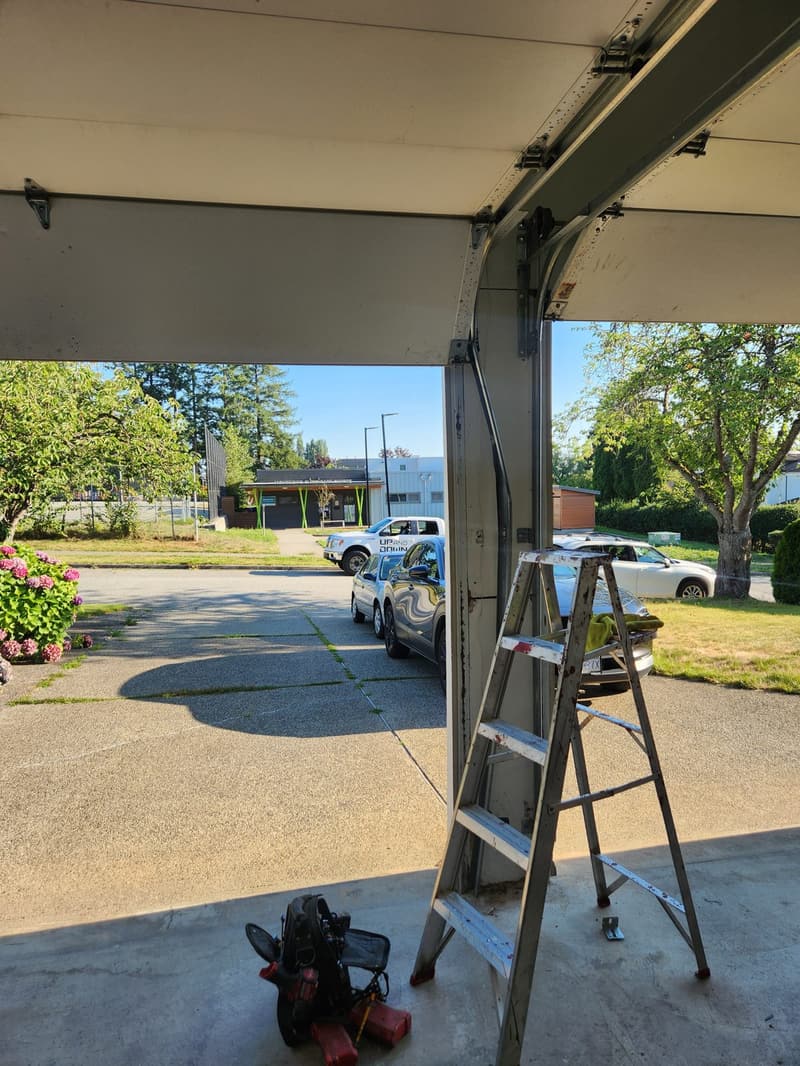
Your garage door opener has two separate safety systems that can cause a reversal. They work on completely different principles, and mixing them up is the most common reason people spend time checking the wrong thing.
The photo-eye system. Two sensors sit near the floor, one on each side of the door opening. They point at each other. When the door is closing, the opener checks for a continuous infrared beam between them. If anything breaks that beam — a kid’s bike, a garbage can, a cardboard box, a spider web — the opener stops the door and reverses it. This system only cares about obstructions in the path of the beam, which is about six inches off the ground.
The force-sensing system. The opener measures how much effort it takes to push the door down. If the door hits something solid, or if the track is pinched, or if a cable has gone slack and the door is binding, the opener feels extra resistance. It interprets that resistance as a trapped object and reverses. This system cares about mechanical resistance, not light beams.
A door that reverses because of a photo-eye issue usually stops partway down, hesitates, then goes back up. A door that reverses because of a force issue usually contacts the floor, or nearly does, then reverses. The difference matters because the fix is different.
Steps to troubleshoot a reversing garage door
Start with the photo-eyes. They fail more often than anything else, and they are the easiest to rule out.
Check for alignment. Walk to each sensor. They should be pointing directly at each other. Even a bump from a broom handle can knock one out of alignment. Most sensors have a small LED indicator. If the light is off or blinking, the beam is broken. Gently adjust the sensor until the LED stays solid. Tighten the bracket.
Check for obstructions. Look at the lens of each sensor. In Richmond’s wet winters, grime builds up fast. A dirty lens can scatter the beam. Wipe both lenses with a dry cloth. Also check for spider webs between the sensors. They are thin enough to miss but thick enough to break the beam.
Check the track. Look down both vertical tracks. A dent, a bend, or a loose bracket can pinch the door as it closes. The opener senses the extra resistance and reverses. Run your hand along the inside of the track — carefully, with the door open and disconnected from the opener — to feel for obstructions.
Check the rollers. A seized roller that has stopped turning will drag against the track instead of rolling. That creates friction. Enough friction triggers the force limit. If you see a roller that is flat-spotted or not spinning freely, that is your problem.
Check the force settings. On most openers, there are two adjustment screws on the back or side of the motor unit: one for open force, one for close force. If the close force is set too low, the door will reverse on any minor resistance. A quarter-turn clockwise on the close-force screw is a reasonable adjustment. Do not crank it. Too much force is dangerous — the door will not reverse when it should.
The point where it stops being a DIY job
If the door reverses consistently and none of the checks above find anything, the problem is likely in the springs or cables. That is where you stop.
A torsion spring under load stores enormous energy. A broken spring is obvious — you will see the gap in the coil. But a spring that has lost tension without breaking is harder to spot. The door becomes heavy. The opener struggles to push it down and senses the extra effort as an obstruction. The fix is spring adjustment or replacement, which requires winding bars, the right spring for your door weight, and the knowledge to handle the stored energy without injury.
A cable that has jumped off the drum or is fraying near the bottom bracket will also cause binding. The door will look crooked as it closes. One side may hit the floor before the other. The opener sees the uneven load and reverses. Cables under tension are not something to pull on.
In Queens Park, New Westminster, where many homes have pre-1941 garages with non-standard openings, the springs are often custom-sized. You cannot walk into a big-box store and buy a replacement off the shelf. In Austin Heights, Coquitlam, where homes are 40 to 50 years old, the original hardware is often at the end of its service life. Springs and cables on that timeline should be replaced in pairs, not patched.
What a technician actually does on the call
First, they disconnect the opener and run the door by hand. That tells them whether the problem is in the door hardware or the opener. A door that moves smoothly by hand but reverses under power points to the opener’s force settings or the opener itself. A door that binds or is heavy by hand points to springs, cables, rollers, or track.
They check the spring tension with the door in the open position. They measure the spring’s wire size, inside diameter, and length. They look at the cable drums to see if the cable is winding evenly. They check the track plumb and the bracket bolts.
If the force settings on the opener have been cranked up by someone trying to fix a reversal, they will reset them to factory spec and then test. If the door still reverses, they go deeper — rollers, hinges, weatherstripping catching on the jamb, even the floor being uneven enough to trip the sensor beam.
What drives the cost of the fix
No two reversal calls cost the same because the cause varies. A photo-eye realignment is a ten-minute job. A seized roller replacement takes longer because you have to remove the door from the track to get the roller out. A spring adjustment or replacement is the most labour-intensive because of the safety procedures involved.
The opener itself can be the problem. Older openers with mechanical force limits drift over time. The internal mechanism wears and the force threshold changes. Sometimes the fix is a new opener. Sometimes it is a simple limit adjustment. The only way to know is to test.
How to keep a garage door from reversing again
Lubricate the rollers and hinges twice a year. Use a silicone-based spray, not WD-40. WD-40 is a solvent, not a lubricant, and it will wash out the grease in your bearings.
Keep the photo-eye lenses clean. In a garage that sees sawdust, car exhaust, or spider activity, check them monthly.
Watch for changes in how the door moves. If it starts hesitating or making sounds it did not used to make, address it before it becomes a reversal problem. A door that reverses once a week will eventually reverse every time.
Up & Down Garage Doors serves Richmond and the rest of Metro Vancouver. If your door is reversing and the simple checks did not fix it, call 778-873-7282. We will come out, find what is actually causing it, and tell you what it will take to get it closing properly again.