Up and Down Garage Doors warns Metro Vancouver homeowners that bottom brackets carry full torsion or extension spring tension — tamper-resistant designs and specialized winding bars make this a certified technician repair, not a DIY project.
Bottom Bracket Safety Explained
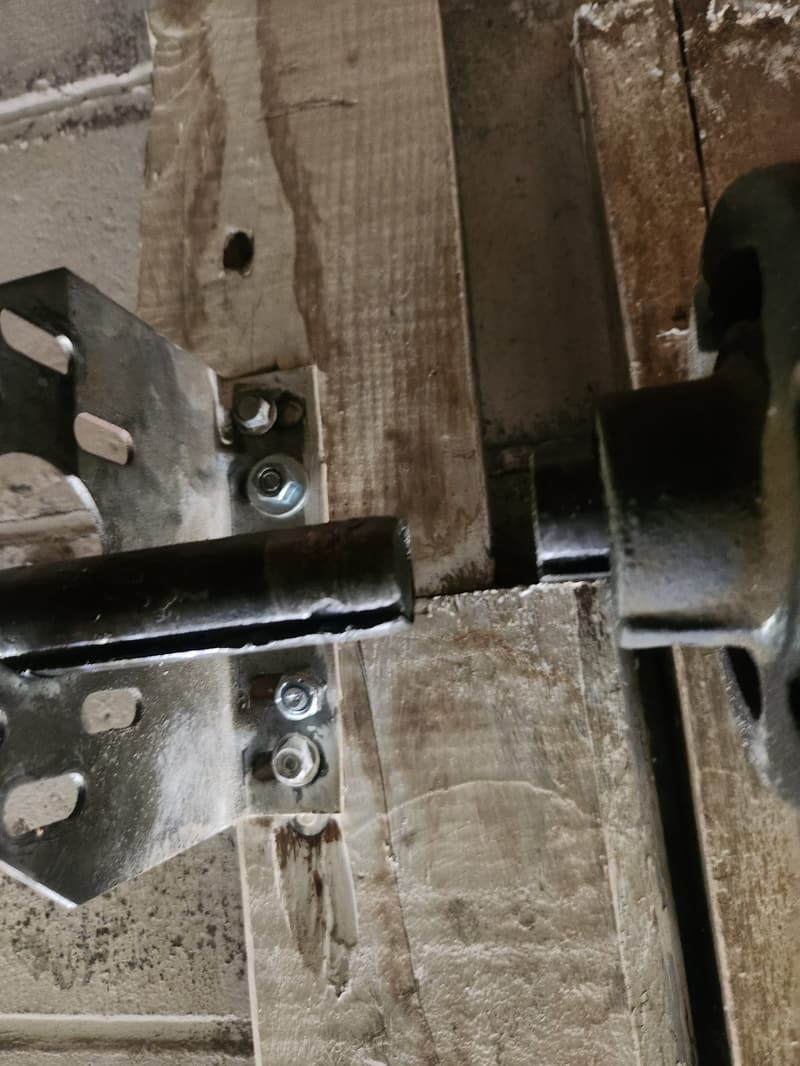
Unlike hinges or rollers, the bottom bracket (often called the bottom fixture) anchors the lifting cable directly to the door’s bottom section. On a standard 7 ft residential door in Richmond or Vancouver, that bracket sees the entire counterbalance force — typically 150–250 lb per side for a 10×7 ft insulated steel door with 0.225 in. (approx. 4 gauge) oil-tempered wire torsion springs rated for 10,000 cycles. The cable drum, shaft, and bracket form a closed load path; loosening the bracket bolts without first securing the spring releases that stored energy instantly.
Tamper-Resistant Designs in Modern Metro Vancouver Installations
Most doors installed in Metro Vancouver since the early 2000s use tamper-resistant bottom brackets per DASMA 102 and ANSI/DASMA 107. These brackets feature:
• Shear-off or breakaway set-screws that strip before the bracket can be rotated off the cable loop.
• Rolled-edge cable loops that prevent the cable from slipping off even if the bracket shifts.
• Factory-riveted or welded cable attachments on many Clopay, Amarr, and Wayne-Dalton models common in Richmond townhome complexes and Vancouver specials.
These features mean a homeowner with a socket set cannot simply “adjust” the bracket — the hardware is designed to defeat casual removal.
Wire Diameter, Gauge, and Cycle Ratings You’ll See on Local Jobs
Trade-standard specs our technicians encounter daily:
• Torsion spring wire: 0.192 in. (6 gauge) to 0.262 in. (3 gauge) for residential; 0.283 in. (1 gauge) and up for high-cycle or commercial.
• Extension spring wire: typically 0.192 in. (6 gauge) to 0.225 in. (4 gauge) for 7–8 ft doors.
• Cycle ratings: 10,000 cycles (builder grade), 25,000 cycles (high-cycle upgrade), 50,000+ cycles (commercial/industrial).
• Common part designations: DASMA color-code system — red/white = 0.225 in., white/white = 0.207 in., etc. — stamped on the spring cone or tag.
Why Metro Vancouver Climate Accelerates Bracket Wear
Coastal humidity and winter road salt (especially on Richmond and Delta doors facing driveways) corrode the bracket’s zinc plating and the cable’s galvanized coating. A corroded 7×19 aircraft cable (typical 1/8 in. diameter) loses up to 30 % of its rated breaking strength in five years. When the cable frays at the bracket loop, the bracket itself often shows stress-cracking at the cable-hole radius — a failure mode we see weekly on 1990s-era doors in East Vancouver and Kitsilano.
FAQ
Can I just tighten the bottom bracket bolts if the door is uneven?
No. The bolts clamp the bracket to the door section, but the cable tension remains on the spring. Loosening or retorquing them without winding bars and a solid shaft lock can let the spring unwind violently. Call a technician who will secure the spring first.
Are all bottom brackets tamper-resistant?
Doors manufactured after roughly 2002 follow DASMA 102 and include tamper-resistant features. Older doors — common in Vancouver’s Shaughnessy and West End neighborhoods — may have plain brackets with standard set-screws. Those are even more dangerous to adjust without training.
What cable size do you use for replacements?
We match the original spec: 1/8 in. (3.2 mm) 7×19 galvanized aircraft cable for most residential doors; 5/32 in. for heavier insulated or wide doors. The cable loop is swaged with a thimble and Nicopress sleeve rated to the cable’s full breaking strength.
How do I know if my bottom bracket is damaged?
Look for: cracked or elongated cable holes, white rust streaks running from the bracket onto the door section, cable strands broken at the loop, or the door sitting crooked when closed. Any of these means the bracket and cable need professional replacement together.
Do you replace brackets on all door brands?
Yes. We stock universal adjustable bottom fixtures (e.g., DASMA 102-compliant 12-gauge steel with 3/8 in. bolt slots) and OEM brackets for Clopay, Amarr, Wayne-Dalton, Raynor, and Hormann — the brands most common across Metro Vancouver.
Related Safety Components
Bottom brackets work with the cable drums, torsion shaft, and center bearing plate. If the drums are worn (groove depth below 0.125 in.) or the shaft is scored, the bracket cannot carry load evenly. We inspect the full counterbalance system on every spring or cable job — see our torsion spring replacement and cable replacement pages for the complete procedure.
Bottom brackets are under full spring tension — do not attempt DIY repair.
Call 778-873-7282 for certified service across Metro Vancouver.
Up and Down Garage Doors — Richmond, BC