Up and Down Garage Doors diagnoses and replaces worn center and end bearing plates on residential torsion systems throughout Metro Vancouver, using correct hardware matched to spring wire size, shaft diameter, and cycle rating — not generic substitutes.
Center Bearing Plate End Bearing Guide — What These Plates Do on a Torsion System
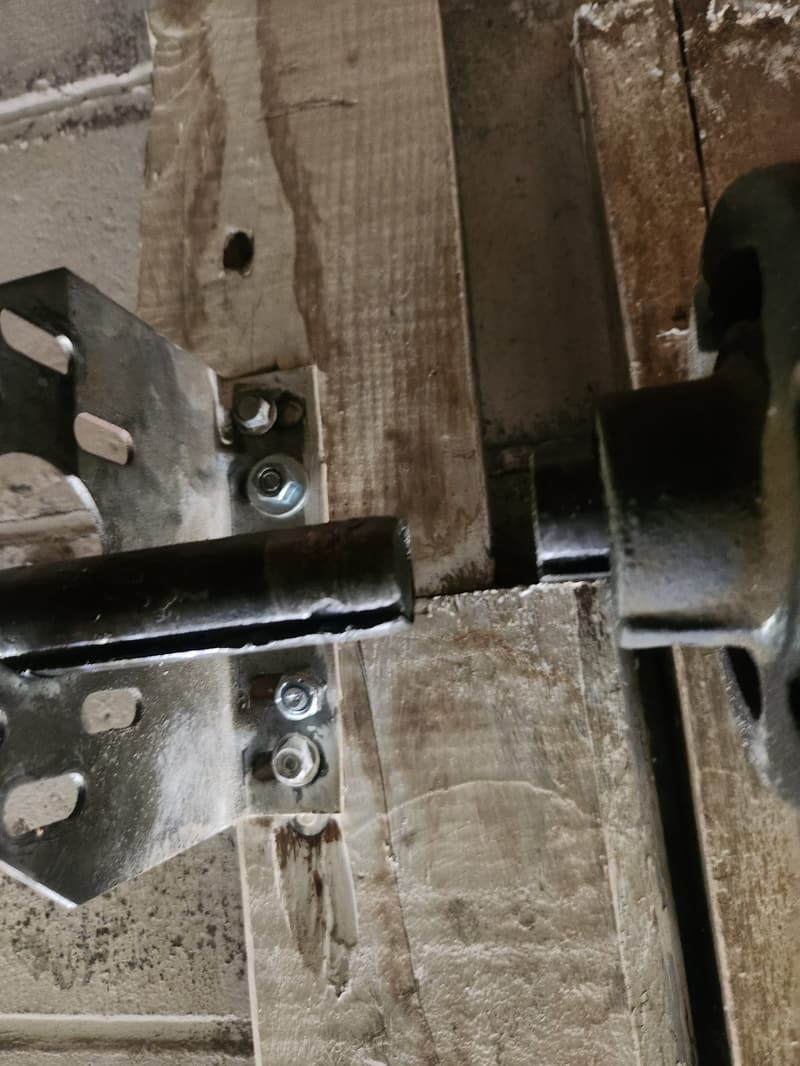
The center bearing plate anchors the stationary cone of the torsion spring to the header wall above the door, while end bearing plates (also called end brackets or flag brackets) support the torsion shaft at each end of the horizontal track assembly. Together they maintain shaft alignment so cables wind evenly on the drums. In Metro Vancouver’s damp climate, the header and jamb framing often absorbs moisture, causing wood movement that shifts plate alignment over time — especially on older homes in Richmond, Ladner, and North Vancouver where original Douglas fir headers have cycled through decades of wet-dry seasons.
How to Spot Wear Before Failure
What does a failing center bearing plate look like?
Look for elongated bolt holes in the header where lag bolts have worked loose, rust streaking down the wall from the plate’s mounting surface, or a visible gap between the plate and framing. On steel commercial headers, watch for cracked welds or torn bolt slots. A shaft that wobbles side-to-side when the door runs often traces back to a center plate that has shifted on its anchors.
What are the signs an end bearing plate needs replacement?
End plates show wear through oval-shaped bolt holes in the horizontal track angle, bearing race pitting that you can feel by rotating the shaft by hand (with springs unwound), or a shaft that sits lower on one side causing the door to run crooked. In coastal areas like White Rock and Tsawwassen, salt-laden air accelerates bearing corrosion — sealed bearings last longer than open races, but both eventually fail if the shaft seal leaks.
Standard Specifications You’ll Encounter
Residential center bearing plates typically use 3/8-inch or 1/2-inch lag bolts into wood headers, with a 1-inch or 1-1/4-inch inner diameter bearing race to match common shaft sizes. End bearing plates come in 12-gauge and 14-gauge steel thicknesses; 12-gauge (approx. 0.105 inches) is standard for doors over 16 feet wide or high-cycle springs rated 25,000+ cycles. Bearing races are commonly stamped 6204-2RS (20mm bore) or 6205-2RS (25mm bore) for 3/4-inch and 1-inch shafts respectively. Cycle ratings on the spring itself — 10,000, 25,000, 50,000 — dictate whether the original plates are adequate; upgrading springs without upgrading plates is a common shortcut that leads to premature plate failure.
Replacement Decision Points
When should bearing plates be replaced during spring service?
Replace the center plate if bolt holes are elongated more than 1/8 inch beyond the bolt shank, if the bearing race shows visible pitting or the bearing spins roughly, or if the plate steel has rusted through at any mounting tab. Replace end plates when the bearing race is pitted, the shaft has worn a groove in the race, or the mounting flange is bent from impact. Always replace both end plates as a set to keep shaft height equal.
Can I just tighten the bolts instead of replacing the plate?
Retightening works only if the wood behind the header is sound and the holes haven’t enlarged. In Metro Vancouver’s older housing stock — particularly pre-1980 builds in Kitsilano, Shaughnessy, and South Vancouver — header rot is common enough that adding longer lags into fresh wood is a temporary fix at best. A proper repair uses through-bolts with washers and nuts on the interior side of the header, or a steel reinforcement plate spanning multiple studs.
Metro Vancouver Installation Realities
Vancouver’s building code requires solid blocking behind header-mounted hardware. Many 1960s-1990s homes in Burnaby, Coquitlam, and Delta have double 2×10 or 2×12 headers that provide good holding power — if the wood is dry. But homes with finished garages often conceal the header behind drywall, making through-bolting impossible without opening the ceiling. In those cases, epoxy-anchored threaded rod into the concrete lintel above the header (common in newer Surrey and Langley builds) provides a code-compliant alternative. We carry 12-gauge end plates with sealed 6205-2RS bearings and 3/8-inch thick center plates drilled for 1/2-inch through-bolts as standard truck stock for the Metro Vancouver market.
Frequently Asked Questions
What wire diameters correspond to which bearing plate specs?
Standard residential torsion springs use wire diameters from .192 inches (light 7-foot doors) to .295 inches (heavy 16-foot doors). Springs up to .243 inches typically run on 3/4-inch shafts with 6204-2RS bearings; .250 inches and above usually require 1-inch shafts with 6205-2RS bearings. The center plate bearing ID must match the shaft, not the spring wire.
How do cycle ratings affect bearing plate selection?
10,000-cycle springs (standard builder grade) work with 14-gauge end plates and standard center plates. 25,000-cycle and 50,000-cycle springs generate higher torque and more vibration; they require 12-gauge end plates and center plates with reinforced mounting tabs. Mismatching high-cycle springs to light plates causes plate fatigue cracking at the bolt holes within 2-3 years.
What part designations should I ask for when ordering?
For center plates: “1-inch ID center bearing plate, 3/8-inch thick, 4-hole pattern, 1/2-inch bolt clearance” or “1-1/4-inch ID center bearing plate, 1/2-inch thick, through-bolt pattern.” For end plates: “12-gauge end bearing plate, 1-inch shaft, 6205-2RS sealed bearing, flag bracket style” or “14-gauge end bearing plate, 3/4-inch shaft, 6204-2RS sealed bearing.” Supplying the shaft diameter and spring cycle rating lets the supplier match the correct plate.
Why does my door run crooked after a spring replacement?
Uneven shaft height from mismatched end plates, a bent end plate flange, or a center plate that isn’t centered on the header will make the door run crooked. Shaft keys (Woodruff keys) must seat fully in both the shaft keyway and the drum keyway; a missing or sheared key lets the drum slip, throwing off cable tension on one side.
Are sealed bearings worth the extra cost?
Yes. Sealed bearings (2RS suffix) keep out the dust, pollen, and moisture that fill Metro Vancouver garages. Open bearings require annual greasing that homeowners rarely perform; sealed units run maintenance-free until the seal fails, typically 7-10 years in this climate.
What’s the typical cost range for bearing plate replacement?
Parts for a full set — center plate plus two end plates with sealed bearings — run roughly $85–$180 depending on gauge, shaft size, and bearing grade. Labor adds 1–2 hours when combined with spring replacement; standalone plate replacement takes longer because springs must be fully unwound and the shaft removed. We quote the complete job before starting so there are no surprises.
Need bearing plates inspected or replaced?
Call 778-873-7282
Up and Down Garage Doors — serving Richmond, Vancouver, Burnaby, Surrey, Delta, Langley, Coquitlam, and all Metro Vancouver
Up and Down Garage Doors | Richmond Garage Door Repair | Torsion Spring Replacement | Door Shaking Diagnosis | Contact Us