Up and Down Garage Doors provides Metro Vancouver homeowners with the technical procedure for manual torsion spring balance testing — covering half-open drift thresholds, wire gauge identification, cycle rating math, and when spring replacement beats adjustment.
Garage Door Balance Test Guide
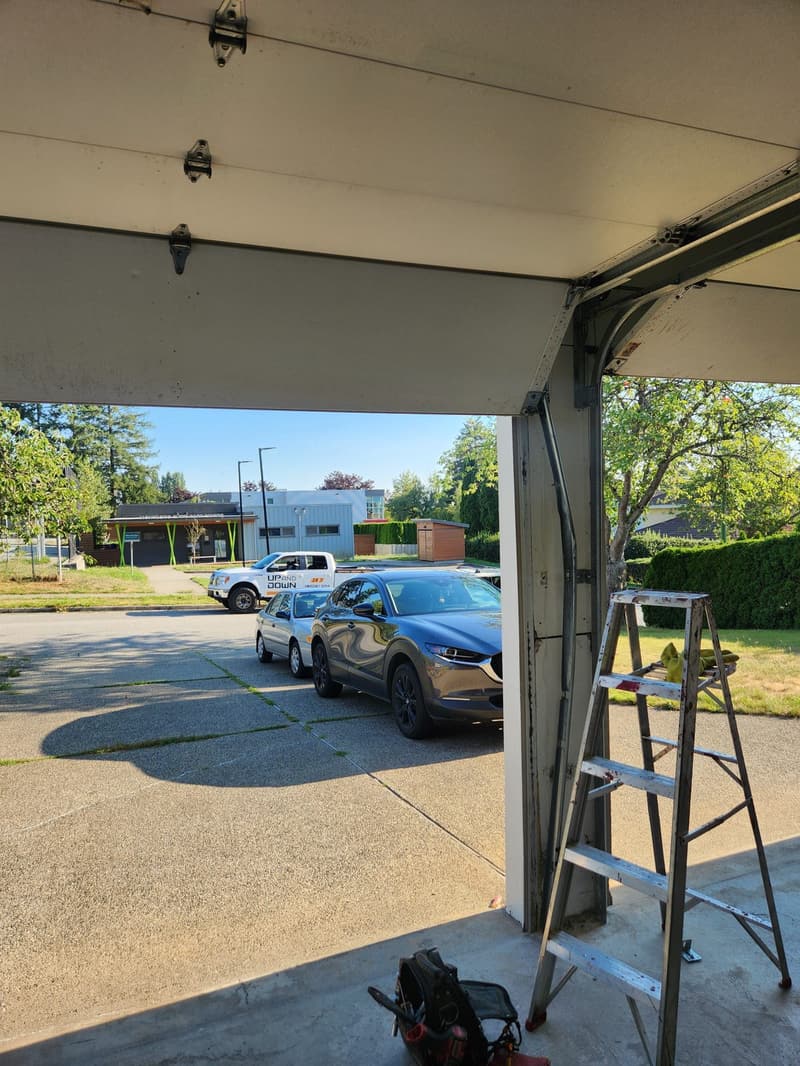
Metro Vancouver’s housing mix — 1970s split-levels in Burnaby, 1990s townhomes in Surrey, 2000s condos in Coquitlam, and custom builds in Richmond — means doors range from 7’×16′ single-car steel (≈130 lb) to 8’×18′ insulated double-car (≈280 lb). Coastal humidity cycles accelerate spring corrosion, while temperature swings between 2 °C and 28 °C cause wire relaxation. A door that passes balance in July may fail by January.
How to Perform the Manual Balance Test
Step 1: Disconnect the Opener
Pull the red emergency release cord straight down until the trolley disengages. Verify the door moves freely by hand — no opener resistance.
Step 2: Lift to Half-Open Position
Raise the door until the bottom edge aligns with the center of the vertical track radius (typically 36–42″ from floor on 7′ doors). Release slowly. A properly balanced door stays within ±3″ of that position.
Step 3: Interpret Drift Direction
- Drifts down: Springs are under-tensioned — add quarter-turns winding direction.
- Drifts up: Springs are over-tensioned — remove quarter-turns.
- Stays put ±3″: Balance is correct.
Step 4: Test Full Travel
Open and close manually through full range. Feel for binding, uneven weight, or sudden acceleration — these indicate cone slippage, cable drum wear, or mismatched spring pair.
What Half-Open Drift Means — Spring Wear Math
Standard residential torsion springs are rated 10,000 cycles (one open + close = one cycle). At 4 cycles/day, that’s 6.8 years. High-cycle upgrades (25,000–50,000 cycles) use larger wire diameter or longer coils. Wire gauge determines torque: .207″ (common 7′ door) ≈ 170 IPPT; .218″ ≈ 210 IPPT; .225″ ≈ 240 IPPT; .234″ ≈ 280 IPPT; .243″ ≈ 320 IPPT; .250″ ≈ 350 IPPT. Each 10% wire diameter increase yields ~25% torque gain and ~2× cycle life.
Spring stretch over time: music wire relaxes ~2–3% in first 500 cycles, then ~0.5% per 1,000 cycles. A 10,000-cycle spring at year 5 has lost ~4% torque — enough to shift balance beyond the ±3″ window on heavier doors. That’s why half-open drift appears before catastrophic failure.
Component Specifications — Trade Standard Data
Torsion Spring Identification
Springs are marked with color cones (red = right-wind, black = left-wind) and stamped wire size/length/ID. Example: “225 27 34″ = .225″ wire, 27″ length, 34″ inside diameter. Inside diameter is almost always 1.75″ (residential) or 2″ (commercial). Length determines turns: 7′ door ≈ 7.5 turns on .225″×27”; 8′ door ≈ 8.5 turns.
Cable Drums
Standard 400-8 (4″ diameter, 8 grooves) for 7′ doors; 525-8 for 8′ doors. Groove count matches cable wraps. Worn grooves cause cable slip — inspect for flattened edges.
Bearing Plates & Center Brackets
Center bearing plate: 3.5″×3.5″×0.125″ steel with 1″ sealed bearing. End bearing plates: 3″×3″×0.125″. Cracks at lag bolt holes = replace, not weld.
When Adjustment Isn’t Enough
If springs are within 1,000 cycles of rating, show visible corrosion pitting, have mismatched wire sizes (common after DIY single-spring replacement), or the door exceeds 250 lb — replace both springs as a matched pair. Adjusting a fatigued spring risks sudden breakage under winding tension.
Metro Vancouver Weather Effects on Spring Life
Coastal salt air (Richmond, Delta, White Rock) accelerates surface corrosion — reduces cycle life by 15–20% vs. inland (Surrey, Langley). Unheated garages see condensation cycles daily October–April. Light oil wipe-down every 6 months extends life; WD-40 attracts grit — use 3-in-One or dedicated garage door lubricant.
FAQ
How often should I test my garage door balance?
Test quarterly — at each season change. Metro Vancouver’s temperature swings shift spring torque enough to matter.
Can I adjust torsion springs myself?
Only if you have winding bars (not screwdrivers), understand turn counts for your wire size/door height, and accept that a slipping bar stores enough energy to shatter bone. Most homeowners should call a pro.
What does it mean if my door is heavy only on one side?
Usually a cable drum issue — worn groove or loose set screw on that side. Check both drums for equal cable wraps.
Why does my door pass the half-open test but feel heavy at the bottom?
Spring rate mismatch: springs sized for door weight but wrong IPPT for the radius change at floor level. Common when 7′ springs are used on 8′ doors.
How do I know my spring wire size without markings?
Measure 10 coils with a tape measure, divide by 10 = wire diameter. Or use a wire gauge tool. Common sizes: .207, .218, .225, .234, .243, .250.
What’s the cost range for spring replacement in Metro Vancouver?
Pricing varies by door weight, spring cycle rating, and access difficulty. Standard 10k-cycle pair replacement typically falls in a mid-range tier; high-cycle 25k–50k upgrades cost more upfront but reduce lifetime cost per cycle. Get a specific quote for your door specs.
CTA
Need a balance test or spring assessment? Call 778-873-7282 — Up and Down Garage Doors serves Richmond, Vancouver, Burnaby, Surrey, Delta, Coquitlam, and surrounding BC communities.
Up and Down Garage Doors Home | Instant Quote | Contact Us | Richmond Repair | Vancouver Spring Repair