Up and Down Garage Doors diagnoses slow garage doors across Metro Vancouver by testing torsion spring torque, opener force limits, and cold-weather lubrication viscosity — pinpointing whether the root cause is spring fatigue, incorrect speed settings, or temperature-related stiffness.
Garage Door Opens Slowly Causes
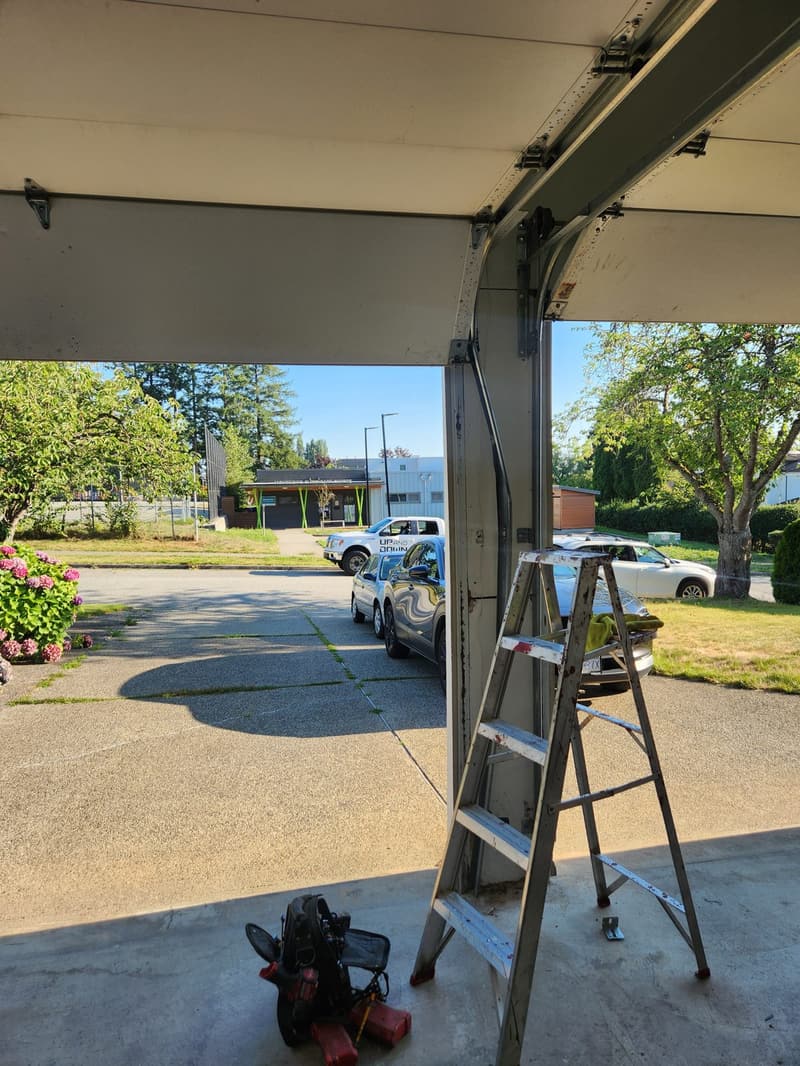
Metro Vancouver’s housing stock — from 1960s split-levels in Burnaby with 7-foot doors to modern insulated 16×7 sectional doors in Surrey and Richmond — creates distinct wear patterns. Coastal humidity accelerates spring corrosion, while winter temperatures dropping to -5°C thicken standard 10W garage door lubricant to near-grease consistency. A door that operates normally in July may crawl at half-speed in January.
Spring Fatigue vs. Opener Settings vs. Cold Stiffness
Three primary failure modes produce similar symptoms but require different fixes:
- Spring fatigue: Torsion springs rated for 10,000 cycles (standard oil-tempered wire, 0.225″–0.250″ diameter) lose 15–20% torque after 7,000 cycles. A 250-lb door needs ~300 in-lb torque; fatigued springs deliver ~240 in-lb, forcing the opener to strain.
- Opener speed/force settings: LiftMaster Security+ 2.0 operators (models 8500W, 84504R, 87802) default to medium force. If the “up force” is set below 5 on a 1–10 scale, the door moves at ~4–5 in/sec instead of 7–8 in/sec. Cold weather compounds this.
- Cold stiffness: Below 5°C, standard lithium grease on rollers and hinges increases drag by 30–40%. Nylon rollers (11-ball, 2″ diameter) on uninsulated doors in Delta or White Rock garages are most affected.
Component Specifications That Matter
Torsion Spring Wire Gauge & Cycle Ratings
Standard residential springs use oil-tempered ASTM A229 wire. Common sizes in Metro Vancouver installs:
| Wire Diameter | Inside Diameter | Length | Cycle Rating | Typical Door Weight |
|---|---|---|---|---|
| 0.225″ (approx. 3.5 gauge) | 1.75″ | 24″–28″ | 10,000 | 180–220 lbs |
| 0.243″ (approx. 3 gauge) | 1.75″ | 28″–32″ | 10,000 | 220–280 lbs |
| 0.262″ (approx. 2.5 gauge) | 1.75″ | 32″–36″ | 10,000 | 280–350 lbs |
| 0.225″ high-cycle | 1.75″ | 36″–40″ | 25,000–50,000 | 180–220 lbs |
High-cycle springs use the same wire diameter but longer length (more active coils) to reduce stress per cycle. We stock 25,000- and 50,000-cycle springs for heavy-use households in Vancouver’s west side and Richmond where doors cycle 8–12 times daily.
Opener Rail Speed & Force Parameters
LiftMaster belt-drive models (8500W, 85870, 84602) run at 7.5 in/sec nominal. Chain-drive models (8365W-267, 2420L) run at 6.5 in/sec. The “speed” setting in the menu adjusts ramp-up/ramp-down profiles, not top speed. Force settings (1–10) control the current limit before reversal — not motor voltage. Setting force too low on a heavy insulated door (R-16, 300+ lbs) mimics spring failure.
Diagnostic Procedure We Use On-Site
- Disconnect opener — pull the red emergency release. Lift door manually. It should stay at waist height (balanced) and move with <15 lbs force.
- Check spring gap — measure between coils on a wound spring. Standard 0.243″ wire: 1/8″–3/16″ gap per coil when wound. Wider gap = lost torque.
- Test opener alone — reconnect, run cycle. Watch RPM sensor (LiftMaster 8500W: 300 RPM nominal). If motor bogs below 200 RPM under load, force setting or spring torque is low.
- Inspect rollers & hinges — 11-ball nylon rollers (part #41A5346) should spin freely. Steel 10-ball rollers (part #41A5345) on older doors in Kitsilano or Shaughnessy homes often seize after 15 years.
- Check lubricant condition — wipe roller stem. White lithium grease turns amber and tacky below 0°C. Synthetic PTFE spray (DuPont Teflon) maintains viscosity to -20°C.
Metro Vancouver Weather Impact on Door Speed
November through March, overnight lows in Burnaby, Coquitlam, and North Vancouver regularly hit 0°C to -5°C. Uninsulated detached garages (common in Ladner, Tsawwassen, Port Coquitlam) drop to outdoor temperature. Insulated attached garages in Vancouver proper stay 5–8°C warmer. This 5–10°C differential changes lubricant viscosity enough to add 2–3 seconds to a full open cycle. We recommend synthetic PTFE lubricant applied each October for coastal customers.
When to Replace Springs vs. Adjust Opener
If manual lift force exceeds 20 lbs or the door drifts down from waist height, springs are the issue — no opener adjustment compensates for lost torque. If manual lift is easy but opener struggles, check force setting first. Increase by one increment per test cycle. Max force (10) on a properly sprung door indicates worn drive gear (LiftMaster part #41A5434) or failing RPM sensor board.
FAQ
How do I know if my torsion springs are fatigued?
Measure the gap between coils on a wound spring. Standard 0.243″ wire should show 1/8″–3/16″ per coil. Wider gaps mean lost torque. Also test manual lift: a balanced door stays at waist height with <15 lbs force. If it drifts down or feels heavy, springs have lost 15%+ torque.
Can cold weather alone make my garage door open slowly?
Yes. Below 5°C, standard lithium grease thickens 30–40%, adding 2–3 seconds per cycle. Uninsulated detached garages in Delta, White Rock, and Ladner see the worst effect. Synthetic PTFE spray lubricant rated to -20°C eliminates most cold-related drag.
What opener force setting should I use for a heavy insulated door?
For R-16 insulated doors (300+ lbs), start at force setting 6–7 on LiftMaster Security+ 2.0 models (8500W, 84504R, 87802). Increase one step at a time until door completes cycle without reversing. Never exceed setting 8 on a properly sprung door — higher settings mask spring failure and risk gear damage.
Do high-cycle springs open the door faster?
No. High-cycle springs (25,000–50,000 cycles) use longer wire length to reduce stress per cycle, not higher torque. They maintain rated torque longer but don’t increase speed. Speed is determined by opener RPM and spring torque matching door weight.
Why does my door open fine manually but slowly with the opener?
This indicates an opener issue: force setting too low, worn drive gear (nylon gear #41A5434 strips after 10–15 years), failing RPM sensor board, or chain/belt tension too loose. Disconnect the opener and test manual lift — if easy, the opener needs service, not the springs.
How often should I lubricate garage door rollers in Metro Vancouver?
Every 6 months minimum. Coastal humidity washes out lubricant faster. Apply synthetic PTFE spray to roller stems, hinge pins, and spring coils in October (pre-winter) and April. Avoid WD-40 — it’s a solvent, not a lubricant, and strips existing grease.
Slow door? We’ll diagnose the exact cause — spring, opener, or cold weather.
Call 778-873-7282 for Metro Vancouver service
Up and Down Garage Doors — Richmond, BC
Related service pages: Richmond garage door repair, LiftMaster 8500W service, high-cycle spring upgrades, torsion spring replacement, get a quote