Up and Down Garage Doors installs and retrofits perforated angle hanging systems for residential garage door openers across Metro Vancouver, using trade-standard 14-gauge slotted steel angle, Grade 5 hardware, and vibration-damping washers to isolate motor vibration from ceiling joists and prevent rail sway during daily cycles.
Garage Door Perforated Angle Hanging
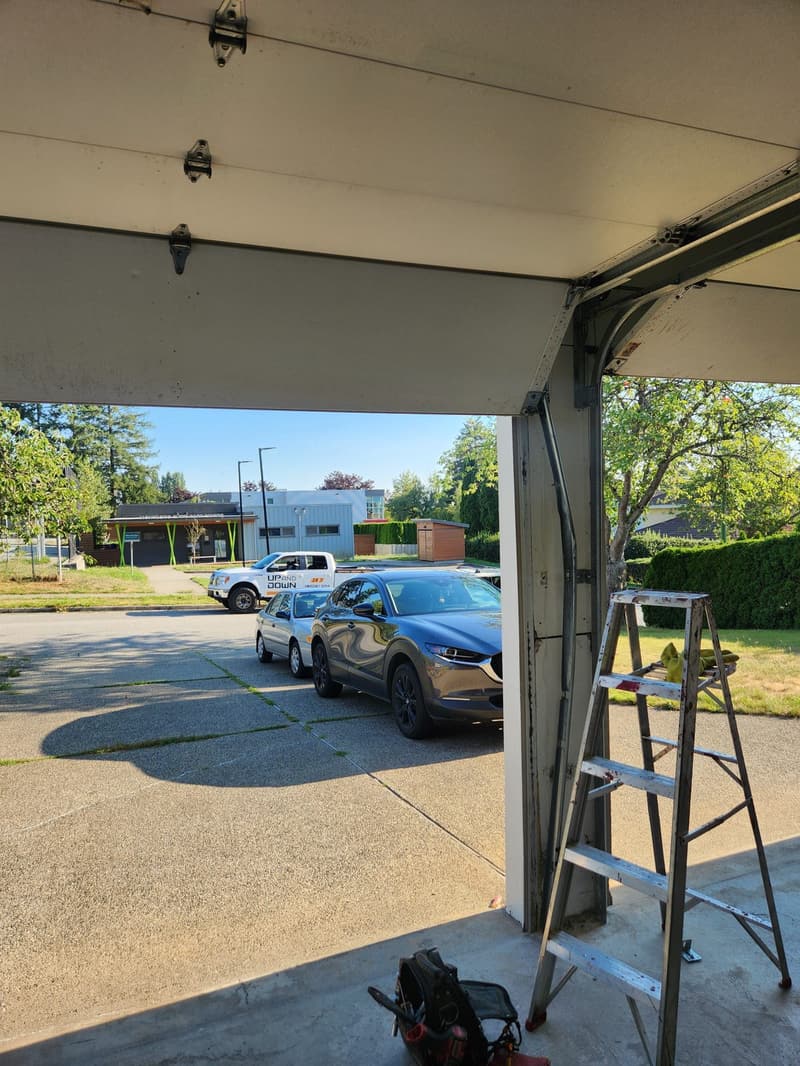
Perforated angle (often called slotted angle or “Uni-strut” style) provides a rigid three-dimensional mounting plane. Unlike 12-gauge perforated strap, which can twist under the torsional load of a jackshaft or trolley operator, 14-gauge (1.9 mm) cold-rolled steel angle with 9/16 in. (14 mm) holes on 1-7/8 in. (47.6 mm) centers resists both vertical deflection and lateral racking. In Metro Vancouver’s older homes — particularly 1960s–1990s split-levels in Richmond, North Delta, and Burnaby with 2×6 ceiling joists on 16 in. centers — the angle spans two joists, distributing the opener’s 15–25 lb (6.8–11.3 kg) motor head weight plus dynamic rail reaction forces across multiple framing members.
Component Specifications (Trade-Standard)
Perforated Angle
- Material: ASTM A1008 CS Type B, commercial steel, 14 gauge (0.0747 in. / 1.90 mm)
- Profile: 1-5/8 in. × 1-5/8 in. (41 mm × 41 mm) equal leg
- Slot pattern: 9/16 in. (14.3 mm) diameter holes, 1-7/8 in. (47.6 mm) on center, staggered
- Finish: Pre-galvanized G90 (Z275) or hot-dip galvanized after fabrication for coastal exposure
- Lengths: 10 ft (3.05 m) standard; cut to span two joist bays (typically 32–34 in. / 813–864 mm)
Fasteners to Joists
- Lag screws: 3/8 in. × 3 in. (M10 × 76 mm) Grade 5, minimum 2 per joist, 1-1/2 in. (38 mm) minimum penetration into joist
- Washers: 3/8 in. SAE flat washer (OD 0.875 in. / 22 mm) under head; 3/8 in. split lock washer or nylon-insert flange nut on threaded rod drops
- Vibration isolation: 3/8 in. ID × 1 in. OD × 1/8 in. thick neoprene or EPDM washer between angle and joist (durometer 50–60A)
Threaded Rod Drops (Rail to Angle)
- Rod: 3/8-16 UNC all-thread, ASTM A307 Grade A, zinc-plated
- Length: Cut to achieve 2–4 in. (50–100 mm) drop from joist to rail bracket — keeps rail level with header bracket
- Hardware per drop: Two 3/8-16 hex nuts (top and bottom of angle), two SAE flat washers, one neoprene isolation washer at angle contact
- Torque: Snug-tight plus 1/4 turn; do not over-compress isolation washer beyond 50% deflection
Rail Bracket Connection
- LiftMaster/Chamberlain trolley rail bracket: 3/8 in. clearance hole, attaches to lower rod nuts
- Jackshaft (wall-mount) operator: Uses manufacturer-supplied mounting bracket; angle provides lateral bracing only
Vibration Isolation Details
The neoprene washer at each joist lag and each rod-to-angle junction breaks the structural-borne vibration path. A typical 1/2 HP AC chain-drive opener (e.g., LiftMaster 8365W-267) generates 15–25 Hz excitation at the motor mount; the 1/8 in. (3 mm) washer at 50A durometer provides a static deflection of ~0.03 in. (0.75 mm) under 20 lb (9 kg) load, yielding a natural frequency near 12 Hz — below the excitation range. For belt-drive units (LiftMaster 8550, 84504R) with lower vibration, the same hardware prevents creep loosening of lag screws over 10,000+ annual cycles.
Sway Bracing Requirements
Longitudinal Bracing (Along Rail)
Per DASMA TDS-162 and manufacturer installation manuals, the rail must be braced against longitudinal movement at intervals not exceeding 8 ft (2.44 m). With perforated angle spanning two joists, install a diagonal brace from the angle to the adjacent joist:
– Material: Same 14-gauge perforated angle, cut 24–30 in. (610–762 mm)
– Angle: 45° from horizontal
– Fasteners: Two 3/8 in. × 3 in. lags into joist, two 3/8-16 bolts through angle slots
Lateral Bracing (Perpendicular to Rail)
Required when rail span between header bracket and first joist support exceeds 4 ft (1.22 m), common in Vancouver Specials with deep soffits. Install a second perpendicular angle from the main hanging angle to the next joist:
– Same 14-gauge angle, length to suit joist spacing (typically 14.5 in. / 368 mm clear)
– Connect with 3/8-16 bolt, two flat washers, lock nut at intersection
– Prevents rail walk during reversal cycles
Metro Vancouver Housing Stock Considerations
Post-1990 Truss Roofs (Surrey, Coquitlam, Langley)
Engineered trusses on 24 in. centers — angle must span three truss chords (48 in. / 1.22 m). Use 12-gauge (2.66 mm) angle for spans >36 in. Verify truss chord capacity with builder specs; do not lag into web members.
Vancouver Special / Rancher Soffits (East Van, South Vancouver, Richmond)
Deep soffits (18–36 in. / 457–914 mm) push the header bracket far from the first joist. Run a continuous 14-gauge angle from header bracket back to first joist bay, supported by two threaded rod drops at 1/3 and 2/3 points. Adds two isolation points; keeps rail straight under 300+ lb (136 kg) door reaction.
West Vancouver / North Vancouver Exposed Beam Ceilings
Douglas fir glulam or solid 4×12 beams on 48 in. centers. Lag screws require 3 in. (76 mm) penetration — use 3/8 in. × 4 in. lags. Pre-drill 5/16 in. (8 mm) pilot to prevent splitting. Two lags per beam minimum.
Cycle Rating Context
Residential openers rated 10,000–15,000 cycles (LiftMaster 8500W, 87504-267). At 4 cycles/day, that’s 7–10 years. Hardware above (Grade 5 lags, A307 rod, G90 angle) exceeds 50,000 cycle fatigue life per ASTM F1554 testing. Neoprene washers should be inspected at 10-year / 15,000-cycle intervals; replace if cracked or compressed >75% original thickness.
Frequently Asked Questions
Can I reuse existing perforated strap when upgrading the opener?
No. 12-gauge strap lacks the torsional rigidity for modern DC belt-drive or jackshaft operators. Replace with 14-gauge angle spanning two joists minimum.
What size lag screws for 2×4 ceiling joists in a 1970s Richmond rancher?
3/8 in. × 3 in. Grade 5 lags with 1-1/2 in. minimum penetration. Two per joist, staggered vertically 1 in. apart to avoid splitting.
Do I need sway bracing for a LiftMaster 8500W wall-mount jackshaft?
Yes — lateral bracing at the motor head prevents unit rotation during torque spikes. Use 14-gauge angle from motor bracket to nearest joist, 45° diagonal.
How much drop can I run with 3/8 in. threaded rod?
Up to 24 in. (610 mm) without additional lateral support. Beyond 24 in., add a mid-span lateral brace to prevent rod bowing under door weight reaction.
Will galvanized angle last in a coastal North Vancouver garage?
G90 pre-galvanized is adequate for interior garage environments. For garages with direct salt-air exposure (oceanfront), specify hot-dip galvanized after fabrication or 304 stainless angle.
Can I hang the rail from a single joist with a heavy-duty bracket?
Not recommended. Single-point mounting transfers all vibration and reversal torque to one joist, causing drywall cracks and fastener loosening within 2–3 years. Dual-joist angle spread is standard practice.
Need Perforated Angle Hanging Installed or Retrofitted?
Call 778-873-7282 — Up and Down Garage Doors serves Richmond, Vancouver, Burnaby, Surrey, Delta, Coquitlam, Langley, North Vancouver, West Vancouver, White Rock, and all Metro Vancouver BC.
Related service pages: LiftMaster 8365W-267 Installation & Repair | LiftMaster 84504R/84505R Installation & Repair | LiftMaster 8500W Installation & Repair | Garage Door Opener Repair (中文) | Garage Door Shaking When Opening — Diagnosis