Up and Down Garage Doors provides Metro Vancouver homeowners with precise door weight data — covering 8×7 vs 16×7, steel, wood, and insulated constructions — so torsion and extension springs are matched to actual load, not guesswork.
Garage Door Weight By Size Material
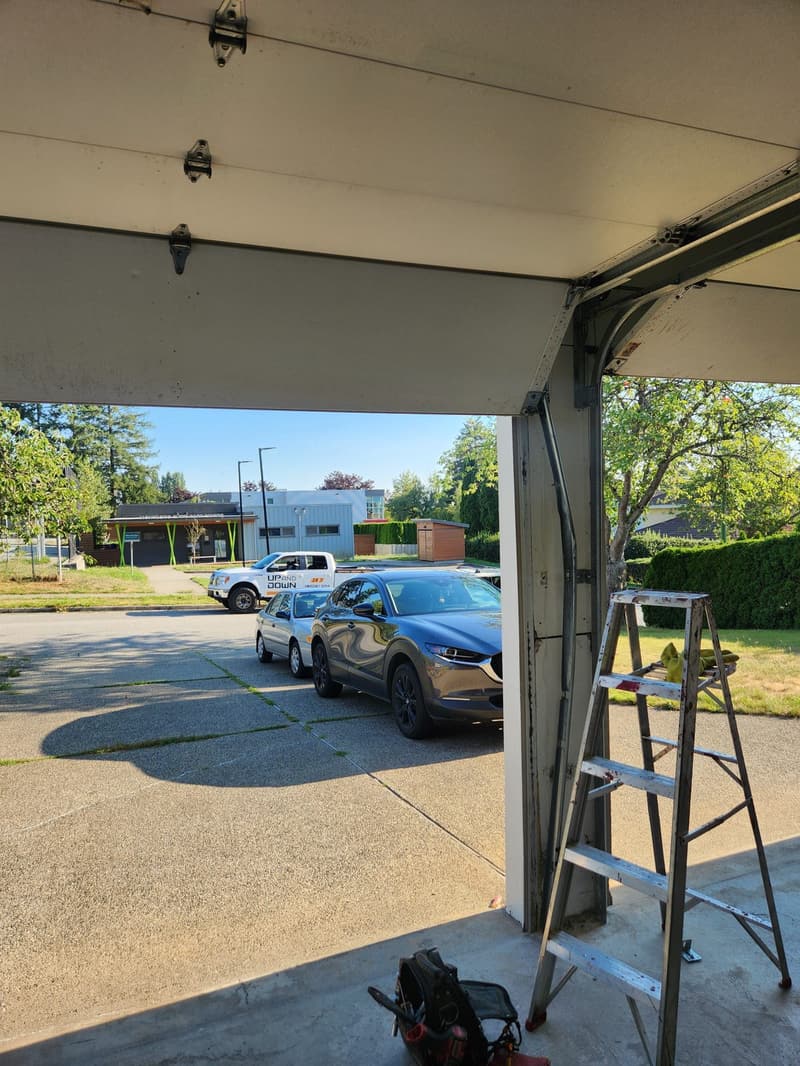
Torsion springs counterbalance the door’s exact weight. A 10 lb error in weight estimation changes required torque by 5–10%, causing premature spring fatigue, opener strain, or unsafe manual operation. In Metro Vancouver’s damp climate, condensation inside non-insulated steel panels adds 3–5 lbs over dry weight, while wood doors absorb moisture seasonally, shifting balance by 8–12 lbs between July and January. Installers must weigh the assembled door — including hardware, struts, and insulation — before selecting wire diameter, inside diameter, and length.
How Weight Changes Wire Gauge and Cycle Rating
Standard residential torsion springs use oil-tempered wire from .192″ to .262″ diameter. Heavier doors require thicker wire (lower gauge number) to achieve target torque without overstressing the coil. A 10,000-cycle spring rated for 180 lbs door weight drops to ~7,000 cycles if the door actually weighs 210 lbs. High-cycle springs (25,000–50,000 cycles) use larger wire diameters and longer bodies to reduce stress per revolution. Wire gauge, inside diameter (typically 1.75″ or 2.0″), and active coil count are calculated from door weight, drum circumference, and desired cycle life — not from door model alone.
Typical Door Weights by Size and Material
8×7 Single-Car Doors
Non-insulated 24-gauge steel: 85–100 lbs. Insulated 24/27-gauge steel with 1-3/8″ polyurethane: 110–130 lbs. 16×7 double-car doors roughly double these ranges. Solid wood (cedar, hemlock common in Vancouver heritage homes): 180–250 lbs for 8×7; 350–450 lbs for 16×7. Composite overlay doors add 30–50 lbs over steel base. Aluminum full-view doors: 90–120 lbs (8×7) depending on glass thickness. Each strut adds 2–4 lbs per section.
16×7 Double-Car Doors
Non-insulated 25-gauge steel: 160–190 lbs. Insulated 24/27-gauge with 2″ polyurethane: 210–260 lbs. Three-layer “sandwich” construction (steel-insulation-steel) adds 15–25 lbs over two-layer. Wood doors in Shaughnessy, Kerrisdale, and Dunbar often exceed 400 lbs with decorative hardware. These weights require .243″–.262″ wire, 2.0″ ID springs, and often dual-spring assemblies for redundancy.
Component Specifications That Follow From Weight
Torsion Spring Wire Diameter & Gauge
.192″ (approx 6 gauge) for doors ≤120 lbs. .207″ (5 gauge) for 120–160 lbs. .218″ (4 gauge) for 160–200 lbs. .225″ (3 gauge) for 200–240 lbs. .234″ (2 gauge) for 240–280 lbs. .243″ (1 gauge) for 280–330 lbs. .250″ (1/0) for 330–380 lbs. .262″ (2/0) for 380–450 lbs. Inside diameter: 1.75″ standard residential; 2.0″ for heavier doors or high-cycle upgrades. Active coils calculated from door height, drum size, and required turns (typically 7.5–8.5 turns for 7′ door on 4″ drum).
Extension Spring Specs
Color-coded by pull weight: tan (100 lbs), white (110 lbs), green (120 lbs), yellow (130 lbs), blue (140 lbs), red (150 lbs), brown (160 lbs), orange (170 lbs), gold (180 lbs), light blue (190 lbs). Length: 25″ relaxed for 7′ doors, 27″ for 8′ doors. Stretch: 42″ max for 7′, 48″ for 8′. Must install safety cables through center — required by BC Building Code.
Drums and Cables
4″ cable drums (standard 7′ doors) with 1/8″ or 5/32″ aircraft cable (7×19 construction). 5-1/4″ drums for 8′ doors or high-lift. Cable length = door height + 18″ (7′ door = 102″, 8′ = 114″). Bottom brackets: 13-gauge for residential, 11-gauge for doors >300 lbs. Center bearing plates: 12-gauge minimum; 10-gauge for dual-spring setups.
Metro Vancouver Climate Effects on Weight & Spring Life
Coastal humidity cycles cause wood doors to swell 2–3% in width, adding 8–15 lbs winter weight. Salt air in Tsawwassen, White Rock, and Richmond accelerates spring wire corrosion — uncoated oil-tempered springs lose 15–20% cycle life within 3 years. Powder-coated or galvanized springs extend service interval. Insulated steel doors with vinyl back skins resist moisture absorption; non-insulated single-skin doors trap condensation between panel and weatherstrip, adding variable weight. Annual re-balancing accounts for these shifts.
FAQ
How do I know my door’s exact weight without a scale?
You cannot determine exact weight from model numbers alone. Manufacturer spec sheets list “approximate shipping weight” without hardware, struts, or insulation. The only reliable method: disconnect opener, support door horizontally, and weigh with a calibrated floor scale under each end. Up and Down Garage Doors weighs every door on service calls before spring replacement.
Can I use a heavier spring to get more cycles?
Over-springing (using higher torque than door weight requires) causes the door to drift open, strains the opener’s limit switches, and creates dangerous manual operation forces. Spring wire diameter, length, and ID must match calculated torque for the actual door weight. High-cycle life comes from larger wire and more active coils at the correct torque — not from excess torque.
Why do my springs break every 2–3 years in Richmond?
Richmond’s high water table and salt-laden air accelerate corrosion on uncoated springs. Standard 10,000-cycle springs rated for 7–9 years in dry climates often fail at 3–4 years here. Upgrading to 25,000-cycle galvanized or powder-coated springs with .234″–.250″ wire (matched to door weight) typically delivers 8–12 years service in coastal BC.
What changes when I add insulation to an existing steel door?
Retrofit insulation kits add 12–18 lbs per section (48–72 lbs total for 16×7). This shifts required spring torque by 15–25%. Existing springs will be under-torqued — door feels heavy, opener struggles, springs fatigue faster. Springs must be replaced or re-torqued (if adjustable) after insulation install. New spring specs: recalculate using weighed door + insulation weight.
Are wood doors harder on springs than steel?
Yes. Wood doors weigh 2–3x comparable steel doors, requiring thicker wire (.243″–.262″), larger ID (2.0″), and often dual springs. Wood’s seasonal moisture cycling changes door weight 5–8% annually, meaning spring balance drifts. Wood also transfers more vibration to springs during operation, accelerating coil fatigue. High-cycle springs (25k+) are strongly recommended for wood doors in Metro Vancouver.
What spring specs apply to 8′ tall doors vs 7′?
8′ doors need 1–1.5 additional turns (8.5–10 turns on 4″ drum), longer spring body (more active coils), and 27″ relaxed extension springs. Cable length increases 12″. Drum diameter may step to 5-1/4″ for high-lift tracks. Weight increases ~15% over 7′ same material. All specs recalculated from weighed door — never assume 7′ specs scale linearly.
Need springs matched to your door’s actual weight?
Call 778-873-7282 for on-site weighing and correct spring installation.
Up and Down Garage Doors — Richmond, BC
Up and Down Garage Doors provides precision spring replacement across Metro Vancouver. For torsion spring details, see torsion spring replacement. For high-cycle upgrades, review high-cycle garage door springs. Get a quote at instant garage door quote or browse Richmond repair services.