Up and Down Garage Doors installs double-track and rear-torsion low-headroom systems across Metro Vancouver, matching hardware to the tight clearances found in Richmond laneway houses, Vancouver basement suites, and Burnaby split-level garages where standard 12-inch radius tracks won’t fit.
Low Headroom Garage Door Hardware
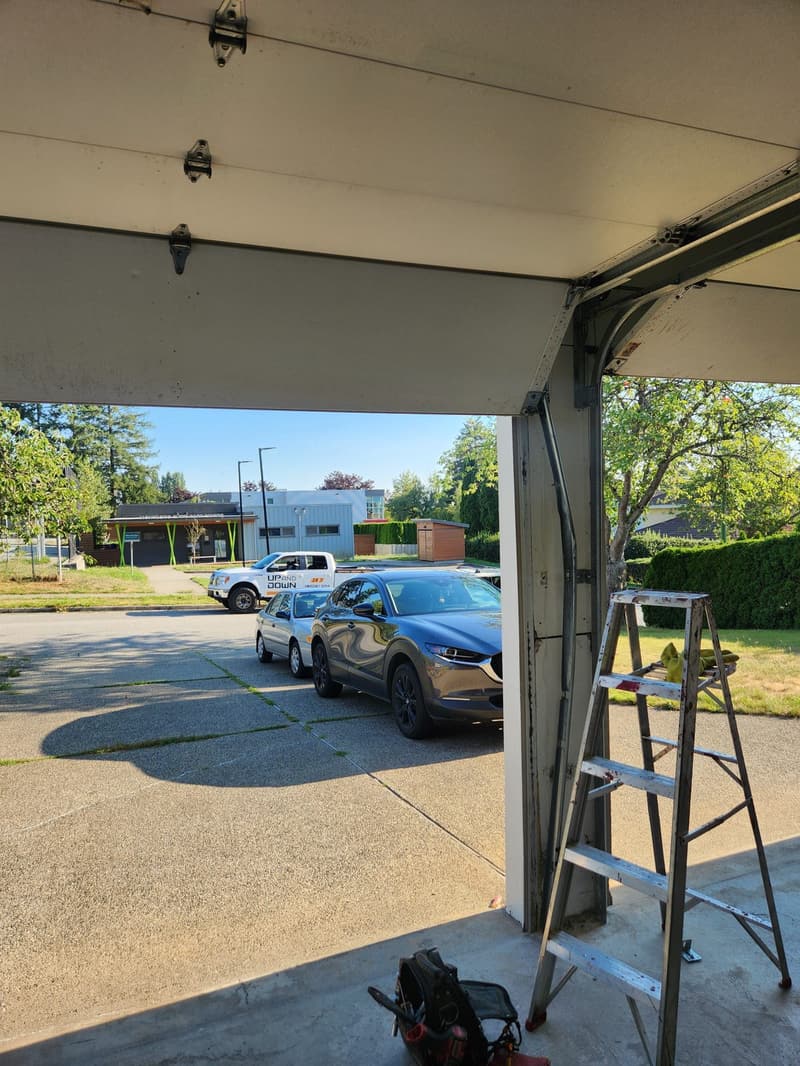
Standard residential garage doors require 12 to 15 inches of headroom above the opening for 12-inch radius track, plus 3.5 to 4.5 inches of sideroom per side. When headroom drops below 10 inches — common in 1960s Richmond rancher conversions, Vancouver special basements with dropped ceilings, and North Shore homes with beam intrusions — you need either double-track (low-headroom) kits or rear-mount torsion systems. Sideroom under 3.5 inches forces center-bearing-plate modifications or wall-mount torsion like the LiftMaster 8500W jackshaft opener.
Double-Track (Low-Headroom) Kit Components
Double-track systems use a second horizontal track mounted directly above the primary track, allowing the top roller to follow the upper track while the bottom roller stays on the standard vertical track. This reduces required headroom to 4.5 to 6 inches depending on door thickness. Key trade-spec components:
- Track radius: 6-inch radius upper track (vs. standard 12-inch)
- Track gauge: 14-gauge (0.075 in) galvanized horizontal; 13-gauge (0.090 in) vertical
- Roller stems: 11-ball nylon rollers, 7/16-inch stem diameter, 2-inch roller OD
- Top fixture: Reinforced 12-gauge adjustable top bracket with dual roller slots
- Hinge pattern: 14-gauge intermediate hinges; 13-gauge end hinges with wider leaf for double-track alignment
- Strut requirement: Minimum 2-inch U-strut on top section; 3-inch on doors over 16 ft wide
Cycle rating: Hardware rated for 25,000 cycles minimum; springs sized separately (see torsion section). Double-track adds 15-20% more friction — factor into spring IPPT calculations.
Rear-Mount Torsion (Rear Torsion) Systems
Rear torsion mounts the torsion shaft horizontally along the back garage wall, eliminating the need for headroom above the door. Required backroom: door height plus 18 to 24 inches. Standard specs:
- Shaft: 1-inch OD solid steel keyed shaft (not hollow)
- Spring wire: Oil-tempered ASTM A229, wire diameters .207 in to .262 in typical for 7-8 ft residential doors
- Spring ID: 1.75 in or 2.0 in depending on cone
- Cones: Stationary cone (red) and winding cone (black) — 180-degree winding capacity
- Center bearing plate: 12-gauge steel, 3.5 in x 5 in, dual bolt pattern for 16 in or 24 in stud spacing
- End bearing plates: 12-gauge with 5/8 in sealed ball bearings
- Cable drums: 4-inch cast aluminum, 7/32 in cable groove, 300 lb rated
- Lift cables: 7×19 galvanized aircraft cable, 1/8 in diameter, 1,700 lb breaking strength
Cycle ratings: 10,000 cycles standard; 25,000-cycle high-cycle springs use .225-.243 in wire with reduced ID — adds 30-40% material cost. Rear torsion requires 6 in minimum sideroom for end bearing plates.
Metro Vancouver Housing Stock Realities
Richmond’s 1970s split-levels often have 7.5 in headroom with a ceiling-mounted heater — double-track fits, rear torsion won’t without relocating the heater. Vancouver specials (basement suites) frequently show 6 in headroom with ductwork; double-track with 6-inch radius track clears if sideroom allows. Burnaby high-rancher garages with glulam beams at 8 ft: rear torsion works if backroom exceeds 22 ft. North Shore homes with exposed joists: measure to bottom of joist, not drywall — joist bottom often 1.5 in lower than ceiling plane.
Coastal humidity accelerates spring corrosion. Spec oil-tempered wire with zinc-phosphate coating (not plain galvanized) for 20-30% longer life in Delta, Ladner, Tsawwassen marine air. Cable drum aluminum resists corrosion better than stamped steel drums.
Frequently Asked Questions
How do I measure headroom correctly for low-headroom hardware?
Measure from the top of the door opening to the nearest obstruction — ceiling, beam, duct, opener rail, or joist bottom. Subtract 0.5 in for weather seal compression. That net number determines kit: 4.5-6 in = double-track; 6-9 in = 10-inch radius track; 9+ in = standard 12-inch radius.
Can I convert my existing door to low-headroom or do I need a new door?
Existing doors can convert if sections are 2-inch thick or less and in good condition. Top section must accept reinforced top fixture. Struts must be added. Doors over 16 ft wide or with section damage require replacement — conversion labor approaches new door cost.
What’s the cycle life difference between standard and high-cycle springs on rear torsion?
Standard 10,000-cycle springs use .207-.218 in wire. High-cycle 25,000-cycle springs use .225-.243 in wire with larger ID, reducing stress per cycle. In Metro Vancouver’s damp climate, high-cycle springs typically deliver 12-15 years vs. 7-9 years for standard.
Does low-headroom hardware work with jackshaft (wall-mount) openers?
Yes. LiftMaster 8500W and 8500 jackshaft openers mount beside the torsion shaft — ideal for rear torsion. For double-track, the opener carriage still needs ceiling space unless you use a jackshaft with a shaft coupler. Jackshaft eliminates rail intrusion, critical when headroom is under 6 in.
What sideroom do I need for double-track vs. rear torsion?
Double-track: 3.5 in minimum per side for standard end hinges; 4.5 in if using wide-leaf low-headroom end hinges. Rear torsion: 6 in minimum per side for end bearing plates and cable drum clearance.
How much does low-headroom conversion cost compared to standard install?
Double-track hardware kit adds material cost over standard track. Rear torsion requires shaft, bearings, drums, and modified spring assembly — higher material than front-mount torsion. Labor increases 1.5-2x for alignment precision. Exact pricing depends on door size, spring cycle rating, and opener compatibility; request a site assessment for a firm quote.
Need low-headroom hardware specified for your garage?
Call 778-873-7282 — Up and Down Garage Doors serves Richmond, Vancouver, Burnaby, Delta, and all Metro Vancouver.
Up and Down Garage Doors | Get a Quote | Panel Replacement | LiftMaster 8500W Jackshaft Opener | Contact Us