Up and Down Garage Doors installs and services residential wall-mount (jackshaft) openers across Metro Vancouver, driving the torsion shaft directly to free ceiling space while meeting coastal climate hardware demands.
Wall Mount Jackshaft Openers Guide
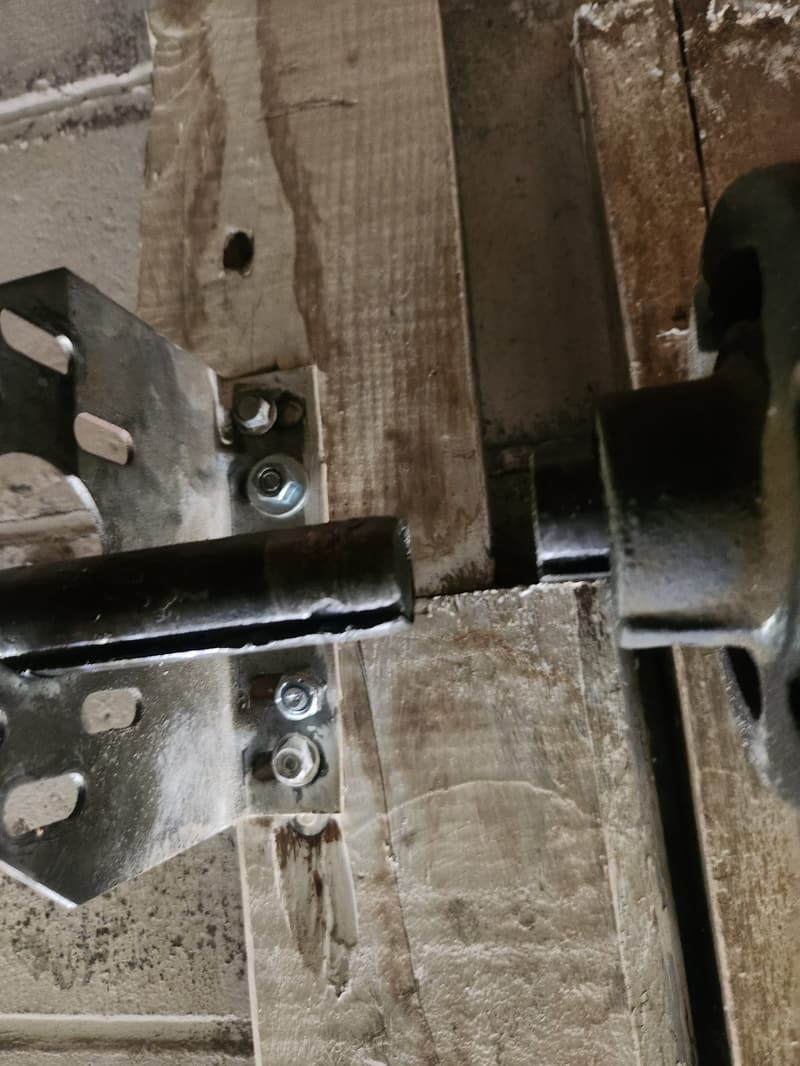
A jackshaft opener mounts on the wall beside the torsion shaft, coupling to it via a 1-inch keyed hollow shaft or a 1-1/4-inch solid shaft adapter. The motor — typically a 24V DC unit rated at 800N to 1200N peak force — turns the shaft through a helical gear reduction (commonly 10:1 to 12:1 ratio). This direct-drive arrangement eliminates the rail, trolley, and chain/belt assembly of a ceiling-mount opener. The opener’s output shaft accepts standard 1-inch or 1-1/4-inch torsion shaft diameters found on most residential doors in Richmond, Burnaby, and Vancouver housing stock built since the 1980s.
Ceiling Space Freed — Real Dimensions
Removing the rail assembly recovers 8 to 12 feet of ceiling run and 4 to 6 inches of headroom. In Metro Vancouver’s typical 7-foot to 8-foot garage ceilings — common in 1970s split-levels in South Vancouver, 1990s townhomes in Coquitlam, and newer infill builds in North Vancouver — this clearance allows full-height storage racks, kayak hoists, or EV charger cable routing without interference. The opener body itself projects 7 to 9 inches from the wall and sits 12 to 18 inches below the shaft centerline, requiring a clear wall zone of roughly 18 inches wide by 24 inches tall.
Component Specifications — Trade-Standard Figures
Torsion Shaft & Coupling
- Standard residential shaft: 1-inch OD, 16-gauge (0.065-inch wall) or 14-gauge (0.083-inch wall) cold-drawn steel
- Heavy-duty / high-cycle shaft: 1-1/4-inch OD, 12-gauge (0.109-inch wall)
- Coupling key: 1/4-inch x 1/4-inch x 2-inch square key (ANSI B17.1)
- Set screws: 3/8-16 UNC, cup point, two per coupling
Spring Wire & Cycle Ratings
- Oil-tempered wire per ASTM A229: common diameters 0.207″, 0.218″, 0.225″, 0.234″, 0.243″, 0.250″, 0.262″, 0.273″
- Standard cycle rating: 10,000 cycles (approx. 7-10 years at 4 cycles/day)
- High-cycle upgrade: 25,000 to 50,000 cycles using larger wire diameter or dual-spring assembly
- DASMA color code: wire diameter mapped to paint stripe (e.g., 0.225″ = yellow, 0.250″ = white, 0.262″ = red)
Cable & Drum Specs
- Aircraft cable: 7×19 construction, 1/8-inch (3.2mm) or 5/32-inch (4.0mm) diameter, galvanized, 1,700 lb / 2,400 lb min breaking strength respectively
- Cable drums: 4-inch or 5.25-inch diameter, cast aluminum or stamped steel, groove depth matched to cable diameter
- Drum-to-shaft attachment: two 3/8-16 set screws on keyed flat
Opener Model Designations (LiftMaster/Chamberlain Platform)
- 8500 / 8500W / 8500C — 800N DC motor, battery backup, Security+ 2.0, MyQ Wi-Fi (8500W/8500C)
- 85870 — 8500-series with integrated camera
- 87504-267 / 87802 — 1200N DC motor, commercial-duty gearbox, 3/4 HP equivalent
- 4690L / 6690L / 98022 / 98032 — jackshaft-compatible DC models with varying accessory bundles
- Legacy 2220L / 2420L / 8365W-267 — earlier DC jackshaft platforms, still serviceable
Metro Vancouver Installation Requirements
Electrical
Dedicated 120V/15A circuit per CEC 2024 Rule 26-700. GFCI protection required in garages (CEC 26-704). The opener draws 1.5A to 3A running, 5A to 8A inrush. Battery backup (standard on 8500W/8500C/87504) adds 12V 7Ah or 12V 12Ah SLA battery — replace every 2-3 years in coastal humidity.
Structural Mounting
Wall must be 2×4 or 2×6 stud framing at 16-inch OC, sheathed with 1/2-inch plywood or OSB. Lag bolts: 3/8-inch x 3-inch minimum, two per mounting bracket, into studs — not drywall anchors. For concrete block walls (common in Richmond slab-on-grade garages), use 3/8-inch wedge anchors at 2-1/2-inch embedment.
Clearances & Safety
- Photo-eye sensors: mounted 6 inches max above floor, per UL 325 / CSA B325
- Emergency release: red handle at 6-foot max height, accessible from inside garage
- Force adjustment: set to reverse at 15-20 lb resistance (measured with force gauge)
- Travel limits: programmed via integrated LCD or MyQ app; fine-tune within 1/4-inch of floor seal
Coastal Climate Wear Patterns
Metro Vancouver’s 1,200-2,000 mm annual rainfall and salt-laden air (especially Richmond, Tsawwassen, White Rock) accelerate corrosion on uncoated hardware. Torsion springs show surface rust at 3-5 years vs. 7-10 years in dry climates. Cable fray initiates at drum groove within 5-7 years if galvanizing is compromised. Jackshaft opener gearboxes — sealed but vented — can ingest moisture during prolonged rain events; we recommend annual grease inspection (white lithium, NLGI #2) on the output shaft bearing and helical gear mesh. Battery backup SLA units sulfate faster above 25°C; in uninsulated garages hitting 35°C+ in July, expect 18-24 month battery life.
When a Jackshaft Is the Wrong Choice
- Low headroom (< 12 inches above shaft) — insufficient for opener body + coupling
- Shaft diameter > 1-1/4-inch or non-standard keyway — requires custom adapter
- Door weight > 600 lb (double 16×8 insulated steel) — exceeds 1200N motor capacity
- No adjacent wall within 3 feet of shaft centerline — mounting not feasible
- Existing 10,000-cycle springs near end of life — replace springs concurrently to avoid callback
Frequently Asked Questions
What torsion shaft diameter do I need for a jackshaft opener?
Standard residential jackshaft openers accept 1-inch or 1-1/4-inch OD shafts. The 1-inch shaft uses a 16-gauge or 14-gauge wall; the 1-1/4-inch uses 12-gauge. Measure your existing shaft with a caliper — do not assume by door size.
Can I keep my existing springs when installing a jackshaft opener?
Yes, if the springs are rated for the door weight and have remaining cycle life. However, Metro Vancouver’s humidity cuts spring life roughly 30%. If springs are 5+ years old, replace them during opener install — labor overlap saves a return visit.
Does a jackshaft opener work with a low-headroom track?
Only if the track hardware leaves at least 12 inches vertical clearance above the torsion shaft centerline. The opener body needs 7-9 inches projection plus coupling height. Most low-headroom double-track setups in Vancouver townhomes do not meet this.
What is the typical installed cost range for a jackshaft opener in Metro Vancouver?
Pricing varies by model tier, spring condition, and electrical access. A mid-range DC unit with battery backup and standard springs installed typically falls in a mid-four-figure range; high-cycle spring upgrades and dedicated circuit runs add to that. We provide itemized quotes after on-site measurement.
How often should the gearbox be serviced in this climate?
Annually. Remove the cover, inspect the helical gear mesh for water intrusion or grease emulsification, reapply NLGI #2 white lithium to the output shaft bearing and gear teeth. Check the vent breather is clear — clogged breathers create vacuum that pulls moisture past seals.
Will my existing remotes and keypad work with a new jackshaft opener?
LiftMaster Security+ 2.0 (yellow learn button) remotes and keypads are backward-compatible. Security+ (purple button) and older rolling-code (orange/red/green) are not. We inventory compatible accessories and can program during install.
Ready to Upgrade? Contact Up and Down Garage Doors
Call 778-873-7282 for a site assessment. We’ll verify shaft specs, spring condition, and electrical access — then recommend the right jackshaft model for your door and Metro Vancouver garage.
LiftMaster 8500W Installation & Repair | LiftMaster 87504-267 Commercial-Duty Jackshaft | Instant Garage Door Quote | Richmond Garage Door Repair | Contact Us