Services
Locations
📞 (778) 873-7282
Home / Blog / Garage Door Closes Then Reopens: Strut Problem Explained

Garage Door Closes Then Reopens: Strut Problem Explained

Learn why your garage door closes then immediately reopens, how strut issues cause this, what to check safely, and when to call a pro. Call (778) 873-7282.

Call (778) 873-7282
Licensed & insured
Open 24 hours
Based in Richmond
5-star rated

When a garage door closes then immediately reopens, the most common mechanical cause is a misaligned or damaged strut interfering with the safety reversal system. This happens when the strut bends, loosens, or shifts so that it contacts the door track or roller during closure, tricking the opener into thinking an obstruction is present. The door reverses to prevent crushing, but since the strut is part of the door itself, it re-triggers the reversal repeatedly. You’ll typically hear the motor strain, then a click as it reverses, followed by the door lifting again—often with a rattling or scraping noise from the strut hitting the track. Start by visually inspecting the struts (the vertical or angled braces inside the door panels) for bends, loose bolts, or rubbing against the track. With the door disconnected from the opener and in the down position, check if any strut protrudes into the track path or makes contact with rollers. Tighten loose strut bolts with a socket wrench, but do not over-torque—strip the threads and you worsen the misalignment. If the strut is visibly bent or cracked, it needs replacement; attempting to straighten it risks sudden failure under load. Never adjust or remove torsion springs, cables, or bottom brackets—these are under extreme tension and can cause severe injury or death if mishandled. If tightening struts doesn’t resolve the issue, or if you notice frayed cables, uneven door movement, or the opener straining excessively, stop and call a technician. The problem may actually stem from misaligned tracks, worn rollers, or a failing opener force setting, but strut interference is a frequent and diagnosable first step. For residential garage door service in Metro Vancouver, contact Up & Down Garage Doors at (778) 873-7282.

Garage Door Closes Then Reopens Strut Problem
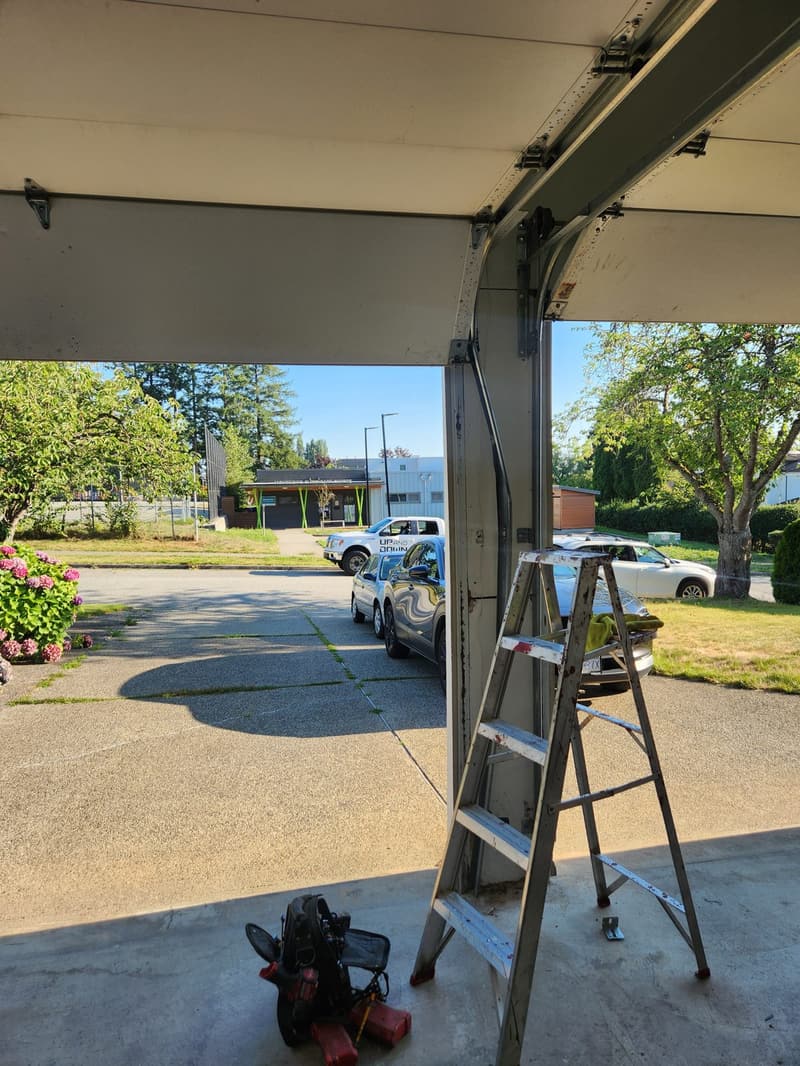
Garage Door Closes Then Reopens Strut Problem — garage door technician on site
Garage Door Closes Then Reopens Strut Problem — real job photo, Up & Down Garage Doors.

What the Problem Looks and Sounds Like
Watch for a consistent pattern: the door begins to close normally, then about halfway down or near the floor, the motor labors, emits a clicking sound (the reversal relay engaging), and the door starts rising again. You may hear a metallic scraping or tapping noise just before the reversal—this is the strut making contact with the track or roller. In some cases, the door might reverse only slightly before reclosing, creating a stuttering effect. If you manually lift the door with the opener disengaged, you might feel a catch or resistance at a specific point where the strut interferes. Visually, look for gaps between the strut and the door panel, loose bolts, or visible deformation. A strut that rubs the track will often leave scuff marks or shiny wear on its edge.

What Homeowners Can Safely Check
First, disconnect the opener by pulling the emergency release cord—this isolates the door’s mechanics from the motor. Lower the door manually to the closed position and inspect each strut for alignment. Use a flashlight to check clearance between the strut and the vertical track; there should be at least 1/8 inch of space on all sides. Wiggle each strut bolt—if it moves more than a slight amount, it’s loose and needs tightening. Use a socket wrench to snug bolts to firm resistance, but avoid impact tools that can strip threads. If the door binds or rubs at a specific point during manual operation, note the location and check the corresponding strut for contact. Do not attempt to bend a strut back into place—steel weakens when deformed and may fail catastrophically under stress. If the door moves freely manually but still reverses when powered, the issue may lie in the opener’s force sensors or limit settings, not the strut.

When to Stop and Call a Technician
If tightening strut bolts doesn’t eliminate the reversal, or if you observe any of the following, discontinue DIY attempts: visible cracks in the strut, severe bending, frayed lift cables, loose or broken bottom brackets, or uneven door movement (one side higher than the other). These symptoms often point to deeper issues like track misalignment, roller failure, or torsion spring imbalance—all of which involve components under dangerous tension. Torsion springs, in particular, store enough energy to launch metal fragments with lethal force if unwound incorrectly. Even experienced DIYers risk injury when adjusting spring tension without proper tools and training. A technician will test the opener’s force settings, inspect cable drums and springs, and verify track alignment using laser or string methods. They can also replace a damaged strut with a factory-matched part that maintains the door’s structural integrity.

Why Strut Issues Are Common in Wider Doors
Single-car garage doors (8-9 feet wide) often rely on panel strength alone, but double-car doors (16 feet or wider) require struts to prevent the center from bowing. The wider the door, the greater the leverage on each panel during wind gusts or manual operation, increasing stress on strut connections. Over time, vibration from cycling loosens bolts, and thermal expansion/contributes to metal fatigue. In coastal areas of Metro Vancouver, salt air accelerates corrosion at bolt holes, weakening the strut’s attachment. Struts are also vulnerable during manual operation—if someone pushes up on the door near the center instead of using the lift handles, they can bend the strut inward. Regular inspection every six months, especially before winter, helps catch loosening or corrosion early.

Frequently Asked Questions
### Can a misaligned opener limit setting cause the door to reopen?
Yes, if the close limit is set too far, the door may hit the floor and trigger the safety reversal, mimicking a strut issue. However, limit-related reversals usually happen only at the very end of closure and lack the mid-cycle scraping noise associated with strut contact. A technician can adjust limits using the opener’s learn button or dial.

Is it safe to lubricate a noisy strut bolt?
Lubricating the bolt threads with a light machine oil can help prevent corrosion and ease future tightening, but never lubricate the strut where it contacts the track—this attracts dust and can increase wear. Focus lubrication on hinges, rollers, and springs, not strut surfaces.

How often should garage door struts be inspected?
At least twice a year—once in spring and once in fall—as part of routine door maintenance. Check for loose bolts, rust, and alignment, especially after extreme weather or if the door has been impacted. Early detection prevents progressive damage that could lead to panel warping or track damage.

Stuck door? Let's get it moving.

One call, a clear price, and the job done right — 24/7 across Metro Vancouver.

📞 Call (778) 873-7282