Up and Down Garage Doors breaks down pan versus sandwich panel construction for Metro Vancouver homeowners, detailing steel gauge, insulation layers, STC ratings, and cycle-life differences so you can match the right door to Richmond’s coastal climate and your garage’s use case.
Garage Door Panel Construction Types — What Is a Pan Panel?
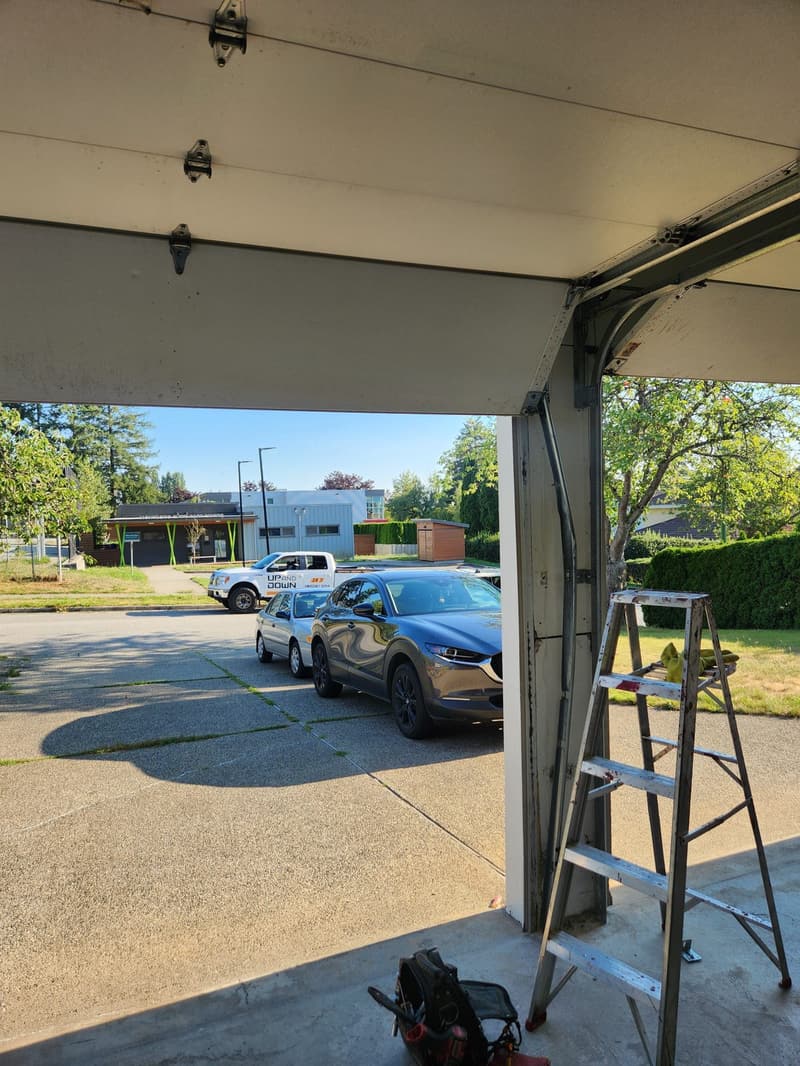
A pan panel — also called a single-skin or non-insulated panel — consists of one layer of roll-formed steel, typically 24 or 25 gauge (0.024–0.021 in / 0.61–0.53 mm), with no foam core. The face is usually embossed with a wood-grain or stucco texture and pre-painted with a baked-on polyester or siliconized polyester finish. Stiffness comes entirely from the roll-formed ribs and the perimeter hem. Typical section thickness is 2 in (51 mm). Because there is no thermal break, the interior steel surface tracks outdoor temperature closely, creating condensation risk in Richmond’s humid winters. Sound Transmission Class (STC) runs 12–15; impact resistance is low — a basketball hit often leaves a permanent dent.
What Is a Sandwich Panel?
A sandwich panel bonds two steel skins — outer skin 24–27 gauge, inner skin 27–30 gauge — to a continuous polyurethane or polystyrene foam core. Polyurethane cores (density 1.8–2.2 lb/ft³) yield R-values of 6.5–7.5 per inch; polystyrene (EPS, 1.0–1.5 lb/ft³) yields R-4 to R-5 per inch. Common overall thicknesses: 1⅜ in (35 mm), 2 in (51 mm), and 3 in (76 mm). The dual-skin composite action raises bending stiffness 3–5× over a pan panel of equal thickness. STC improves to 18–22. The inner liner (usually 27–28 gauge galvanized, white pre-paint) resists interior impacts from tools or bikes.
Layer Counts and What They Mean
Two-layer (pan + retrofit foil)
A pan panel with reflective foil or thin EPS board glued to the back. Adds R-1 to R-2, negligible stiffness gain. Often a DIY aftermarket kit; foil tears during spring adjustments.
Three-layer (standard sandwich)
Outer steel / foam core / inner steel. The baseline for any insulated residential door in Metro Vancouver. Polyurethane-injected doors (e.g., Clopay Intellicore, Amarr Heritage, Wayne Dalton 8500) achieve R-12 to R-18 at 2 in thickness.
Four-layer (commercial/heavy-duty)
Adds a second interior steel liner or a 26-gauge interior skin over a thicker 3 in core. R-20 to R-28. Used for heated shops or living-space-above-garage builds in North Vancouver and Burnaby. Adds 15–20 lb per section; requires 25k-cycle springs and 14-gauge track.
Wire Diameter, Gauge, and Hardware Specs
Torsion springs: oil-tempered ASTM A229, wire diameters 0.207–0.262 in (5.26–6.65 mm) for 7 ft residential doors; 10k-cycle standard, 25k-cycle upgrade adds ~0.015 in wire diameter. Extension springs: 0.192–0.218 in wire. Cables: 7×19 galvanized aircraft cable, 1/8 in (3.2 mm) diameter, 1,700 lb min breaking strength. Rollers: 2 in nylon 11-ball (standard) or 13-ball precision bearing; stem 7/16 in (11 mm). Hinges: 14-gauge (0.075 in) galvanized for residential, 12-gauge for 3 in doors. Track: 2 in vertical, 12-gauge (0.105 in) hot-dip galvanized; horizontal 12- or 14-gauge depending on door weight.
Sound, Stiffness, and Thermal Performance in Coastal BC
Richmond’s marine air carries salt and moisture; condensation forms on single-skin panels when interior humidity exceeds 60 % at 10 °C dew point. Sandwich panels with polyurethane core keep the inner skin above dew point down to -15 °C. Wind load: 2 in sandwich door rated Design Pressure (DP) ±30 psf meets BC Building Code for most low-rise zones; 3 in DP ±40 psf for exposed Tsawwassen or UBC high-rise exposures. Deflection under 20 psf: pan panel ~L/60, sandwich ~L/150. Operational noise: nylon rollers on pan door ~72 dBA; sandwich door with 13-ball rollers and polyurethane core ~64 dBA — noticeable when bedroom adjoins garage.
How Panel Type Affects Repair and Replacement
Pan panel dent repair: heat-shrink or body-filler cosmetic only; structural integrity not restored. Section replacement cost is lower but colour match fades in 2–3 years under UV. Sandwich panel: foam core crush requires full section swap; skins cannot be separated. Matching foam density and skin gauge is critical — mixing 24 ga outer with 27 ga inner from different manufacturers creates galvanic corrosion at the hem. Up and Down Garage Doors stocks common Clopay, Amarr, and Wayne Dalton section profiles for same-day swaps in Richmond, Delta, and Surrey.
FAQ
What gauge steel is standard on a residential sandwich door in BC?
Outer skin 24 or 25 gauge (0.024–0.021 in), inner liner 27 or 28 gauge (0.016–0.015 in). Commercial doors step to 22/24 gauge.
Does a thicker foam core always mean higher R-value?
Only if density stays constant. 2 in polyurethane at 2.0 lb/ft³ outperforms 3 in polystyrene at 1.2 lb/ft³. Check manufacturer’s tested R-value per DASMA 105, not just thickness.
Can I upgrade pan panels to sandwich later?
Not practically. The hinge locations, strut requirements, and spring counterbalance change. Full door replacement is the correct path.
How many cycles should springs be rated for with a 3 in sandwich door?
Minimum 25,000 cycles. The added 15–20 lb per section cuts 10k-cycle spring life in half.
What STC rating do I need for a garage under a bedroom?
Target STC 20+. A 2 in polyurethane sandwich door with 13-ball nylon rollers and perimeter weatherseal typically hits STC 21–22.
Are there salt-spray rated finishes for Richmond homes?
Yes. Look for AZ-50 or AZ-55 galvanneal with a siliconized polyester or PVDF (Kynar 500) topcoat — 15–20 year chalk/fade warranties in coastal zones.
Get the Right Panel for Your Metro Vancouver Home
Match panel construction to your exposure, noise sensitivity, and heating plan. Up and Down Garage Doors installs and repairs pan, sandwich, and four-layer doors across Richmond, Vancouver, Burnaby, and the Fraser Valley. Call 778-873-7282 for a specification review or visit our panel replacement page. For full door pricing see new garage door cost Vancouver. Need opener compatibility? Check LiftMaster 8500W installation or LiftMaster 84504R/84505R. Book online via instant garage door quote.