Services
Locations
📞 (778) 873-7282
Home / Blog / Can You Replace a Garage Door Belt Drive Yourself

Can You Replace a Garage Door Belt Drive Yourself

Learn how garage door belt drives work, when DIY replacement is possible, and why torsion spring tension makes most belt drive jobs unsafe for homeowners.

Call (778) 873-7282
Licensed & insured
Open 24 hours
Based in Richmond
5-star rated

Replacing a garage door belt drive yourself is not recommended for most homeowners due to the risk of injury from torsion spring tension, even though the belt itself is a simple component. The belt drive system transfers motion from the motor to the door via a reinforced rubber belt, but removing or installing it requires disconnecting the door from the opener and managing stored energy in the springs. If the belt is broken, you’ll notice the motor runs but the door doesn’t move, often accompanied by a slapping or flapping noise as the belt spins freely. Visually, you might see fraying, cracking, or separation along the belt’s length, especially near the attachment points. Before attempting any inspection, disconnect power to the opener and pull the emergency release cord to manually operate the door—if it doesn’t stay open halfway or feels excessively heavy, the springs are likely worn or improperly tensioned, which increases danger during service.

How a Belt Drive Opener Actually Works
The motor turns a gear that drives a pulley at one end of the rail. A continuous loop belt, reinforced with steel or fiberglass, runs from this pulley around an idler pulley at the opposite end and back to the motor shaft. As the belt moves, it pulls a trolley connected to the door arm, translating rotational motion into linear movement. Unlike chain drives, belts operate quietly and don’t require lubrication, but they degrade over time from UV exposure, temperature cycling, and mechanical stress. The belt itself doesn’t store energy—it’s the torsion springs above the door that do, wound tightly to counterbalance the door’s weight. This is why belt replacement isn’t just about swapping a part; it’s about safely managing a system under significant load.
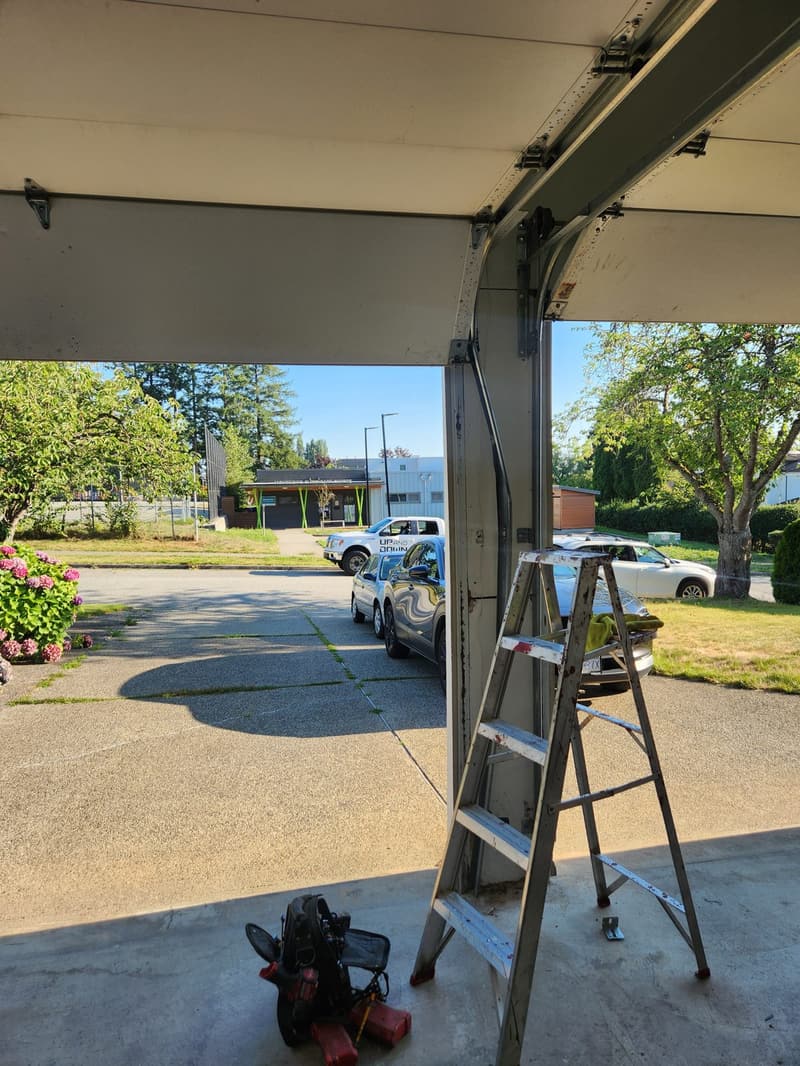
garage door technician on a ladder servicing a home door
Garage door technician on a ladder servicing a home door.

What Belt Failure Looks and Sounds Like
A failing belt often starts with intermittent slipping—you’ll hear the motor run but the door moves sluggishly or not at all, especially during cold starts. As damage progresses, the belt may develop a rhythmic slapping sound against the rail or housing, indicating it’s loose or broken internally. Visual inspection might reveal glazing (a shiny, hard surface), cracks perpendicular to the belt’s length, or teeth shearing off if it’s a toothed design. In some cases, the belt will snap completely, leaving the trolley detached and the door unresponsive to the opener. Importantly, a broken belt doesn’t cause the door to fall—the springs hold it in place—but attempting to manually lift the door with a broken belt can still be hazardous if the springs are misadjusted.

What You Can Safely Check Yourself
You can inspect the belt for visible wear with the door closed and power disconnected. Look for cracks, fraying, or missing sections, particularly where the belt bends around pulleys. Check belt tension by pressing midway between pulleys—it should deflect slightly but not feel loose or excessively tight. Listen for unusual noises during operation: grinding suggests pulley bearing issues, while slapping points to belt damage. Test the door’s balance by lifting it manually to waist height after releasing the trolley—it should stay put without drifting up or down. If it moves, the springs need professional adjustment. Never attempt to adjust or remove torsion springs; they store enough energy to cause severe injury or death if mishandled.

Why DIY Belt Replacement Is Risky
Even though the belt isn’t under tension, accessing it requires disconnecting the door from the opener and often involves working near the torsion spring assembly. If the springs are already compromised or incorrectly wound, a slip of a tool or sudden release can lead to uncontrolled door movement. Additionally, improper belt alignment after replacement can cause premature wear, pulley damage, or door binding. Many homeowners underestimate the precision needed to re-engage the trolley and reset the opener’s travel limits—getting this wrong means the door won’t open or close fully, or worse, it could crush objects in its path. Manufacturers design these systems for service by trained technicians who understand spring dynamics and opener calibration.

When Professional Service Is Necessary
If the belt is broken, worn, or making noise, or if the door doesn’t operate smoothly when disconnected from the opener, a technician should assess the entire system. They’ll check spring tension, pulley alignment, motor torque, and belt tracking—factors that affect safety and longevity. Replacing the belt without addressing underlying issues like worn pulleys or failing springs leads to repeat failures. Professionals also have the tools to safely reset opener limits and force settings after installation, ensuring the door stops correctly at open and close positions without straining the motor or hardware.

Frequently Asked Questions
### How long does a garage door belt drive typically last?
Under normal use, a quality belt drive lasts 8 to 12 years, though exposure to extreme temperatures, frequent cycling, or poor door balance can shorten this. Regular visual checks help catch wear before failure.

Can I lubricate a garage door belt to make it last longer?
No—belts are designed to run dry. Applying lubricant attracts dust and debris, which accelerates wear and can cause slipping. Only metal components like hinges, rollers, and springs require periodic lubrication.

What happens if I install the belt upside down or backwards?
Most belts are symmetrical and directionally neutral, but some toothed belts have a specific orientation. Installing it incorrectly can cause poor engagement with pulleys, noise, or premature tooth wear. Always follow the manufacturer’s routing diagram.

Stuck door? Let's get it moving.

One call, a clear price, and the job done right — 24/7 across Metro Vancouver.

📞 Call (778) 873-7282