Up and Down Garage Doors diagnoses garage door noises across Metro Vancouver by matching each distinct sound — grinding, popping, squealing, rattling — to the specific worn component, using trade-standard specs like wire gauge, cycle ratings, and part designations to pinpoint the repair.
Garage Door Noise Diagnosis Guide — What Does a Grinding Noise Mean?
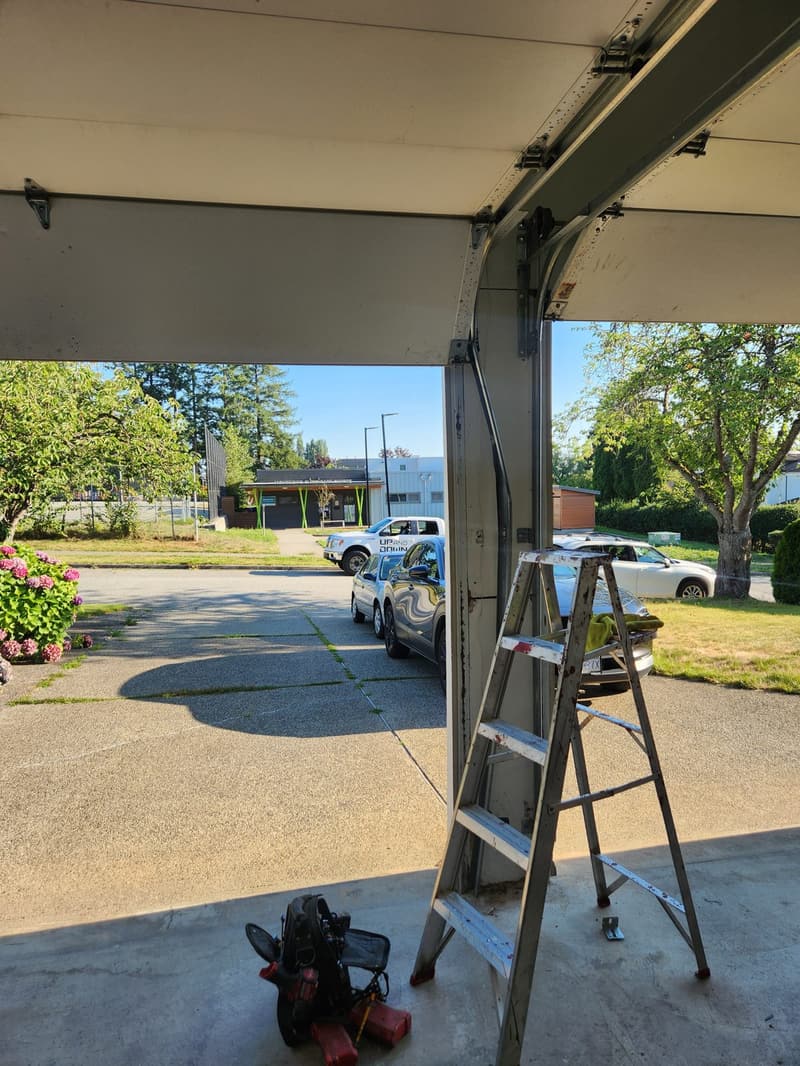
A low-pitched metal-on-metal grind usually signals roller or bearing failure. Standard nylon rollers use 11-gauge (0.091 in) stem wire with 6200-2RS sealed bearings rated for 10,000–15,000 cycles. Steel rollers on 10-gauge (0.102 in) stems with 6201-2RS bearings last 20,000+ cycles but seize faster in coastal humidity. When the bearing race collapses, the roller drags along the track flange, producing a continuous grind that worsens under load. On LiftMaster 8500W jackshaft openers, a worn output-shaft bearing (part 41A5634) creates an identical sound at the motor head.
What Does a Popping or Snapping Sound Indicate?
A sharp pop each cycle typically comes from a torsion spring coil binding or a cable drum keyway cracking. Standard residential torsion springs use 0.207 in or 0.218 in wire diameter (DASMA 102), wound on a 1.75 in ID cone, rated 10,000 cycles. In Metro Vancouver’s wet winters, uncoated oil-tempered wire develops micro-corrosion at the coil gap; when the door cycles, the coils catch and release with a loud snap. Raynor 10,000-cycle springs (part RS-10000) and Clopay EZ-SET 25,000-cycle springs (part 401277) both exhibit this once the zinc coating fails. A cracked cable drum keyway (DASMA 403-1, 4 in or 5.25 in diameter) produces a single pop per revolution as the key jumps the fracture.
What Causes a High-Pitched Squeal?
Squealing is almost always dry metal-on-metal at hinge points or opener rail. Standard 14-gauge (0.075 in) hinge pins on 18-gauge (0.048 in) leaf hinges need lithium grease every 6 months; without it, the pin galling creates a 2–4 kHz squeal. On belt-drive openers (LiftMaster 85870, 84504R), a contaminated or over-tensioned belt (part 41A5436, 0.375 in pitch) slips on the sprocket, generating a similar frequency. Chain-drive units (LiftMaster 8365W-267) squeal when the #41 roller chain (0.5 in pitch) stretches beyond 2 % elongation and rides the sprocket teeth.
What Does Rattling or Clattering Reveal?
Rattling means loose hardware or panel separation. Section joints on 2 in thick insulated doors (R-16 polyurethane, 27-gauge steel skins) use 14-gauge end hinges (part 41A5235) and 11-gauge center hinges; when the 1/4-20 carriage bolts back out, panels flex independently, clattering against the track. Strut brackets on 16-ft wide doors require 3/8-in Grade 5 bolts torqued to 31 ft-lb; undertorqued bolts vibrate at 15–20 Hz. On LiftMaster 8500W installations, a loose motor-mount bracket (part 41A5632) transmits vibration directly to the wall, amplifying the rattle inside attached garages common in Richmond and Burnaby townhomes.
FAQ: Garage Door Noise Diagnosis
Why does my garage door grind only in cold weather?
Nylon rollers contract more than steel tracks below 5 °C, increasing bearing preload. Coastal Metro Vancouver garages often sit at 2–4 °C overnight. The 6200-2RS bearing clearance (C3 fit, 0.008–0.018 mm) disappears, causing metal-to-metal contact until the garage warms up.
Can I lubricate a popping torsion spring?
No. Oil on the coils attracts grit that accelerates wire fatigue. The pop is coil bind from corrosion or a cracked cone; the spring must be replaced with a matching wire diameter and cycle rating.
What hinge pin size do Metro Vancouver installers use?
Standard 14-gauge (0.075 in) hardened pins for 18-gauge hinges on residential doors; 12-gauge (0.105 in) pins for 16-gauge hinges on commercial sectional doors in Delta and Surrey industrial parks.
How do I know if the noise is the opener or the door?
Disconnect the opener via the emergency release and operate the door manually. If the sound persists, it’s door hardware (rollers, hinges, springs). If it stops, the noise originates in the opener drivetrain — chain, belt, or output bearing.
What belt part number fits a LiftMaster 85870?
Part 41A5436, 0.375 in pitch, 1/2 in wide, Kevlar-reinforced polyurethane. Tension to 1/2 in deflection at mid-span with 10 lb force.
Why does my door rattle more after a windstorm?
High winds on 16-ft doors in exposed Ladner and Tsawwassen properties flex panels, loosening 1/4-20 carriage bolts at end hinges. Re-torque to 7 ft-lb and add nylon-insert locknuts.
Hear a noise you can’t identify? We’ll diagnose it on the spot.
Call 778-873-7282
Up and Down Garage Doors — Richmond, BC
Grinding noise repair details | Popping sound causes | LiftMaster 8500W service | Get a quote | Contact us