

When the power goes out in a storm, most garage door openers become dead weight on the ceiling. A garage door opener battery backup keeps the motor running for a limited number of cycles so you can still get the car out, or get yourself out, without pulling the red release cord and lifting the door by hand. This guide explains what a backup actually does, what it does not do, which rules apply in British Columbia, and what to check before you buy one.
What a garage door opener battery backup actually does
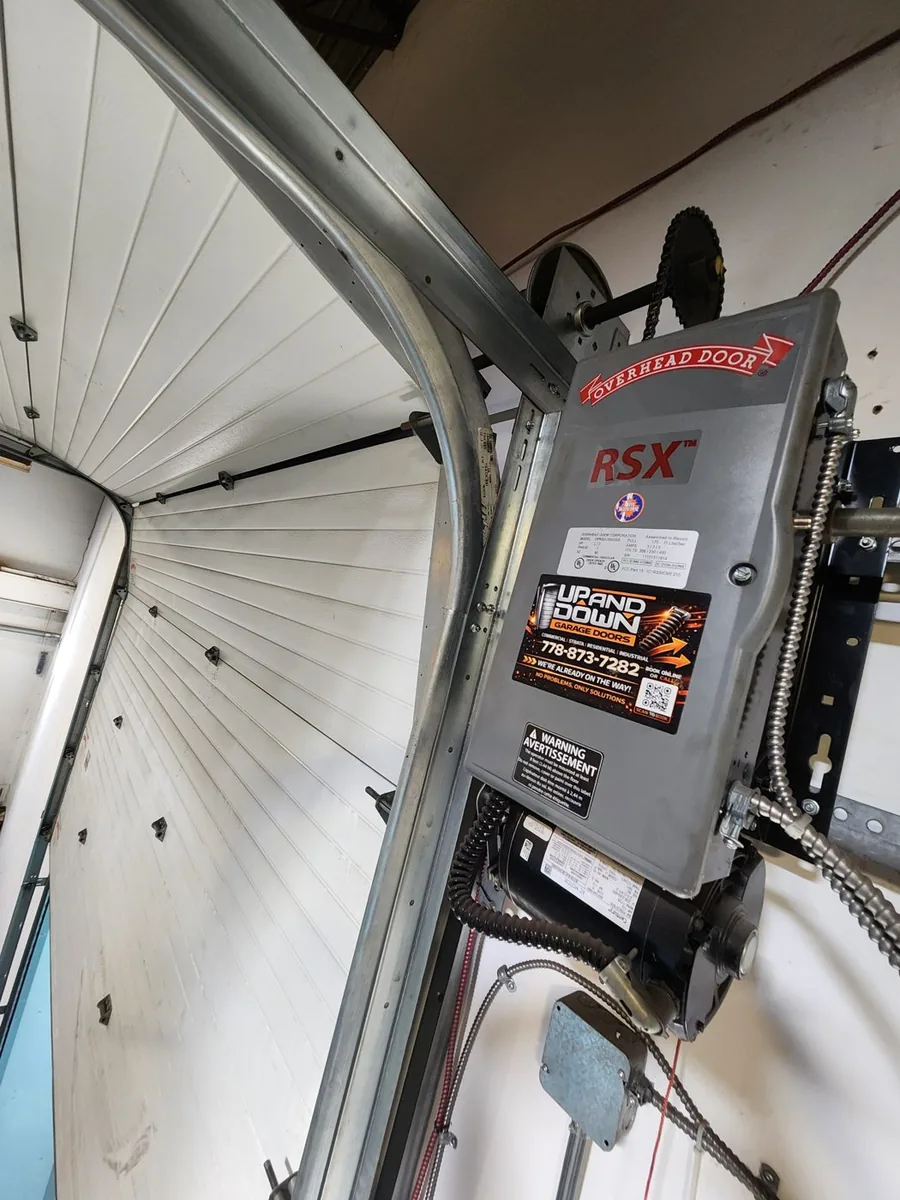
A battery backup is a rechargeable 12-volt battery that lives inside the opener's motor housing (or in a small box wired to it). While the power is on, the opener keeps it topped up. When the power drops, the opener switches over and runs from the battery instead.
The manufacturer manuals are specific about the numbers, and they are lower than many people expect:
- LiftMaster's owner's manual for the 8355W/8360W family says a fully charged battery supplies 12 volts DC "for one to two days of normal operation" during an outage, needs 24 hours to charge fully, and recharges within 24 hours once the power is back.
- The LiftMaster 8500W wall-mount manual says that in battery mode the opener "should be able to operate up to 20 times," and that battery power lasts "for 30 hours or up to 20 cycles over a 24 hour period."
- LiftMaster says the battery itself typically lasts about one to two years with normal use. The industry association DASMA, in its Technical Data Sheet #385, gives a wider range of 2 to 5 years depending on usage and battery type. Treat the shorter number as your planning figure and test it.
So a backup is not a generator. It is a way to get through a typical outage, open the door a handful of times, and close it again behind you.
What stops working when the opener is on battery
This is the part most sales pages skip. The LiftMaster manuals list several features that switch off in battery mode:
- The opener lights. The light will not come on, so keep a flashlight in the garage.
- Remote Close and Timer-to-Close. The 8360W manual says both are unavailable on battery.
- myQ app control and wireless myQ accessories. The 8500W manual says these are disabled in battery mode. If you rely on your phone to open the door, plan on using a handheld remote or the wall button during an outage.
- The automatic door lock on models that have one. Per the manual, the lock releases when the door opens and stays disabled until power returns.
- Speed. The opener runs slower, and it can run slower still if the battery is not fully charged.
The 8500W manual adds one more note that matters if you open your door from the car: if you use a HomeLink repeater, keep your original LiftMaster remote programmed and in the glove box for outages. Your car's built-in button may not be enough on its own.
Is a battery backup required in BC?
Short answer: we could not find any British Columbia or Canadian rule that requires a battery backup on a residential garage door opener. We checked for provincial and federal requirements and found none. If you read online that one is "required," that almost always refers to California.
California's Senate Bill 969 was signed in September 2018. Starting July 1, 2019, it requires residential garage door openers manufactured, sold or installed in California to have "a battery backup function that is designed to operate when activated because of an electrical outage," sets a $1,000 civil penalty per violation, and stops installers from connecting a replacement garage door to an existing opener that does not comply. The law followed the 2017 California wildfires, where some people had trouble getting vehicles out of garages during power cuts.
That law does not apply here. But because the big manufacturers build for the whole North American market, many current openers sold in Canada include a battery backup anyway, and DASMA's guidance in TDS #385 is plain: if you live where outages or wildfires happen, a battery-backed opener is "a convenient method of getting the garage door open in a power outage."
What BC does require is that electrical equipment carries a certification mark from an agency accredited by the Standards Council of Canada (Technical Safety BC cites section 21(1) of the Electrical Safety Regulation). That applies to the opener, including its battery system, so buy one sold for the Canadian market.
Who gets the most out of a battery backup in the Lower Mainland
Fall and winter windstorms regularly cut power to parts of Metro Vancouver, and BC Hydro's outage map is a familiar page for anyone on a street with overhead lines and big trees. A garage door opener battery backup earns its keep in a few situations:
- The garage is the only way out. Many townhouses and lane-way homes have no side door to the garage, so the overhead door is the only exit for the car.
- Someone in the house can't lift the door. A well-balanced door should be light to lift by hand, but older doors with tired springs can be heavy. Seniors, people with injuries, and anyone home alone with kids benefit most.
- You have to leave for work or a medical appointment no matter what the weather is doing.
- You often return home after dark. Driving up to a dead door in the rain, then hunting for the release cord from outside, is no fun. If the garage has no other entry, you may not be able to reach the cord at all.
If none of those apply, the manual release still works and costs nothing. Our guide to opening a garage door by hand during a power outage walks through it step by step.
Can you add a battery backup to the opener you already have?
It depends on the opener. Battery backup is built into the opener's logic board and power supply, so you can't simply bolt one onto any motor.
Openers that were built for it
Many LiftMaster DC models list battery backup in their specifications. In our brand catalogue these include the 8500W and 8500WCAM wall-mount units, the 84504R and 87504-267 belt drives, and the 81602 and 87802 chain drives. Check whether the battery is included or sold separately for your exact model. LiftMaster says the 485LM "works on all LiftMaster integrated battery backup garage door openers," and its manuals say to use only that part number as the replacement.
On the Chamberlain side, our catalogue lists battery backup on models such as the B4655T, B6755T and C870, and the B1381 is listed with backup power for up to three days. Some Genie DC models, including the 7155 StealthDrive Connect and the 4063B screw drive, list a battery backup rated for about 50 cycles.
Openers that weren't
Many older AC chain-drive openers have no battery circuit at all. For those, the realistic choices are to keep using the manual release or to replace the opener with a battery-backed DC model. Not sure which one you have? Check the model number on the motor housing label against our product catalogue, or send us a photo of the label.
| Question | Where to look |
|---|---|
| Does my opener support a battery? | Model number on the motor label; the "Battery Backup" section of the owner's manual |
| Is the battery installed? | A battery status LED on the motor housing, usually green when charged |
| Is the battery still good? | Unplug the opener and run the door (test below) |
| Which replacement battery? | The part number in the manual (for LiftMaster integrated units, 485LM) |
Reading the battery status light
On the LiftMaster models covered by the manuals above, the battery status LED tells you most of what you need:
- Solid green: battery fully charged.
- Flashing green: battery charging. If it flashes green constantly and never goes solid, the manual's diagnostic chart points to a charging circuit fault on the logic board.
- Solid orange, beeping about every 2 seconds: the opener has lost power and is running on the battery.
- Flashing orange, beeping every 30 seconds: battery low.
- Solid red, beeping every 30 seconds: the battery no longer holds a charge and needs replacing.
That 30-second chirp is easy to mistake for a fault in the opener. More often it's simply asking for a new battery.
How to test your garage door opener battery backup
Do this twice a year, ideally in the fall before storm season. It takes five minutes:
- Unplug the opener from the ceiling outlet. The status light should turn solid orange (or flash if the battery is low).
- Open and close the door with the wall button or a handheld remote. Expect it to move slower than normal.
- Run it through a couple of full cycles. If it stalls, reverses or won't start, the battery is weak or the door is out of balance.
- Plug the opener back in and confirm the light goes to flashing green (charging).
Two cautions from the manuals and from DASMA. First, disconnect both the mains power and the battery before doing any service work on the opener. A battery-backed opener can still move with the plug pulled. Second, an opener is not built to make up for a badly balanced door. If the door feels heavy when you lift it by hand, get the springs checked. A weak spring drains the battery faster, and DASMA warns that an unbalanced door may not reverse when it should.
If you'll be away for months, such as at a summer or winter home, LiftMaster recommends disconnecting the battery so it doesn't run flat while the opener is unplugged.
Our take
For most Lower Mainland homes, a battery backup is a convenience, not a legal requirement. It makes a lot of sense if the garage is your only way out, if someone at home can't lift the door, or if you're replacing the opener anyway. If you're shopping, look for "battery backup" or "integrated battery" in the specifications, not just "battery-ready." Plan on replacing the battery every few years, and test it every fall.
If you'd like help choosing an opener or checking whether yours can take a battery, see our garage door opener installation page or our LiftMaster openers page. If your opener is already beeping or acting up, start with garage door opener repair.
Call (778) 873-7282 to book. New clients: 10% off labour on your first repair — mention NEW10 when you book (one per household/business, work booked by Dec 31, 2026).