

Cross-border shopping is normal in the Lower Mainland. Blaine is a short drive from Surrey, and an opener on sale in Washington State can look like an easy saving. Most of the time it goes fine. Sometimes it doesn't, and the reason is almost never the motor. It's the label.
This guide covers what actually decides whether a US garage door opener in Canada is legal to install and use, what the electrical side looks like in BC, and how remotes and keypads fit in. Every rule here comes from the BC regulation, Technical Safety BC, Innovation, Science and Economic Development Canada (ISED) or the manufacturers' own documents. Links are in the sources list.
The short answer on a US garage door opener in Canada
The power is the same. Homes in BC and the US both run 120-volt, 60 Hz household circuits with the same plug shape, so an opener sold in Washington will physically plug in and run here. Whether it is allowed to stay up there is a separate question, and BC answers it in one section of the law.
Section 21(1) of the BC Electrical Safety Regulation says a person must not use electrical equipment in British Columbia, or sell it for use here, unless it displays a certification mark, an accepted certification agency label, or an approval mark. Technical Safety BC's information bulletin on approved marks (B-E3 071019 3) restates the same rule: the mark has to come from a certification body accredited by the Standards Council of Canada, or the unit needs a field approval label such as an SPE-1000 label.
Yes, if the opener's label carries a certification mark accepted in Canada, such as a CSA mark or a UL mark with the C indicator. BC's Electrical Safety Regulation, section 21(1), says electrical equipment cannot be used in the province unless it displays an accepted certification or approval mark. A US-only mark does not meet that on its own.
How to read the certification label
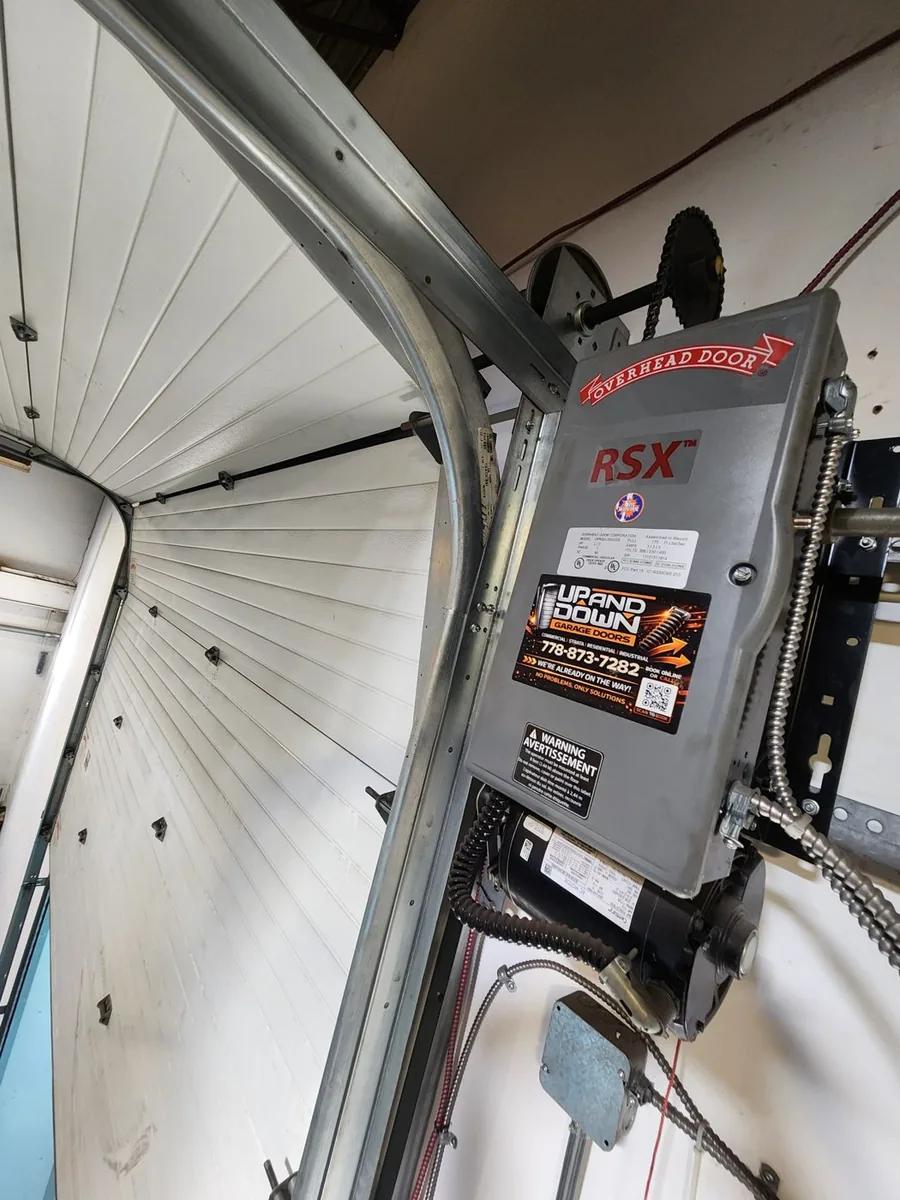
Pull the light lens off the motor head or look on the side or back of the unit. You're looking for a rating plate with the model number, voltage and one or more certification marks. Here is what the common ones mean.
| What you see | What it tells you | OK for use in BC? |
|---|---|---|
| CSA mark (with or without "C" and "US" beside it) | Certified by CSA Group. A "C" or no indicator covers Canada; a "US" indicator alone covers the US only. | Yes, when the Canadian indicator is there |
| UL in a circle with a small "C" to the left | UL evaluated it to Canadian requirements | Yes |
| UL in a circle with "C" on the left and "US" on the right | One mark covering both countries | Yes |
| UL in a circle, no "C" | US requirements only | Not on its own |
| UL Enhanced Mark listing "CA" (or "CA" and "US") | Newer UL label style; CA is the ISO code for Canada | Yes, when CA is listed |
| Other accredited certifiers' marks (Intertek, TÜV and others) with a Canadian indicator | Accepted if the body is accredited by the Standards Council of Canada | Yes |
UL's own guide to its North American marks spells out the logic: some versions of the mark are for the United States, some for Canada and some for both, and products carrying the Canadian version "have been evaluated to Canadian safety requirements, which may be somewhat different from U.S. safety requirements." The Standards Council of Canada keeps the official list of recognised certification bodies and their marks.
What about the instructions and warning labels?
Units built for both markets usually carry bilingual English and French safety text. The LiftMaster user manual we checked prints its radio notices in both languages and refers to Industry Canada rules alongside the FCC. Bilingual text isn't a legal test by itself, but it's a quick hint that the product was made with Canada in mind. The rating plate is still what counts.
Remotes, keypads and radio certification
Your opener is also a radio receiver, and every remote, keypad and wall-mounted Wi-Fi hub is a radio transmitter. That brings a second regulator into the picture. ISED's general radio standard, RSS-Gen, says no one may import, distribute or sell Category I radio apparatus in Canada unless it is listed on ISED's Radio Equipment List, and the certification number is shown on the device in the format "IC:" followed by the number (RSS-Gen section 9.4.4.1).
In practice, the big North American opener brands certify the same radios for both countries. The LiftMaster manual we read states the device complies with Part 15 of the FCC rules and Industry Canada's RSS-210, and warns that adjusting or modifying the transceiver is prohibited under FCC and IC rules. Cheap no-name universal remotes are where the IC number tends to go missing.
Will it pair with what I already have?
Compatibility is about radio generation, not country. On LiftMaster, Chamberlain and Craftsman units the colour of the learn button tells you which remotes will work:
- Purple – 315 MHz rolling code
- Red/orange – 390 MHz Security+ rolling code
- Green – 390 MHz fixed Billion Code (not interchangeable with red/orange, even though the frequency matches)
- Yellow – Security+ 2.0, the current myQ-era system
Genie's Intellicode and Overhead Door's CodeDodger use the same rolling code and work together. Hörmann is the odd one out: its European radios run at 868.3 MHz, while North American Hörmann models use 315 MHz, so a remote brought back from Europe won't talk to a Canadian unit. If your remote won't pair after a cross-border purchase, our remote troubleshooting guide walks through the reset steps.
Usually, yes. LiftMaster, Chamberlain and Genie sell the same radio systems on both sides of the border, so compatibility depends on the opener's learn-button colour and radio generation, not the country of purchase. Check the remote for an IC: number before you buy.
The electrical side: plug-in versus hard-wired
Most residential openers ship with a cord and plug into a ceiling receptacle above the motor. If that receptacle is already there, swapping one plug-in opener for another isn't new wiring. Where people get into trouble is the garage that never had an opener, or a ceiling with no outlet near the motor.
BC's regulation is specific about who can do what. Section 18 lists the small jobs anyone can do without a permit, such as replacing an existing receptacle or switch with one of a similar type and rating. Adding a new receptacle or circuit isn't on that list. Section 17 lets a homeowner take out their own installation permit, but only for a fully detached house they live in. Townhouses, duplexes and condo parkades are outside that, so the work goes to a licensed electrical contractor. Permits are issued by Technical Safety BC or, in some cities including Vancouver, by the municipality's own electrical permit office.
Plugging a new opener into an existing ceiling receptacle is not new wiring. Adding a receptacle, running a new circuit or hard-wiring the opener is electrical work that needs a permit and, in most cases, a licensed electrical contractor. Homeowner permits in BC only cover fully detached homes you live in.
One more mechanical note from the manufacturer: the LiftMaster manual says to install the opener 7 feet (2.13 m) or more above the floor, and to disable all locks and remove any ropes on the door before the opener goes in. Those apply no matter where you bought it.
Safety standards: UL 325 and CSA C22.2 No. 247
In the US, residential openers are tested to UL 325. In Canada, the matching standard is CSA C22.2 No. 247, "Operators and systems of doors, gates, draperies and louvres." CSA Group's description of the current edition says it covers electrically powered door operators rated 600 V or less and includes requirements for entrapment protection on residential garage door operator systems. That's the reversing feature and the photo-eyes at the bottom of the track.
Not by design. Mainstream openers are built to UL 325 for the US and CSA C22.2 No. 247 for Canada, and both include entrapment-protection requirements for residential garage door operators. The difference is paperwork: the Canadian mark shows the unit was evaluated to Canadian requirements.
Whatever the label says, the photo-eyes and the auto-reverse need to work the day the opener goes up. If yours keep blinking or refuse to close, our safety sensor troubleshooting guide covers alignment and wiring checks.
Warranty, parts and service
Warranty coverage is written per product and printed in the owner's manual, so it's worth five minutes of reading before you load the box into the car. LiftMaster's warranty page tells owners to check the manual for the terms on their specific model, and the warranty starts from the purchase date, so keep the receipt. LiftMaster also runs a Canadian website with its own product listings, which is a good place to confirm whether your model is sold here.
It depends on the model. Warranty terms are printed in each owner's manual and vary by product, so read that section before you buy and keep the dated receipt.
Parts for a model that was never sold in Canada can be harder to source locally, which is the practical reason to check before you buy.
A quick checklist before you buy across the border
Run through this list before you bring a US garage door opener in Canada home, ideally while you're still in the store.
- Look up the exact model on the manufacturer's Canadian site, or ask the store to show you the rating plate.
- Confirm a Canadian certification mark: CSA, or UL with the C indicator (or CA on the newer UL label).
- Check that remotes and keypads carry an IC: number.
- Match the learn-button colour to any remotes, keypads or car systems you want to keep.
- Check whether there is a receptacle within cord reach of where the motor will hang. If not, book an electrician first.
- Read the warranty section of the manual and keep the receipt.
- Have the door's springs and balance checked before any new opener goes on. An opener isn't built to lift a door the springs can't hold.
If you'd rather skip the guesswork, we supply and install LiftMaster and Chamberlain openers locally. See our opener installation page, the LiftMaster lineup, or what goes into opener pricing in Vancouver.
Already bought one? Call (778) 873-7282 and tell us the model number. We'll check the label with you before we book the install. New clients: 10% off labour on your first repair — mention NEW10 when you book (one per household/business, work booked by Dec 31, 2026).