West Cambie sits between the Canada Line and the Fraser River, a corridor of 1970s split-levels, 1980s two-storeys, and newer infill townhomes replacing original bungalows on 33-foot lots. That mix means we see 40-year-old torsion springs on original hardware one call, and a builder-grade opener on a three-year-old townhouse the next. The common thread: wet winters, salt air off the river, and doors that cycle daily through temperature swings that stiffen grease and corrode uncoated hardware.
If your door will not open, reverses before the floor, or makes a sound like a gunshot from the garage ceiling, call 778-873-7282. We are based in Richmond and know the stock in this neighbourhood.
Garage Door Repair West Cambie — What fails most often in West Cambie
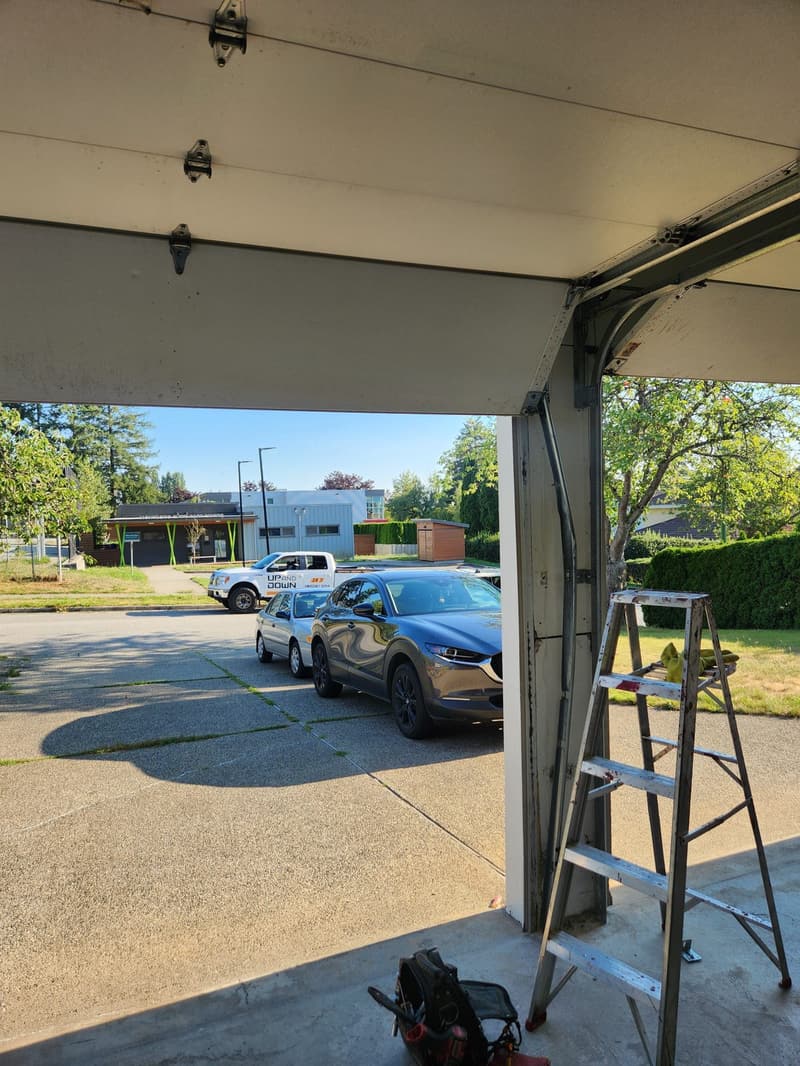
Torsion springs at or past cycle life
Most homes along Cambie Road, Granville Avenue, and the side streets feeding into them were built between the mid-1970s and late 1990s. A standard torsion spring is rated for 10,000 cycles — roughly seven to nine years at four cycles a day. If the spring has never been replaced, it is living on borrowed time. When it breaks, the door will not move. The opener may hum, the trolley may travel, but the counterbalance is gone. You will see a two-inch gap in the spring coils, or the spring hanging loose on the shaft.
West Cambie’s split-levels often have 16-foot double doors. That weight on a single spring — common in original builds — accelerates fatigue. We replace with dual-spring setups rated for 25,000 cycles unless the shaft diameter or headroom prevents it.
Cables fraying at the bottom bracket
Wet winters and road salt splash up the track. The bottom roller bracket sits in that spray zone. Steel cables corrode from the inside out, strands snapping one by one until the cable lets go. The door then skews in the track, jams, or falls crooked. If you see rust staining the concrete below the vertical track, or individual wire strands poking through the cable sheath, it is already compromised.
Rollers seizing in cold snaps
Nylon rollers on unsealed bearings absorb moisture. When the temperature drops below freezing, that moisture locks the bearing. The door shudders, groans, or stalls halfway. Steel rollers with sealed bearings solve it, but only if the track is straight and the hinges are not worn oval. We check the whole assembly, not just the roller.
Openers losing limit and force settings
Chain-drive openers from the 1990s and 2000s — Chamberlain, Craftsman, LiftMaster — drift out of adjustment as the chain stretches and the carriage wears. The door reverses two inches off the floor, or slams down hard enough to bounce. Belt drives are quieter but the belt teeth shear under a heavy, unbalanced door. If the opener runs but the door does not move, the drive gear inside the motor unit is often stripped — a $40 part that takes an hour to swap.
Photo-eyes misaligned by ground movement
West Cambie’s clay soil shifts with the seasonal water table. The safety sensors mounted six inches off the floor move independently. A quarter-inch offset breaks the beam. The door will not close from the remote, only from the wall button held down. You can often fix this yourself: loosen the wing nut, pivot the sensor until the LED is solid, retighten. If it recurs weekly, the mounting bracket or the concrete pad is moving. We anchor to the framing, not the slab.
What you can check before calling
- Power and lock — Is the opener plugged in? Has the GFCI tripped? Is the vacation lock on the wall console engaged?
- Photo-eyes — Both LEDs solid? Clean the lenses with a dry cloth. Spider webs and condensation are the usual culprits.
- Manual release — Pull the red cord. Does the door move freely by hand? If it binds, catches, or feels heavy, do not re-engage the opener. The problem is mechanical, not electrical.
- Springs and cables — Look up at the torsion spring above the door. A clean break shows a gap. A stretched spring shows elongated coils. Check cables at the bottom brackets for fraying or rust. Do not touch either under tension.
- Track and rollers — Visual inspection only. Bent track, rollers popped out, hinge screws backed out. If the door is crooked in the opening, stop. Forcing it bends more hardware.
When to stop DIY garage door repair
Torsion springs, cables under tension, and the bottom bracket assembly are not DIY territory. The spring stores enough energy to shear a ½-inch bolt. The bottom bracket is the anchor point for that energy. Loosening the set screws on a wound spring, or unbolting a bottom bracket with the cables attached, can put the spring, the cable, or the bracket through a wall — or through you.
We have seen fingers lost, eye sockets fractured, and garage doors embedded in drywall across the street. If the spring is broken, the cables are slack, or the door is off-track, leave it. Call 778-873-7282.
What a service call looks like
We arrive, verify the symptom, and test the door manually. If the spring is broken, we measure wire size, inside diameter, and length — then wind the replacement to the calculated turns for your door weight and height. We do not guess by counting turns on the old spring; a worn spring has lost torque and will mislead you.
Cables are replaced in pairs. We use 7×19 galvanized aircraft cable, swaged thimbles, and new bottom brackets if the old ones are corroded. Rollers are upgraded to 13-ball sealed-bearing nylon or 10-ball steel depending on door weight and track condition. Hinges are graded by gauge — 14-gauge for residential, 11-gauge for heavy double doors.
Openers are diagnosed at the logic board and the mechanical drive. A stripped gear, a failed RPM sensor, a bad capacitor — each is a different repair. We carry the common boards and gears for LiftMaster, Chamberlain, Genie, and Craftsman. If the unit is over 15 years and parts are obsolete, we will say so and quote a replacement with a belt-drive DC opener, battery backup, and MyQ.
We lubricate every pivot point with PTFE spray — not WD-40, not grease. We check balance, force limits, and reversal pressure against UL 325. The call ends with you operating the door through three full cycles.
What changes garage door repair pricing
- Spring replacement — single vs. dual spring, cycle rating, shaft diameter, headroom clearance for winding bars.
- Cable replacement — door height, drum size, whether bottom brackets need replacing.
- Opener repair — board vs. gear vs. motor, parts availability, age of unit.
- Off-track repair — number of rollers popped, track bending, hinge damage, whether the door panel is cracked.
- Travel time — West Cambie is ten minutes from our shop. No mileage surcharge.
We quote the repair before starting. If additional wear shows up during the job — a second spring near failure, a cracked hinge — we show you and ask before adding it.
Keeping it running
Lubricate rollers, hinges, and springs every six months. PTFE spray. Wipe the excess. Test the auto-reverse monthly: place a 2×4 flat on the floor, close the door. It must reverse on contact. Clean photo-eyes when you wash the car. Watch for rust at the bottom brackets — that is your earliest warning on cables.
If the door starts sounding different — a new groan, a snap, a hesitation — call then. A spring that is stretching but not yet broken still holds the door. A broken one drops it.
Book garage door repair in West Cambie
Call 778-873-7282. Describe the symptom. We will tell you what it likely is, what the repair involves, and what it costs. No dispatch fee if we do the work.