Up and Down Garage Doors diagnoses crooked and jammed garage doors across Metro Vancouver BC, identifying root causes like slack cables, spread tracks, and worn bearings before they damage panels or openers.
Crooked Garage Door Diagnosis — Why Metro Vancouver Doors Go Crooked
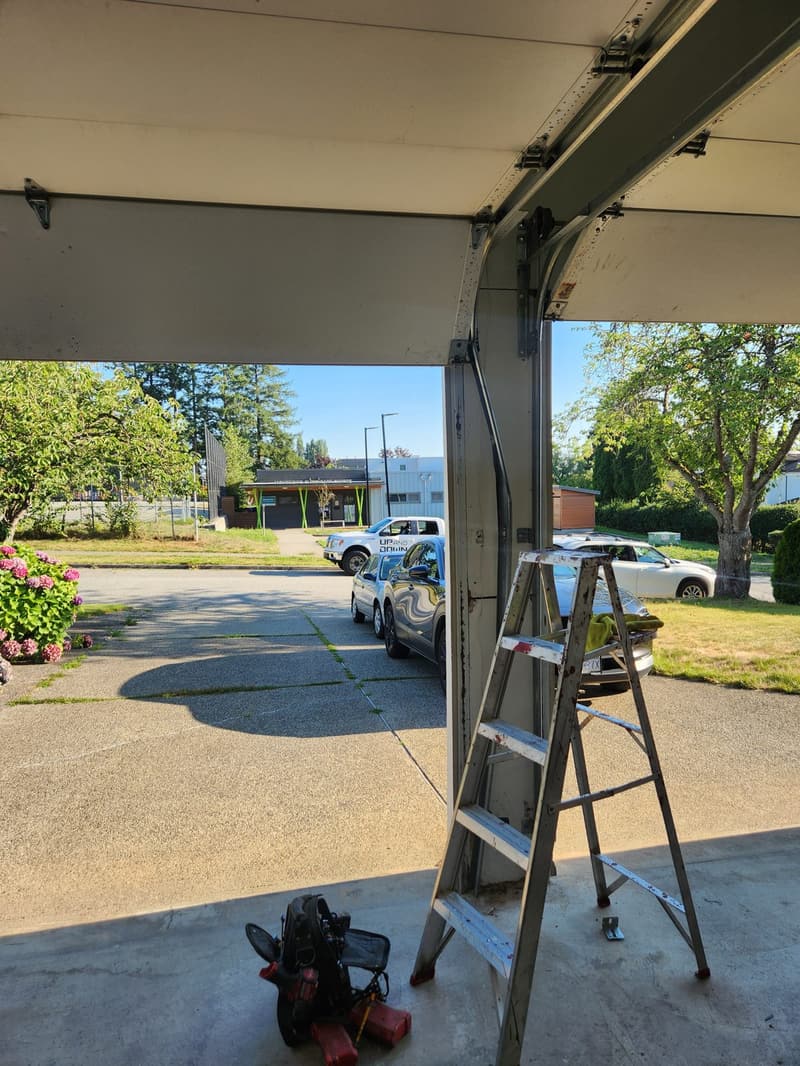
The Lower Mainland’s wet winters and humid summers accelerate corrosion on uncoated hardware. In Richmond, Delta, and Ladner, salt-laden air from the Fraser River estuary attacks cable strands and bearing races faster than in drier climates. North Shore homes face heavier rain exposure on windward exposures. These conditions reduce the service life of standard 7×19 galvanized aircraft cable (typically 1/8 in. or 3/32 in. diameter) and unsealed roller bearings rated for 10,000–15,000 cycles. Older 2 in. horizontal track (0.075 in. gauge) on 1980s–1990s builds in Kerrisdale, Shaughnessy, and Kitsilano often spreads at the flag bracket when the jamb brackets pull loose from aged Douglas fir framing.
One Cable Slack — What It Means
When one lift cable hangs loose while the other stays taut, the door cocks sideways in the opening. This usually traces to a broken strand inside the cable where it wraps over the drum — common on 7×19 galvanized 1/8 in. cable after 8–12 years in coastal BC air. The drum groove wears unevenly, letting the cable walk off the flange. On torsion-spring systems, a cracked winding cone or loose set screw on the cable drum produces the same symptom. Never operate the opener with a slack cable; the uneven load bends the top section and can snap the remaining cable under full spring tension.
Track Spread and Flag Bracket Failure
Horizontal track spread shows up as a widening gap between the vertical and horizontal track at the curve. Standard residential track uses 14-gauge (0.075 in.) galvanized steel; heavier 12-gauge (0.105 in.) appears on doors over 16 ft wide. The flag bracket — the L-shaped bracket joining vertical to horizontal track — carries the door’s full weight at the transition. In Metro Vancouver’s older housing stock, lag bolts into 2×6 or 2×8 Douglas fir jambs loosen as the wood seasons and shrinks. A 1/4 in. gap at the flag bracket lets the roller climb the track edge, jamming the door mid-travel. We reinforce with 3/8 in. × 3 in. lag screws into solid framing and add a second bracket where the original single bracket has pulled out.
Bearing Failure on Torsion and Extension Systems
Torsion spring bearings (typically 1 in. ID × 2 in. OD sealed ball bearings, 6205-2RS or equivalent) fail when moisture penetrates the seal. The raceway pits, the inner race seizes on the shaft, and the spring cone drags — causing the door to bind or shake. Extension spring pulleys use 3/8 in. ID × 7/8 in. OD bearings (often 6203-2RS) that suffer the same fate. In high-cycle commercial doors (25,000+ cycle ratings), we specify greaseable tapered roller bearings (LM11949/LM11910) instead of sealed balls. For residential doors in Burnaby, Coquitlam, and Port Moody where daily cycles exceed 4–6, upgrading to 25,000-cycle torsion springs with oil-tempered wire and sealed bearings extends service intervals significantly.
Diagnostic Steps We Perform On-Site
How do we confirm a cable problem?
We disconnect the opener, manually lift the door to waist height, and measure cable tension on each side with a spring scale. A difference over 15 lb indicates internal strand breakage or drum misalignment. We then inspect the drum grooves for wear and the cable for fraying at the thimble and stop sleeve.
How do we measure track spread?
Using a 4 ft level across the horizontal track flanges at three points — curve, mid-span, and rear hanger — we check for deviation over 1/8 in. per foot. We also verify flag bracket fasteners with a torque wrench; lag bolts should hold 150+ lb withdrawal in sound Douglas fir.
How do we test bearing condition?
With springs unwound, we rotate the torsion shaft by hand. Roughness, axial play over 0.010 in., or audible grinding confirms bearing failure. On extension systems, we spin each pulley; seized bearings show discoloration (blueing) on the pulley bore from heat.
Repair vs. Replace Decision Points
Cable replacement uses 7×19 galvanized 1/8 in. or 3/32 in. cable matched to drum groove width. Drums are cast aluminum (typically DASMA-rated for 10,000 cycles) — if the groove is worn over 0.015 in. deep, we replace the drum, not just the cable. Track sections bent beyond 1/4 in. over 4 ft get replaced; minor bends we straighten with a track jack. Bearing replacement always includes both sides — mixing old and new bearings creates uneven drag. Spring replacement follows DASMA color-coding: red/white for 10,000-cycle, gold for 25,000-cycle oil-tempered wire. We do not reuse old springs.
Common Metro Vancouver Housing Stock Scenarios
Vancouver Specials (1960s–1980s) often have 7 ft high doors on 2 in. track with single flag brackets — prone to spread. Richmond ranches and split-levels from the 1970s use extension springs with 3/8 in. pulley cables that fray at the S-hook. North Shore custom homes with 18 ft wide double doors need 12-gauge track and 25,000-cycle springs from day one. Surrey and Langley newer builds (post-2000) typically have 2 in. 14-gauge track with double flag brackets — more robust but still vulnerable to bearing seizure in unheated garages.
Frequently Asked Questions
Can I just tighten the loose cable?
No. A slack cable means internal strands have broken or the drum groove is worn. Tightening the set screw without replacing the cable and inspecting the drum risks sudden failure under full spring tension.
How long does a crooked door repair take?
Most single-door cable, track, or bearing repairs complete in 2–3 hours. Double doors with dual torsion springs and bearing plates may require 3–4 hours if both sides need attention.
Will my opener be damaged if I keep using a crooked door?
Yes. The opener’s drive gear (typically nylon on chain-drive models, steel on belt-drive) strips when the door binds. Replacing a LiftMaster or Chamberlain drive gear costs significantly more than fixing the underlying track or cable issue early.
Do you stock parts for older doors in Kitsilano or Shaughnessy?
We carry 2 in. 14-gauge track, 1/8 in. 7×19 cable, 6205-2RS and 6203-2RS bearings, and standard residential drums on every truck. For obsolete one-piece doors or unique drum profiles, we source within 24 hours.
What warranty covers the repair?
Parts carry the manufacturer’s warranty (typically 1 year on cables, bearings, and track; 3–5 years on torsion springs). Labor warranty matches the part warranty period.
Can you upgrade my door to high-cycle springs during the repair?
Yes. If your door sees heavy daily use — common in households with two commuters — we can install 25,000-cycle oil-tempered torsion springs with sealed bearings during the same visit. The shaft and drums must match the new spring ID (typically 1 in. or 1-1/4 in.).
Door crooked, jammed, or shaking? We’ll find the root cause and fix it right.
Call 778-873-7282
Up and Down Garage Doors — serving Richmond, Vancouver, Burnaby, Surrey, and all Metro Vancouver BC
Up and Down Garage Doors provides garage door repair across Metro Vancouver. For cable replacement in your city, see Vancouver cable replacement, Richmond cable replacement, or Burnaby cable replacement. Related symptom pages: door uneven one side lower, door shaking when opening.