

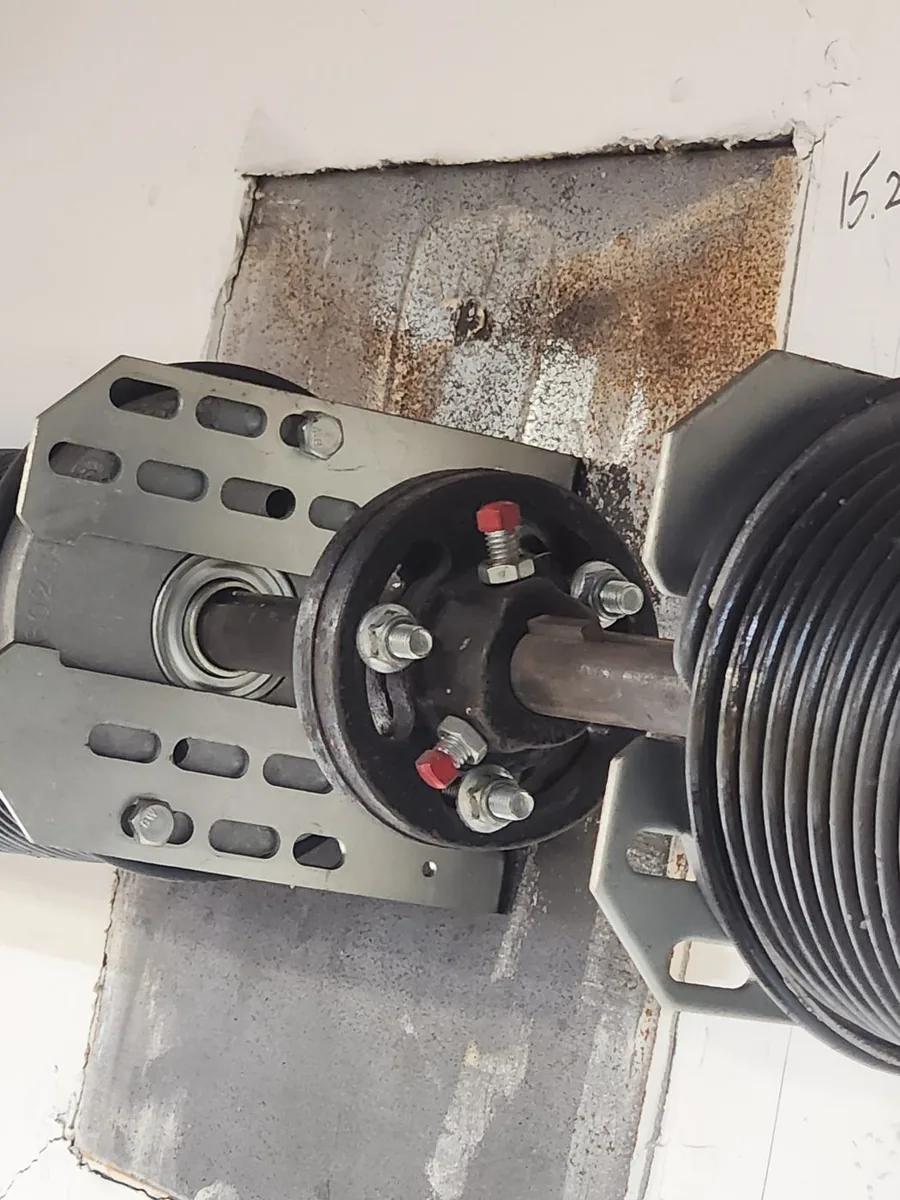
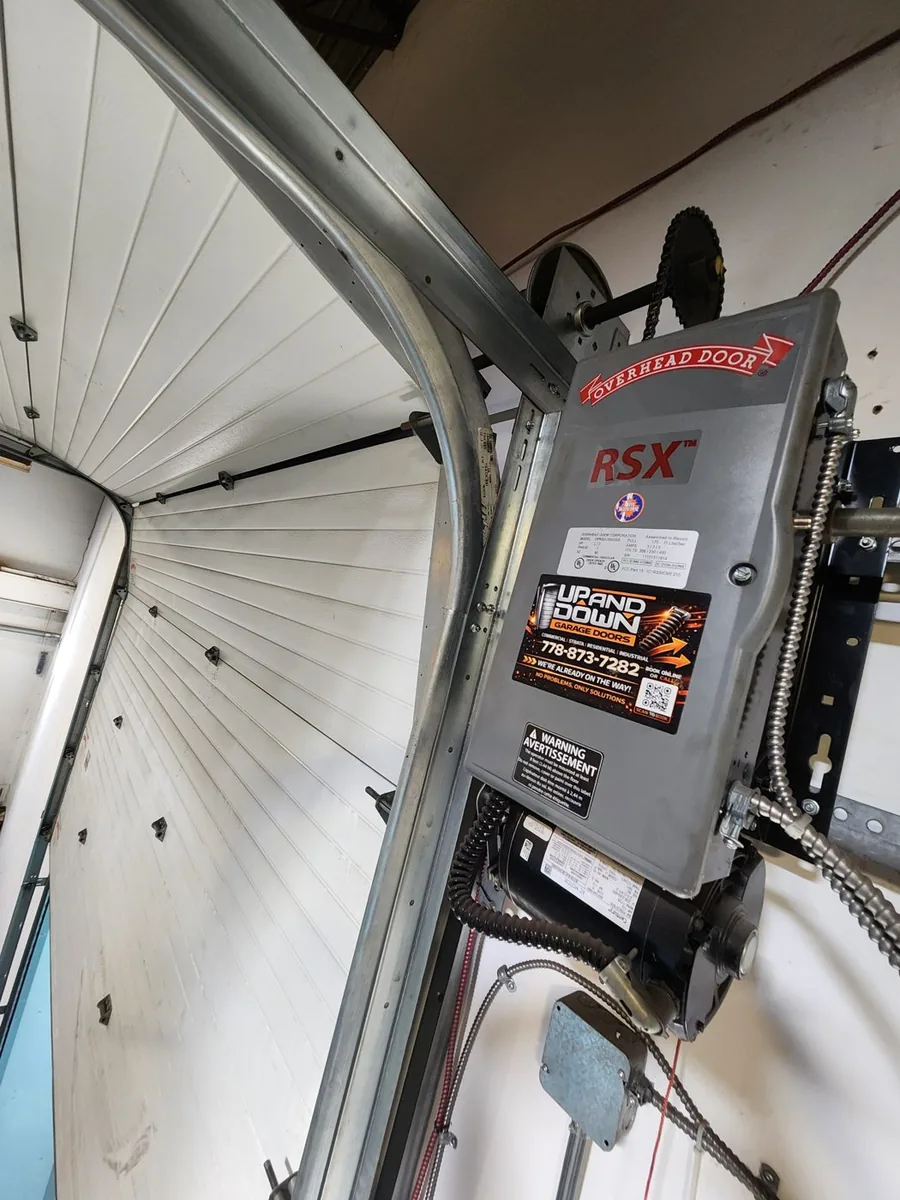
Look at the springs above or beside your garage door and you'll usually find a dab of paint on one end: red, tan, gold, light blue. That paint is a real code. DASMA, the door manufacturers' trade association, publishes the official colour chart in its Technical Data Sheet 171, written for spring manufacturers. The colour tells you less than most people think.
What does the colour on a garage door spring mean?
It depends on which kind of spring you have.
On a torsion spring (the one wound around a steel shaft above the door), the colour marks the wire diameter. DASMA's table runs from .1200-inch wire (orange) up to .6250-inch wire (brown). A spring painted gold, for example, could be .2500-inch wire.
On an extension spring (the long springs that stretch along each horizontal track), the colour marks the door weight the pair is built for, in 10-pound steps from 50 lb (red) to 300 lb (tan). DASMA's sheet notes that two extension springs are required for the weight shown, so a "140 lb" colour means a pair of springs for a 140 lb door, not 140 lb per spring.
A black mark means the spring is outside the list, or unspecified.
Why the colour alone can't tell you which spring to buy
The chart has more sizes than it has colours, so the colours repeat. Here is what that looks like, straight from DASMA's tables:
| Torsion colour | Wire sizes that share it (inches) |
|---|---|
| White | .1390, .2187, .2950, .4062, .5312 |
| Gold | .1770, .2500, .3310, .4615 |
| Blue | .1875, .2625, .3437, .4687 |
| Red | .1430, .2253, .2970, .4218, .5625 |
Extension springs repeat the same way, every 100 pounds. Red is the code for a 50 lb door, a 150 lb door and a 250 lb door. Brown covers 60, 160 and 260. So a faded red stripe on an extension spring narrows it down to three possible door weights, and the difference between them is not small.
The colour also says nothing about the inside diameter, the length, how far an extension spring stretches, the material or the finish. DASMA spells this out on the first page of the sheet: colour coding gives only partial identification. On a torsion spring, two springs with the same gold stripe can have completely different lengths and inside diameters and lift completely different doors.
The older the door, the less you should trust the paint
DASMA's own caution on the extension-spring chart is that colour codes should be backed up by physical measurements and door weights, "particularly on older installations." There are a few reasons for that, and all of them show up in garages around Metro Vancouver:
- Paint wears off or rusts over. On springs that have lived in a damp garage for fifteen years, the stripe can be gone, or the colour can look like its neighbour on the chart.
- Somebody may already have replaced one spring with a different one. A mismatched pair can happen on doors that have changed owners a few times.
- The door may not weigh what it did when it was installed. Paint, added trim or a new window insert all add weight. Our post on what added weight does to springs covers that in detail.
So what is the colour useful for?
It's a good starting point and a quick cross-check. If a technician measures a torsion spring at .2500-inch wire and it's painted gold, the measurement and the paint agree, and that's reassuring. If the paint says one thing and the micrometer says another, go with the measurement.
It's also handy when you call for a repair. A photo of the broken spring, with the colour mark visible, plus a photo of the label on the door if it still has one, gives us a head start. The replacement is still decided by measuring the springs and the door.
Can I just match the colour and replace the spring myself?
DASMA's colour chart opens with the answer: it is meant for manufacturers, and "should not be used by homeowners or maintenance personnel to replace garage door springs." A torsion spring stores enough energy to lift the whole door, and winding or unwinding one with the wrong tools is how people get hurt. If you want the full picture on the do-it-yourself question, we've written about it in Can I replace a garage door spring myself?
What you can safely do is look. Note the colour on each spring and whether the two springs match. If a spring is broken, don't pull the emergency release, don't lift the door and don't run the opener.
What a technician actually measures
For a torsion spring, the usual set is wire diameter, inside diameter, length, and which way the spring is wound (left or right hand). For extension springs it's the door weight, the spring length and the stretch the track allows. The spring measurement guide walks through how each one is taken. Those numbers, checked against the door's real weight, decide the replacement. The paint just confirms it.
Spring broke, or door feels wrong?
If a spring has snapped, leave the door where it is and don't use the opener to force it. If it's stuck open and you can't secure the garage, call and tell us. Call or text us at (778) 873-7282 with a photo, or book a time online. Our broken spring repair page explains what the visit involves, and the spring replacement cost page covers what drives the price.
Source: DASMA Technical Data Sheet #171, "Official Color Codes for Torsion and Extension Springs" (Rev. 9/15, reaffirmed 5/23).