

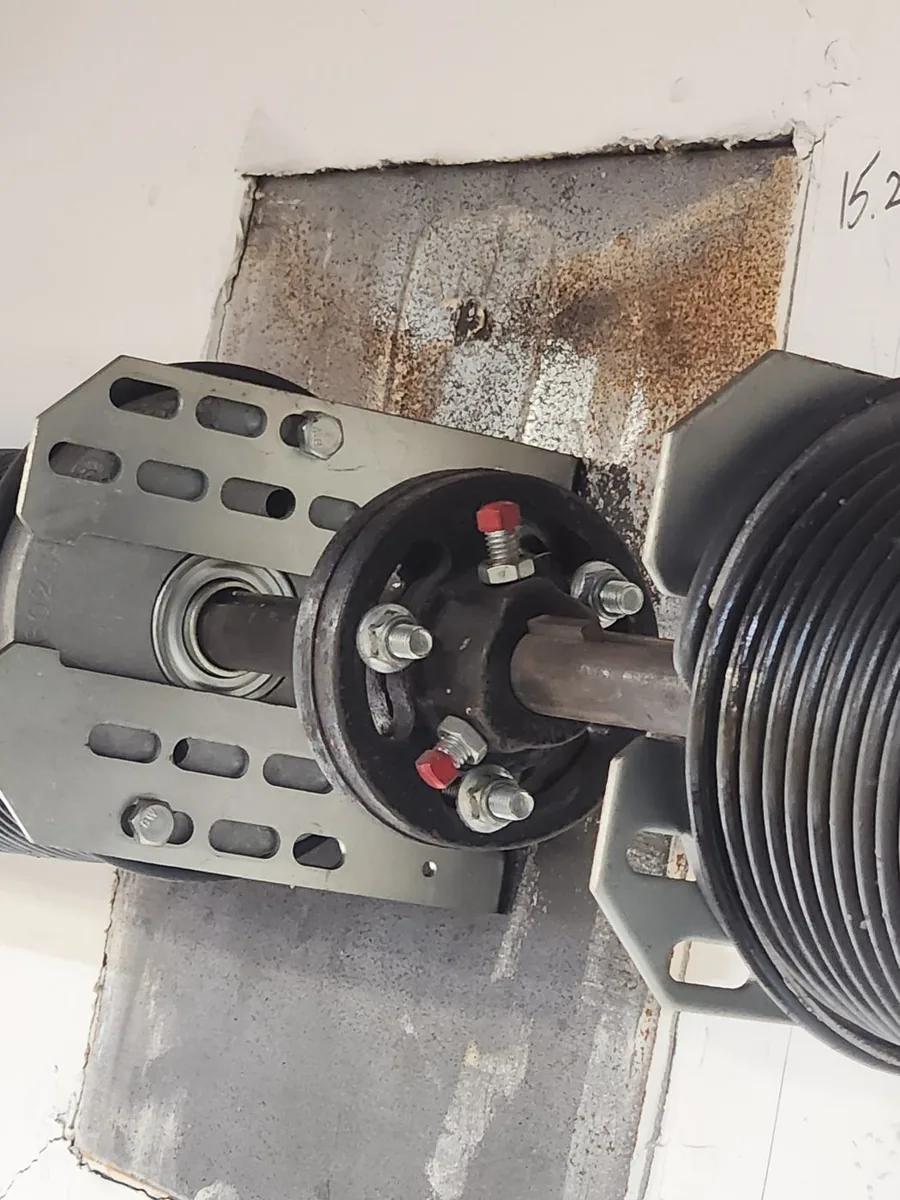
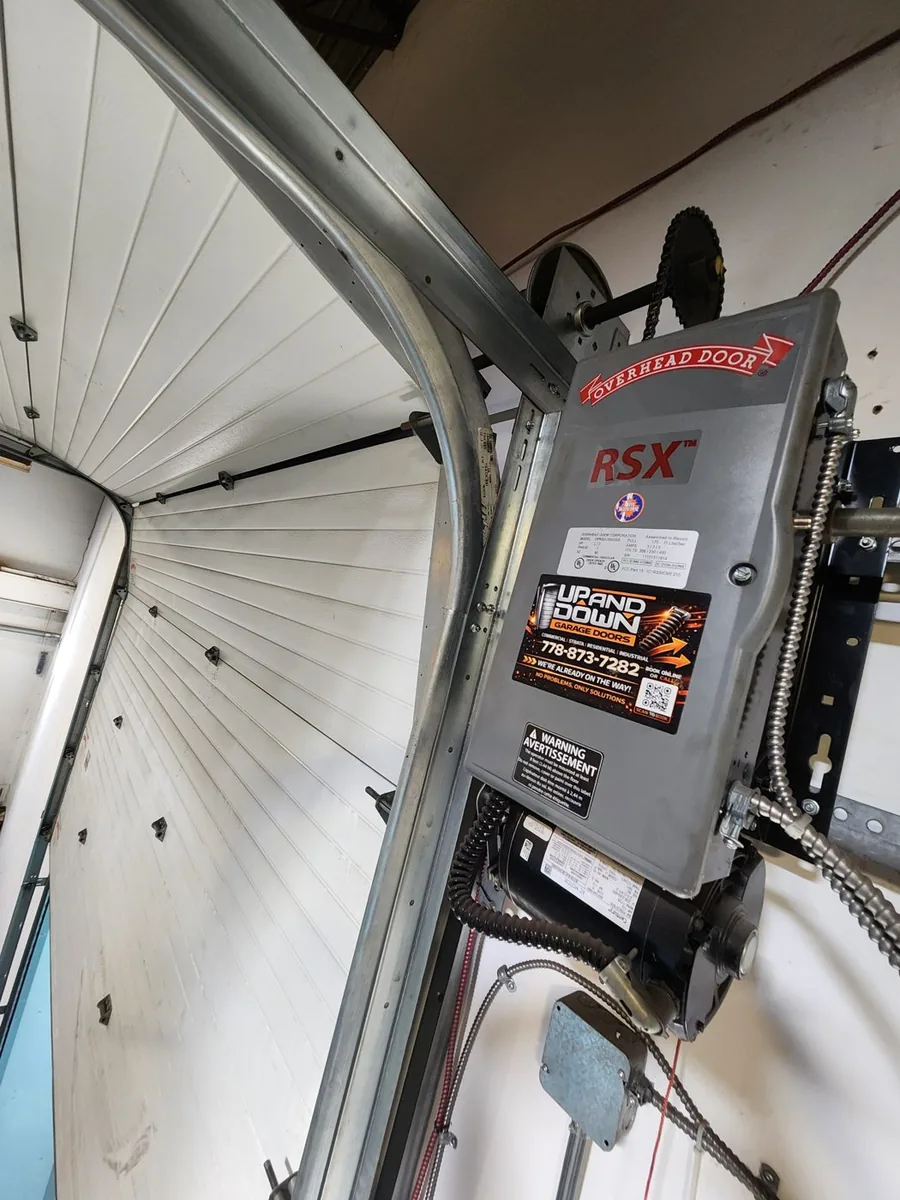
When a torsion spring breaks, there are usually two ways to replace it. One is an exact match for what was there. The other is a spring made from slightly thicker wire, set up to lift the same door. The second option lasts longer, and it's also longer, heavier and more expensive. This post shows why, using the standard spring formulas.
Why does thicker wire make a garage door spring last longer?
Because it runs at lower stress for the same door. Springs wear out by fatigue: every open and close bends the steel, and the harder each cycle works the wire, the fewer cycles it survives. Newcomb Spring, a spring manufacturer, publishes the standard formula for the bending stress in a torsion spring:
S = (32M ÷ πd³) × K
S is the stress in the wire, M is the twisting load (the moment), d is the wire diameter and K is a small correction factor for coil shape. The door decides M: a heavier door needs more twisting force to hold it up. The wire diameter is the part you can choose, and it sits in the formula cubed.
How much does a thicker wire change the stress?
Hold the door the same, so M stays the same, and the stress changes with 1/d³. Here's what that works out to for a few wire sizes from DASMA's list:
| Wire change (inches) | Stress at the same load |
|---|---|
| .2500 → .2625 | about 14% lower |
| .2437 → .2625 | about 20% lower |
| .2253 → .2437 | about 21% lower |
These are our own calculations from the formula, holding the coil diameter the same and ignoring the small shift in the correction factor, so treat them as close estimates rather than a spec sheet. The point they make is solid, though: a change that looks tiny on a tape measure cuts the stress noticeably, and lower stress is what buys more cycles.
So why isn't every spring made from thick wire?
Because thicker wire is also stiffer, and the door only wants a certain amount of lift per turn. The standard deflection formula for a torsion spring puts the wire diameter to the fourth power: θ = 64MDN ÷ (Ed⁴), where D is the coil diameter, N is the number of active coils and E is the stiffness of the steel. To keep the lift per turn the same with thicker wire, you need more coils. Working the .2500 → .2625 step through, at the same coil diameter:
- about 22% more coils to keep the same lift per turn,
- about 28% more length, because each of those coils is also thicker,
- about 34% more steel in the spring overall.
That extra steel and length is a large part of why a longer-life spring costs more than a standard one.
The limit is the length of your shaft
A torsion spring has to fit on the shaft above the door, between the centre bracket and the end bearing plate. Some doors have room for a longer spring and some don't, especially with two springs on the shaft or tight side room. A larger coil diameter doesn't lower the stress (the stress formula barely depends on it), but it means fewer coils are needed for the same lift, so thicker wire can fit in less length. Splitting the load across two springs instead of one also lowers the moment on each spring. Every one of those changes the numbers above, so the replacement has to be worked out from measurements of the door and the space, not from a chart.
Is a longer-life spring worth it for my house?
It comes down to how often the door moves. Our post on how long garage door springs last walks through cycles per day; a door that opens a few times a day and a door that's the main entrance for a busy household are very different jobs for the same spring. If your current springs have broken sooner than you expected, or the garage is how everyone comes and goes, the thicker-wire option is worth asking about. If the door rarely moves, a correct like-for-like match is fine.
Two things to check either way. Make sure the door's weight hasn't crept up from paint or trim, which we cover in added weight and garage door springs; a spring sized for the old weight starts life overworked. And if one spring of a pair has broken, the other has done the same number of cycles. Our torsion vs. extension springs page explains how the two systems differ.
Get the numbers for your door
None of this is a do-it-yourself job; winding a torsion spring is how people get hurt, and our post on replacing a spring yourself explains why. Sizing a replacement means measuring the wire, inside diameter, length and wind of what's on the door, and checking the door's balance and weight. Call or text (778) 873-7282, see broken spring repair, or read the spring measurement guide if you want to see what we'll be measuring.
Sources: Newcomb Spring, "Torsion Spring Stress" formula (newcombspring.com); standard torsion spring deflection formula θ = 64MDN/(Ed⁴); DASMA Technical Data Sheet #171 wire-size list. Percentages are Up & Down's own calculations from these formulas.