Garage Door Repair Renfrew Collingwood — The Vancouver Special Garage
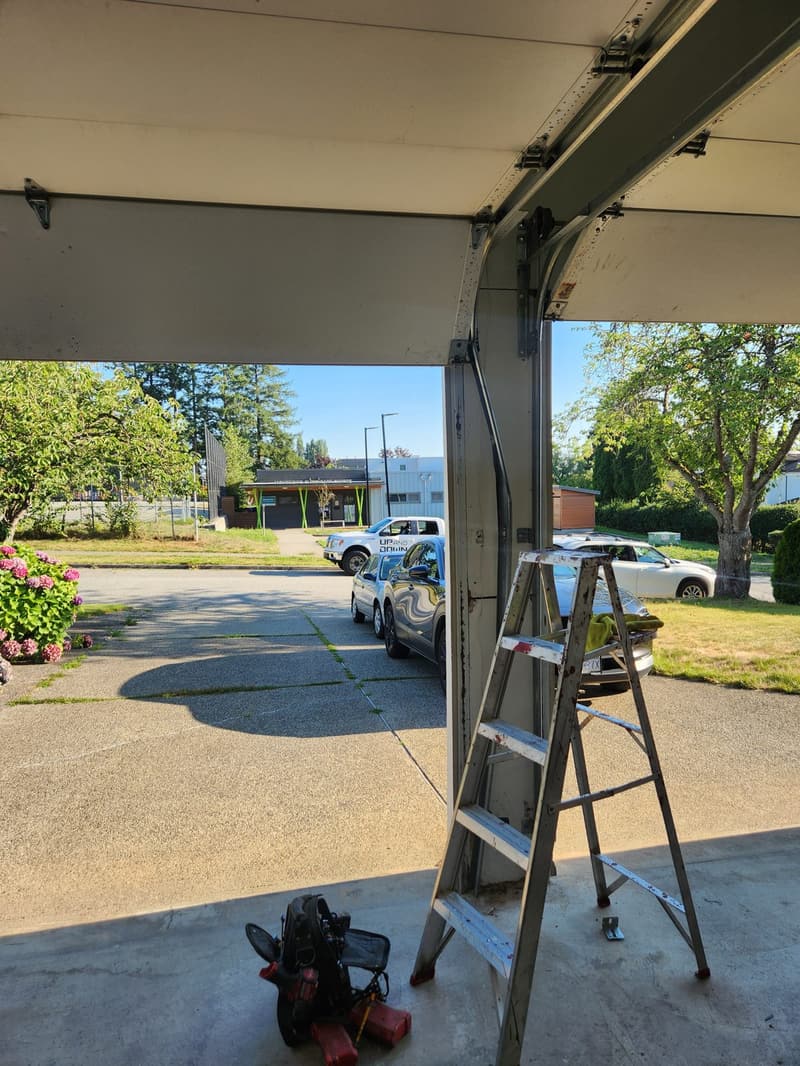
Most houses in Renfrew-Collingwood are 1950s and 60s Vancouver Specials. The garage sits under the living space or tucked at ground level with the front door. Headroom is tight — often six inches or less above the top panel. The original doors were single-panel wood that swung up and out, or early steel sectionals with thin 24-gauge skins. Openers weren’t part of the plan. Someone added a chain-drive unit in the 80s or 90s, bolting the rail to ceiling joists that were never meant to carry the vibration. The brackets loosen. The rail sags. The door binds. We see the same failure patterns on Joyce, Rupert, and Earles because the framing is identical block to block.
Getting to You
We run from 12180 Horseshoe Way in Richmond. The drive is 20–35 minutes from our Richmond shop (about 17.8 km) depending on the Knight Street Bridge and Kingsway traffic. If you’re near Joyce-Collingwood Station, we take Knight to 41st and cut across. For the north end by Renfrew Ravine, Grandview Highway is faster. We know the shortcuts when the bridge backs up. Call 778-873-7282 and we’ll give you a real ETA, not a four-hour window.
Low Headroom, Real Solutions
Standard torsion springs need 12 inches of headroom. Most Vancouver Special garages have half that. We install low-headroom torsion kits with a shorter radius track and a side-mounted bearing plate that fits in the six-inch gap. If the ceiling is truly gone — pipes, ducts, the floor joists above — we switch to a jackshaft opener mounted on the wall beside the door. No rail overhead. No clearance problem. The motor sits where you can reach it for service. We’ve done this on dozens of houses along Slocan and Rupert where the laundry room shares the garage ceiling.
Springs on the Original Hardware
The original torsion tube on a 1960s Vancouver Special is often 1-inch OD galvanized pipe, not modern 1-inch keyed shaft. The cones are welded or peened. You can’t just slide new springs on. We cut the old springs off, press the tube out, and replace the whole assembly with a keyed shaft, new bearings, and oil-tempered springs rated for 25,000 cycles. Two-spring systems are common on the wider 16-foot doors facing Kingsway. Single springs on the 8-footers tucked behind the house. Either way, the price is in the table below.
Cables, Rollers, and the Tracks That Guide Them
Frayed cables on these doors usually mean the bottom bracket has pulled through the thin bottom section. We replace the bracket with a reinforced version and run new 7×19 aircraft cable. Rollers are next. The original nylon tires crack after 30 years. We swap the full set for 13-ball-bearing steel rollers with nylon tires — quieter, longer life. Tracks get inspected for the characteristic bow where the opener arm pushes against the flag bracket. We straighten or replace. Off-track calls on Nanaimo or Vanness are often just a roller that popped because the track spread.
Openers Retrofitted Decades Later
That chain-drive unit bolted to the centre joist? The joist flexes every cycle. The rail bows. The trolley hits the header bracket wrong. We reinforce the mounting with a steel angle spanning two joists, then install a belt-drive opener with a solid rail. If headroom is too low for any rail, we go jackshaft. We carry LiftMaster 8500W and 8500 models on the truck. Supply and install is in the table. Repair — new logic board, safety eyes, gear kit — is often half the cost. We’ll tell you straight if the opener is worth fixing or if the door balance is killing it.
Renfrew Ravine and Central Park Edges
Houses backing onto Renfrew Ravine Park or Central Park sit lower. Water runs toward the garage. Bottom sections rot. Weatherstrip freezes to the concrete in January. We replace bottom sections with 25-gauge steel, insulated if you heat the space. We set the bottom retainer in silicone and screw it to pressure-treated sill plate, not just the concrete. The slope at the driveway approach matters. If the door hits pavement before the floor seals, we adjust the travel limits and add a vinyl threshold that flexes instead of cracking.
Pricing
| Repair Type | Typical Range | Avg. Time |
|---|---|---|
| Torsion Spring Replacement (1 spring) | $189 – $289 | 45–60 min |
| Torsion Spring Replacement (2 springs) | $269 – $389 | 60–75 min |
| Cable Replacement (pair) | $149 – $229 | 45–60 min |
| Roller Replacement (full set) | $129 – $199 | 30–45 min |
| Off-Track Repair | $129 – $249 | 30–60 min |
| Opener Repair (labour + common parts) | $149 – $299 | 45–90 min |
| Opener Replacement (supply & install) | $349 – $599 | 60–90 min |
| Annual Tune-Up & Safety Inspection | $89 – $119 | 45 min |
Frequently Asked Questions
Can you automate my original single-panel swing-up door?
We can, but we don’t recommend it. The geometry puts huge side load on the opener arm. The door twists. The frame cracks. Better to replace with a modern sectional that fits the same opening. We do it in a day.
My garage ceiling is full of pipes and ducts. Do I have any opener options?
Yes. A wall-mount jackshaft opener needs zero ceiling space. The motor bolts to the wall beside the torsion tube. We run power from the nearest junction box. It’s the cleanest install for Vancouver Specials with finished ceilings below the living room.
What’s the difference between the $189 and $289 spring price?
One spring versus two, wire size, cycle rating, and whether the torsion tube needs replacement. We quote the exact number after we measure the door weight and check the shaft. No surprises.