

How an extension system works
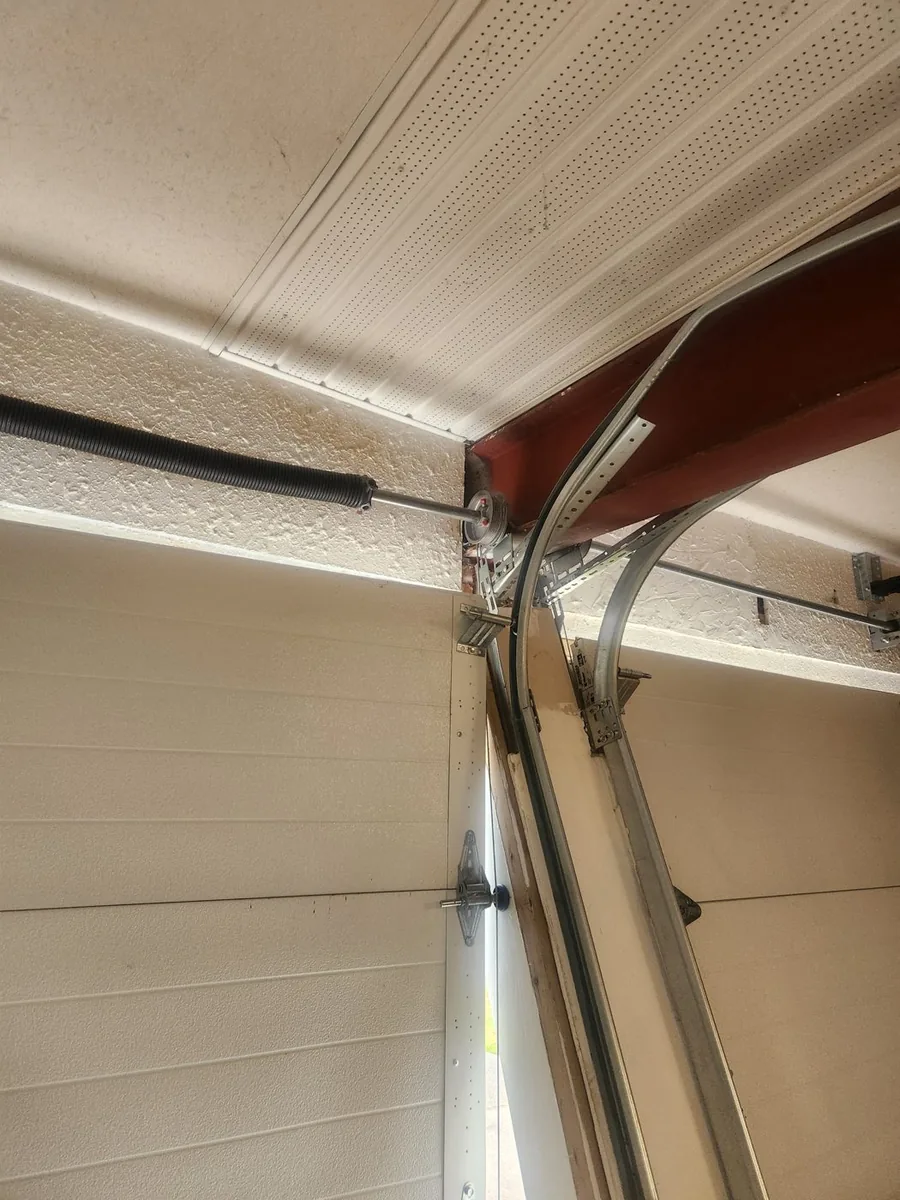
Instead of one spring winding on a shaft, an extension door has a spring on each side running parallel to the horizontal track. Each spring hooks to the track hanger at the back and to a pulley at the front. A cable runs from the bottom bracket of the door, up over a sheave at the front of the horizontal track, back through the pulley on the spring, and anchors at the track angle. As the door comes down, the cable pulls the pulley forward and stretches the spring. You still see this on single-car doors in older Vancouver, Burnaby and New Westminster houses, on low-headroom garages where a torsion shaft would not fit, and on cheap builder installs. The torsion vs extension page compares them properly.
How extension springs are rated
Extension springs are sold by the weight they balance as a pair, in 10 lb steps, with a colour painted on the end loop. Unlike torsion springs, the colour here is the primary rating rather than a wire-size code, though the colour code page covers the full chart for both. A pair rated 140 lb balances a 140 lb door. Two lengths are standard: 25" for a 7' door and 27" for an 8' door, measured relaxed from loop to loop. The spring ends are either an open loop, a closed loop or a double loop; the pulley and hanger hardware need to match.
| Spec | Typical values | Notes |
|---|---|---|
| Rating | 80 to 240 lb per pair, 10 lb steps | Colour on the end loop marks the rating; springs are always replaced as a matched pair |
| Length (relaxed) | 25" (7' door), 27" (8' door) | Taller doors use longer springs or a torsion conversion |
| Stretch at closed | Roughly door height, cable-doubled | A 25" spring stretches to about 42" to 48" when the door is down |
| Wire diameter | .148" to .207" | Heavier rating uses thicker wire and the same length |
| Pulleys | 3" sheave, 3/8" bore, steel or nylon | One at the front of each track, one on each spring |
| Cable | 3/32" or 1/8" 7x7 | Loops at the bottom bracket; sized for the spring rating |
Why we insist on safety cables
A torsion spring that breaks stays on the shaft. An extension spring that breaks under stretch becomes a steel whip with a pound of metal on the end, and it goes wherever the hook sends it: through drywall, car windows, or a person standing in the bay. The fix is a safety cable, a length of 1/8" aircraft cable threaded through the centre of each spring and anchored at the track hanger and the front angle, so a broken spring is caught on the cable instead of flying. They have been standard practice for decades, they cost very little, and we fit them on every extension door we service that does not already have them. If your door has extension springs and no cable running through the middle of them, that is the first thing to fix.
What wears out
- Pulleys. The small pulleys on the spring and at the front of the track run on a plain bore or a cheap bearing. In a damp Richmond garage they seize, the cable saws a groove in the sheave, and then the cable frays. A squeal from the side of the door, or a cable sitting off-centre on a pulley, is the warning.
- Spring loops. The open loop at each end is where the stress concentrates. Look for a rusty orange ring at the loop; that is where it breaks.
- Cables. The cable on an extension door runs over two pulleys and takes a sharp bend at each. Fraying at the bottom bracket loop and at the pulley contact points. The cables page covers sizes, and cable replacement is a same-visit job.
- Uneven stretch. One side opens before the other, the door climbs crooked and rubs the jamb. Usually one spring has lost tension or one cable has stretched.
Adjusting extension springs
Extension doors are adjusted by moving the S-hook or the cable clip at the track hanger one hole at a time, with the door fully open and clamped so the springs are at their slackest. Even then the spring is under some load, and the door can drop if the clamp slips. We treat it as a tech job, mainly because the real question is usually whether the springs are still the right rating for the door, which needs the door weighed. The balance test tells you whether it needs adjusting at all.
When a torsion conversion is the better answer
If the springs need replacing anyway, a torsion conversion kit (shaft, drums, centre bracket, end bearing plates, cables and one or two springs) often makes sense on a double door or a door that is opened a lot. Torsion springs last longer per dollar, lift evenly, and are far safer when they fail. It needs about 12" of headroom above the opening for a standard-lift torsion shaft; low-headroom garages can use a rear-mount torsion layout instead. We quote both options on site when we see an extension door with worn springs, and our broken spring repair page has what a visit looks like.
Not sure which part you need?
Send a photo of the part to (778) 873-7282 on WhatsApp or text, or use the contact page. We identify it, bring the right one, and fit it the same visit.
Contact us(778) 873-7282